
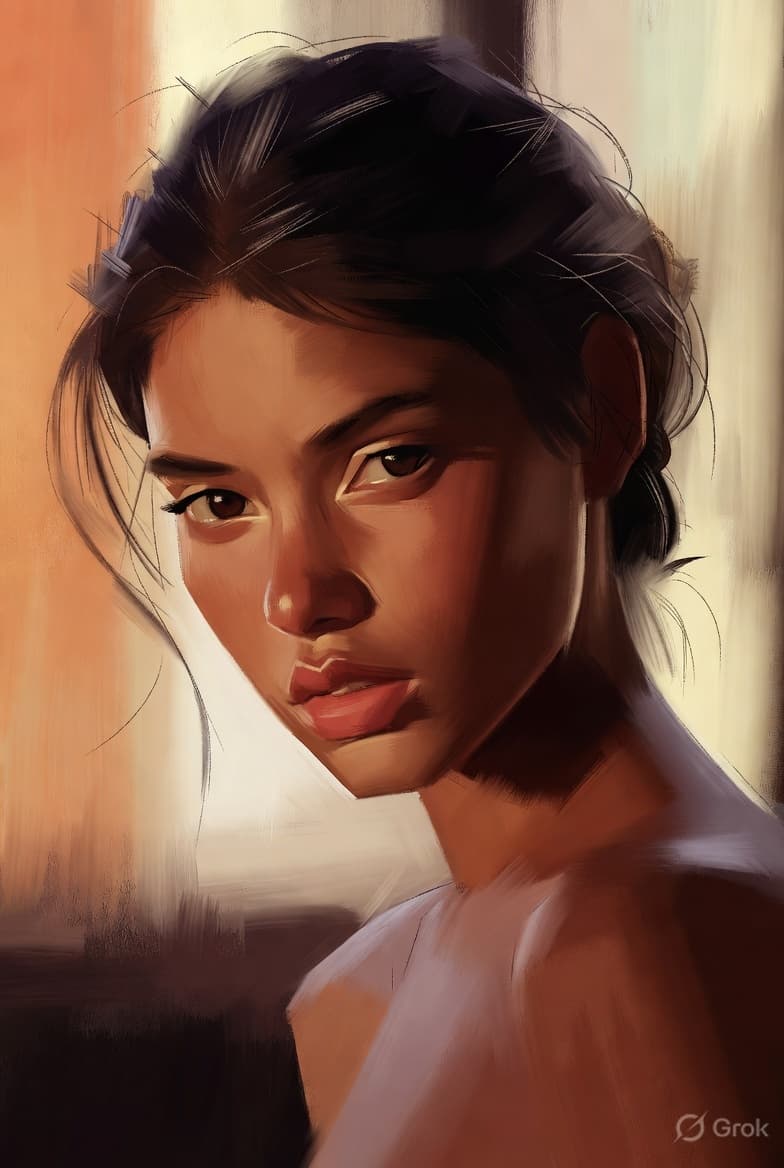
Portrait photography is the most competitive and technically demanding genre for AI image prompting — because humans are hardwired to notice when something is wrong with a face. Getting portrait prompts right requires understanding both the technical vocabulary of photography and the artistic principles that make great portraits. This guide focuses specifically on the combination that produces the most professional-looking results: 85mm lens compression + creamy bokeh + studio lighting mastery.
Why 85mm Is the Portrait Standard
The 85mm focal length (or its equivalent in different sensor formats) has been the portrait standard for decades. Here's why it matters for your prompts:
Compression effect: At 85mm, the background appears closer to the subject — this compression is flattering and creates a natural, professional-feeling separation between subject and environment.
Minimal distortion: Wide angles (35mm, 24mm) distort facial features — noses appear larger, faces look wider. The 85mm is essentially distortion-free for portraits.
Working distance: At 85mm, you're far enough from your subject to allow natural interaction and expression — this shows in the final image.
Bokeh quality: 85mm lenses (especially at f/1.4 or f/1.8) produce the smoothest, most aesthetically pleasing bokeh in the portrait focal range.
Studio Lighting Vocabulary
Before the templates, understand these lighting terms — including them in your prompts makes an enormous difference:
Lighting Pattern Names
- Rembrandt lighting: Small triangle of light on shadow-side cheek — dramatic, classic, 3D effect
- Loop lighting: Shadow of nose loops down to upper lip — flattering, professional standard
- Split lighting: Half face in light, half in shadow — dramatic, masculine look
- Broad lighting: Light on same side as camera — opens up face, slightly flattening
- Short lighting: Light on opposite side from camera — narrows face, more modeling
- Butterfly lighting: Light directly above camera — glamour standard, creates shadow under nose
- Clamshell lighting: Light above + reflector below — beauty/commercial standard, minimizes wrinkles
Light Modifier Terms
- Softbox: Creates soft, wrapping light — most common studio modifier
- Beauty dish: Creates medium-contrast wrap — skin-flattering, slightly harder than softbox
- Octabox: Large round softbox — very soft, fashion and beauty standard
- Umbrella: Bounced or shot-through — soft, accessible, large spread
- Fresnel/spot: Hard, directional light — theatrical, editorial looks
- Reflector/V-flat: Bounce card filling shadows
12 Portrait Photography Prompt Templates
1. Classic Studio Portrait — 85mm Standard
Create a professional studio portrait photograph of [subject description].
Lens: 85mm f/1.8 equivalent. Aperture: f/2.0 — sharp focus on eyes with
creamy background bokeh. Lighting: Loop lighting setup — large softbox at
45-degree angle to subject, silver reflector opposite side filling shadows
softly. Background: [seamless backdrop color — gray/white/navy/black].
Focus: Tack sharp on near eye, slight depth of field falloff on far eye.
Skin rendering: Natural texture, no over-smoothing, realistic pore detail.
Expression: [natural smile/serious professional/warm and open]. Color grading:
Clean, neutral, professional color correction — accurate skin tones.
Composition: Head and shoulders, subject centered or rule of thirds offset.
Quality: Commercial headshot photography standard.
2. Environmental Portrait — Natural Light 85mm
Create a natural light environmental portrait of [subject] in [environment].
Lens: 85mm equivalent creating beautiful compression and background separation.
Light: [window light/shade/overcast outdoor] — soft, directional natural light.
Direction: Light coming from [left/right/slightly front]. Background: [real
environment] beautifully blurred by 85mm compression and f/1.8 aperture.
Subject: In their natural context, [engaged in activity/relaxed/interacting
with environment]. Depth of field: Subject sharp, background recognizable but
soft — bokeh balls visible if any light sources in background. Color: Natural,
warm, authentic — no heavy processing. Mood: [documentary warmth/intimate/
spontaneous]. Quality: Editorial photography suitable for magazine or profile.
3. Rembrandt Lighting Portrait
Create a dramatic Rembrandt lighting portrait of [subject]. Lighting: Classic
Rembrandt setup — single light source at 45 degrees above and to one side of
subject, creating the signature small triangle of light on the shadow-side cheek.
Shadow side: Rich, deep shadow across half the face with the characteristic
inverted triangle highlight on shadow cheek. Light side: Well-lit but not
overexposed, showing skin texture and dimension. Background: Dark, graduated
— lightest directly behind subject, darker at frame edges. Lens: 85mm equivalent.
Depth of field: f/2.8 — subject fully sharp, background dark and slightly soft.
Color temperature: Warm — tungsten practical or warm studio light. Mood:
Dramatic, painterly, Old Masters quality. Subject: [description]. Suitable for
fine art portrait photography.
4. Beauty Photography — Clamshell Setup
Create a professional beauty photography portrait with clamshell lighting of
[subject]. Lighting: Clamshell setup — large octabox directly above camera
axis at 45 degrees, large white reflector or second light below at 45 degrees.
This creates the signature even, shadow-free beauty lighting. Eyes: Catch lights
in a ring or butterfly pattern. Skin: Luminous, even illumination — texture
beautifully rendered without harsh shadows. Makeup: [if relevant, specific
makeup description] shown in maximum detail. Background: Pure white or soft
gradient. Lens: 85mm equivalent, f/2.8. Focus: Eyes sharp, skin texture visible.
Color: High-key, clean, beautiful skin tones. Framing: Tight head and shoulders
or three-quarter view. Quality: Major beauty brand campaign standard.
5. Dramatic Editorial Portrait
Create a dramatic editorial portrait of [subject] for magazine publication.
Lighting: [choose one: split lighting for maximum drama / Rembrandt for
classic drama / single fresnel spot for theatrical quality]. Post-processing
look: [high contrast black and white / desaturated editorial color / deep
color with shadows lifted]. Composition: [dramatic close crop / extreme
close-up of eye and lip / full-length dramatic pose]. Lens: 85mm equivalent
with [wide aperture for isolation / stopped down for detail]. Background:
[stark black / raw concrete / abstract environmental]. Mood: [intense /
mysterious / defiant / ethereal]. Clothing and styling: [description showing
editorial fashion or conceptual styling]. Quality: Major international magazine
publication standard.
6. Bokeh Separation — 85mm f/1.4 Style
Create a portrait demonstrating maximum 85mm f/1.4 bokeh quality with subject
[description]. Background elements: [specific elements in background — trees,
city lights, flowers, string lights] rendered into smooth, circular bokeh balls.
Bokeh quality: Smooth, circular, no "cat-eye" or harsh polygon shapes —
high-quality prime lens bokeh. Depth transition: Focus falls perfectly on
eyes (near eye at maximum sharpness), transitions to soft background in
approximately [3-5] feet behind subject. Separation: Subject appears to
float against the background due to bokeh isolation. Light sources in
background: Rendered as perfect circles of various sizes. Skin: Sharp
with natural detail. Environment hinted at through bokeh character.
Color: Background colors desaturated into soft, pastel bokeh tones.
7. Outdoor Portrait — Golden Hour Light
Create a portrait photograph taken during golden hour light of [subject]
in [outdoor location]. Light quality: Warm directional light from setting
sun at approximately 15-20 degrees above horizon. Color temperature: Very
warm — 4000-5000K, orange-golden tones in highlight areas. Rim light:
Subject backlit with golden edge lighting creating separation and glow.
Fill: Natural skylight providing cool-toned fill in shadow areas — this
warm/cool split is the golden hour signature. Background: [location
environment] rendered soft by 85mm compression and f/1.8 aperture. Sky:
Visible — graduated golden to blue. Expression: [natural, relaxed — golden
hour portraits feel informal and warm]. Color grading: Preserve warm tones,
slight warm-to-cool shadow treatment. Quality: Lifestyle photography at its
most beautiful.
8. High-Fashion Portrait — Hard Light Editorial
Create a high-fashion editorial portrait with deliberate hard lighting of
[subject]. Lighting: Hard, directional light from [fresnel spot / bare strobe /
harsh window] creating strong shadows and edge definition. Hard light effect:
Visible shadow cast across face or background — dramatic contrast, not
flattering in commercial sense but powerful in editorial context. Fashion
subject: [clothing/styling description] that works with dramatic lighting.
Composition: [Tight / three-quarter / full-length] with strong pose. Background:
[Plain colored / textured / environmental]. Mood: [powerful / avant-garde /
fierce / intense]. Color treatment: Either clean color or high-contrast black
and white. Post-processing: Minimal or deliberate creative processing matching
editorial aesthetic. Quality: Vogue or fashion week backstage aesthetic.
9. Black and White Portrait Mastery
Create a timeless black and white portrait of [subject] demonstrating mastery
of tonal photography. Technical: Converted to black and white with deliberate
tonal control — not simply desaturated. Skin tones: Luminous — specific skin
tones rendered beautifully in black and white using equivalent of color filtration.
Highlights: Protected and detailed — no blown-out areas. Shadows: Rich and
detailed — no crushed blacks unless deliberate. Tonal range: Full spectrum from
paper white to deep black with complete gradation between. Lighting: [Specific
lighting pattern] chosen for its three-dimensional modeling of the face.
Lens: 85mm equivalent. Depth of field: [Specified]. Composition: Classic,
confident framing. Reference quality: Comparable to Irving Penn, Yousuf Karsh,
or Platon's portrait work.
10. Soft Glamour Portrait
Create a soft glamour portrait of [subject] combining elegant lighting with
1940s-1950s Hollywood glamour aesthetic updated for contemporary photography.
Lighting: Butterfly lighting (high, centered key light creating the characteristic
shadow beneath the nose) — the classic glamour lighting pattern. Modifier: Large
beauty dish or softbox directly above camera. Eye light: Strong catchlights.
Diffusion: Very slight diffusion over lens simulating classic Hollywood glamour
soft focus — detail maintained but edges slightly softened. Hair light: Optional
separate hair light creating luminous hair detail. Background: Seamless [colors].
Color: Warm, flattering, classic photography aesthetic. Makeup: [glamorous/
natural/period-appropriate]. Expression: [classic old Hollywood / contemporary].
Depth of field: f/2.0 equivalent, focus on eyes.
11. Lifestyle Portrait — Natural Candid Feel
Create a lifestyle portrait photograph of [subject] appearing spontaneous and
natural despite being professionally crafted. Environment: [specific relatable
setting — home office / café / outdoor / kitchen]. Activity: [Subject engaged
in natural activity — reading, coffee, working, laughing]. Light: [Window
natural light / soft ambient] giving authentic, non-studio quality. Composition:
Slightly imperfect, allowing white space, not rigidly centered. Expression:
Natural smile or absorbed concentration — not posed for camera. Color grading:
Clean, warm, lifestyle photography aesthetic — slight warm tones, open shadows.
Lens: 85mm equivalent maintaining subject separation. Bokeh: Moderate — enough
to separate from environment, not so much as to lose authentic feel. Quality:
Brand lifestyle photography for aspirational consumer brands.
12. Environmental Headshot — Professional Context
Create a professional environmental headshot of [subject description and profession]
in their professional environment. Setting: [Office / studio / workshop / laboratory /
outdoor professional context] suggesting their field. Lighting: [Available
environmental light enhanced by natural light / subtle off-camera flash blending
with ambient]. Background: Professional environment visible but soft (85mm
compression + appropriate aperture). Subject: Confident, approachable, professional
expression. Framing: Head-and-shoulders or upper-body framing. Attire: [Professional
clothing appropriate to field]. Quality: Premium LinkedIn profile / corporate
website / speaker bio photography quality. Feeling: Professional but human —
approachable expert rather than corporate stock photo stiffness.
Aperture Quick Reference for Portrait Prompts
| Aperture | Best Use | Background Effect |
|---|---|---|
| f/1.4 | Maximum bokeh, thin DOF | Very blurred, large bokeh balls |
| f/1.8 | Sweet spot for bokeh + sharpness | Beautiful bokeh, excellent sharpness |
| f/2.0 | Beauty/fashion standard | Creamy bokeh, both eyes often sharp |
| f/2.8 | Groups, full sharpness | Soft background, excellent everywhere |
| f/4.0 | Environmental context wanted | Moderate blur, environment readable |
| f/8.0 | Maximum sharpness throughout | Background in focus |
Related Resources
- 85mm Portrait Bokeh Generator — Generate perfect 85mm bokeh portraits
- ChatGPT Image Prompts 4K Quality Guide — Apply maximum quality techniques to portraits
- ChatGPT Golden Hour Prompts — Outdoor portrait lighting
- AI Headshot Generator Prompts — apply these same lighting and lens techniques to professional headshots
Conclusion
Portrait photography prompts live or die on specificity. The more precisely you describe the lens, lighting pattern, aperture, and aesthetic reference, the more professional and intentional your results will be.
The 85mm + creamy bokeh + studio lighting combination works because each element is encoding specific training data that corresponds to professional portrait photography. Use these 12 templates as starting points — each one can be customized with different subject descriptions, lighting variations, and color grading approaches to produce an endless range of portrait styles.
Start with Template 1 (Classic Studio Portrait) to establish your baseline, then experiment with more dramatic lighting patterns like Rembrandt (Template 3) or editorial hard light (Template 8) to develop your visual signature.