
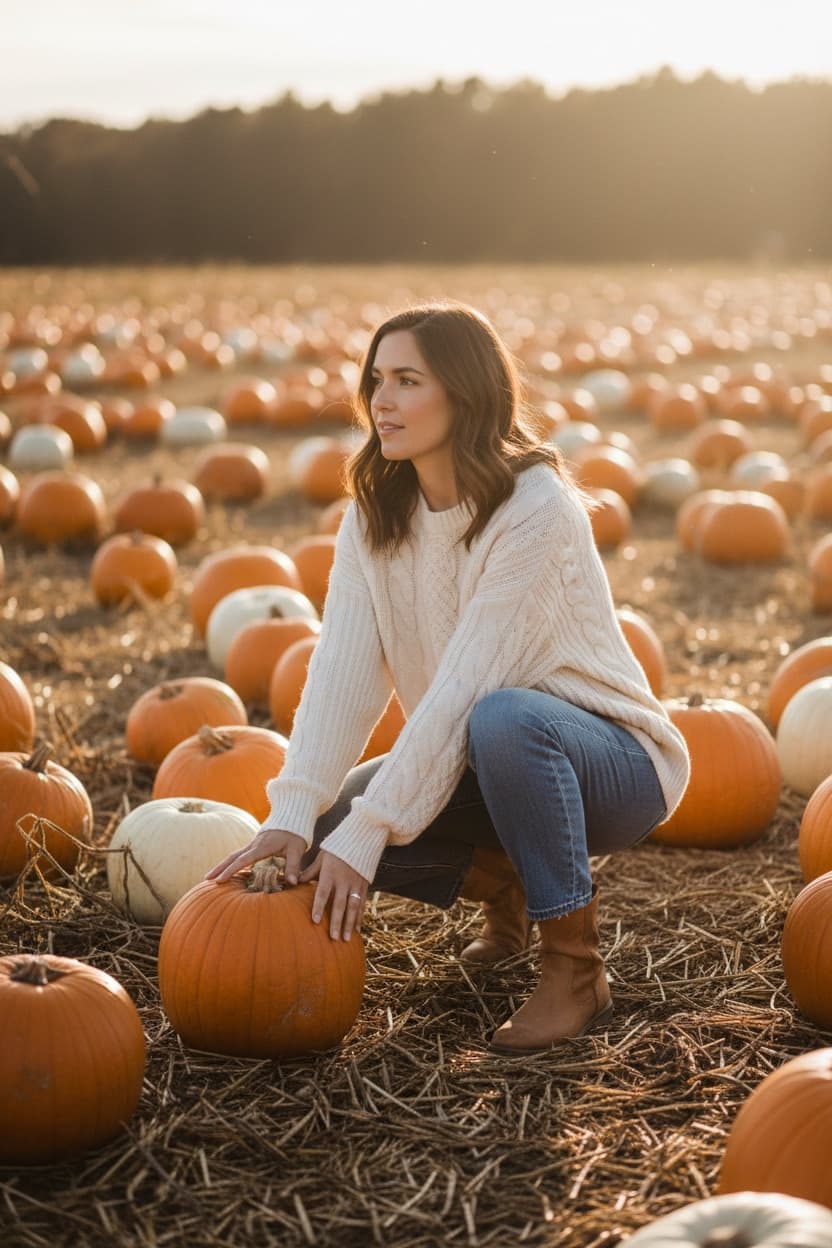
Pinterest has Pumpkin Patch Outfits up 400% month over month, sitting at number one. Searches for the term go from about 5,400 a month in August to 40,500 in October. Halloween photoshoot searches follow the same curve.
Which means the useful window for figuring out what you're wearing, what the shot looks like, and whether that costume is worth buying is now — before the field is muddy and every good slot is booked.
These are ten prompts for that. They generate images, so you can see the outfit, the light and the composition before you commit to any of it. Each one has a fill-in template if you'd rather not edit the text by hand.
The one rule that makes a Halloween photo look like a Halloween photo
Every prompt below is built on the same principle, and it's worth understanding before you copy any of them.
Describe the light, not the objects. "A pumpkin on a porch" gets you a stock photo. "Candlelight glowing from inside the carved pumpkin, pooling close and falling off fast into deep blue-black shadow" gets you the thing you actually pictured.
Halloween has a signature: deeply saturated warm light against cold, desaturated shadow. That split is the entire mood. Autumn daylight has its own version — low sun coming from behind the subject, rim-lighting the hair, with soft bounce filling the face from the front. Get that one relationship right and the image reads as intentional. Get it wrong and no amount of pumpkins will save it.
The second rule follows from the first: ask for less saturation, not more. The fastest way to make an AI image look cheap is to ask for orange. Ask for "warm ochre, cream and faded denim, slightly desaturated, film-like" instead.
Pumpkin patch photoshoot
The backlit golden-hour shot everyone is actually trying to take.
Lifestyle photograph of a woman in her 20s at a pumpkin patch. 4K ultra-high definition.
Outfit: an oversized cream cable-knit sweater, straight-leg blue jeans and tan leather boots —
fabrics reading as real cloth with visible weave, weight and natural creasing.
Pose: crouched between the rows, hands resting on a pumpkin, looking off to the side —
relaxed and caught mid-moment rather than posed.
Lens: 85mm, f/1.8. Time of day: golden hour, about forty minutes before sunset.
Lighting: low warm sun raking across the field from behind the subject, rim-lighting the hair
and shoulder line, with soft bounce filling the face from the front. This backlit separation is
what makes the shot read as autumn rather than as a snapshot.
Setting: an open pumpkin field with rows running away from camera — pumpkins of varying size
and colour at genuinely irregular intervals, dried vines and flattened straw underfoot,
treeline going soft in the background haze.
Colors: warm ochre, cream and faded denim blue — slightly desaturated, film-like.
Negative: oversaturated orange, plastic pumpkins, HDR halos, smoothed airbrushed skin.
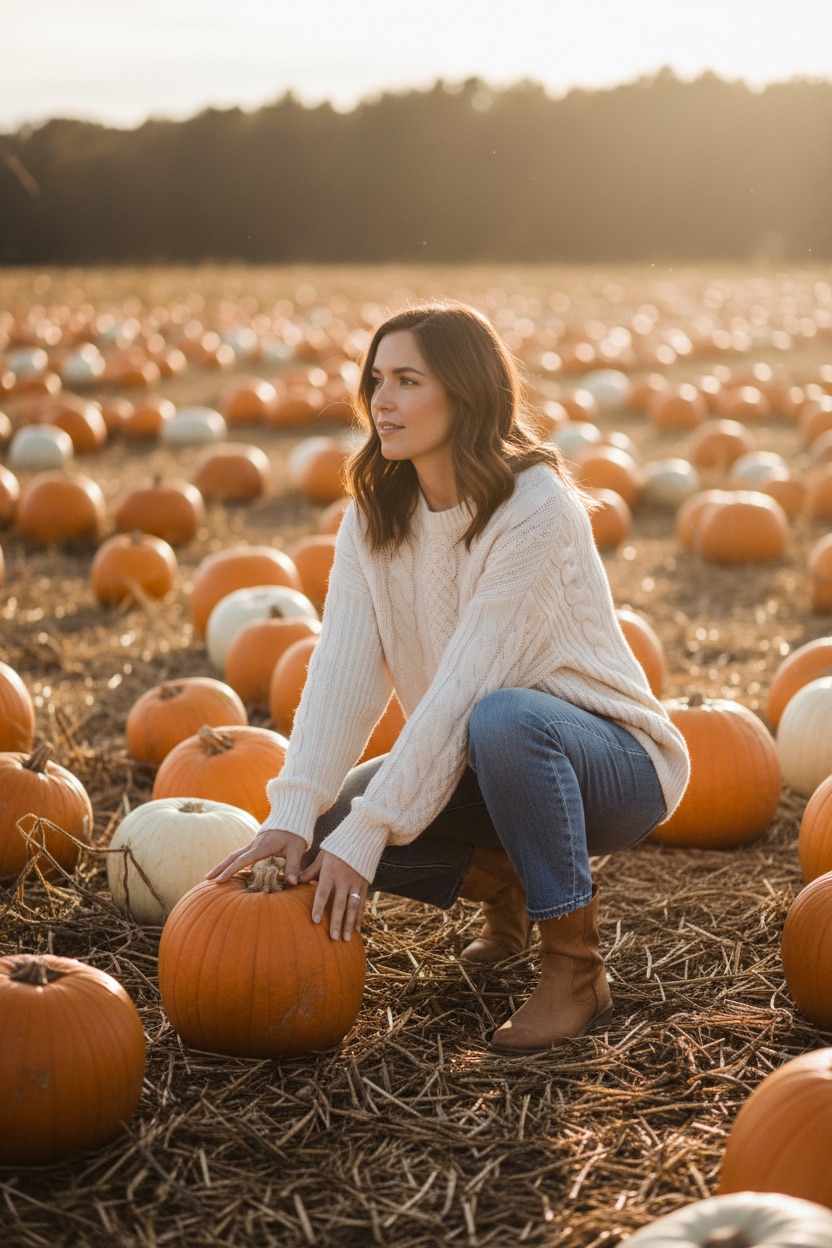
Generated output. The sun is behind her, rimming the hair and shoulder, with the field bouncing enough light back to fill her face — that's the whole technique. Note the pumpkins sitting at genuinely irregular spacing rather than in a grid.
▶ Try this as a fill-in template →
"Irregular intervals" is doing quiet work there. Left alone, image models arrange pumpkins in a suspiciously even grid, and that single detail is what makes a generated field look fake.
Pumpkin patch outfits
Less a photo, more a decision tool — full length, even light, every layer legible.
Full-length outfit photograph of a woman in her 20s styled for a pumpkin patch visit,
shot as a fashion lookbook frame. 4K ultra-high definition.
Outfit: a cream ribbed knit sweater on top, straight-leg mid-wash jeans below, a plaid flannel
worn open as a layer, tan leather ankle boots, finished with a woven tote and small gold hoops.
Every garment rendered with honest fabric behaviour — knit showing stitch definition, denim
showing weave and whisker creasing at the hip, leather showing grain at the toe.
Silhouette: oversized on top, fitted through the leg.
Weather it is dressed for: a crisp 12C autumn afternoon — the layering must make practical
sense for that temperature, not just look good.
Lens: 50mm, f/4, full body head to below the boot, no crop.
Lighting: soft overcast daylight, even across the whole figure so every layer is legible —
this is a clothing reference, so nothing may fall into shadow.
Negative: harsh shadows hiding garments, cropped feet, mannequin look, visible brand logos.
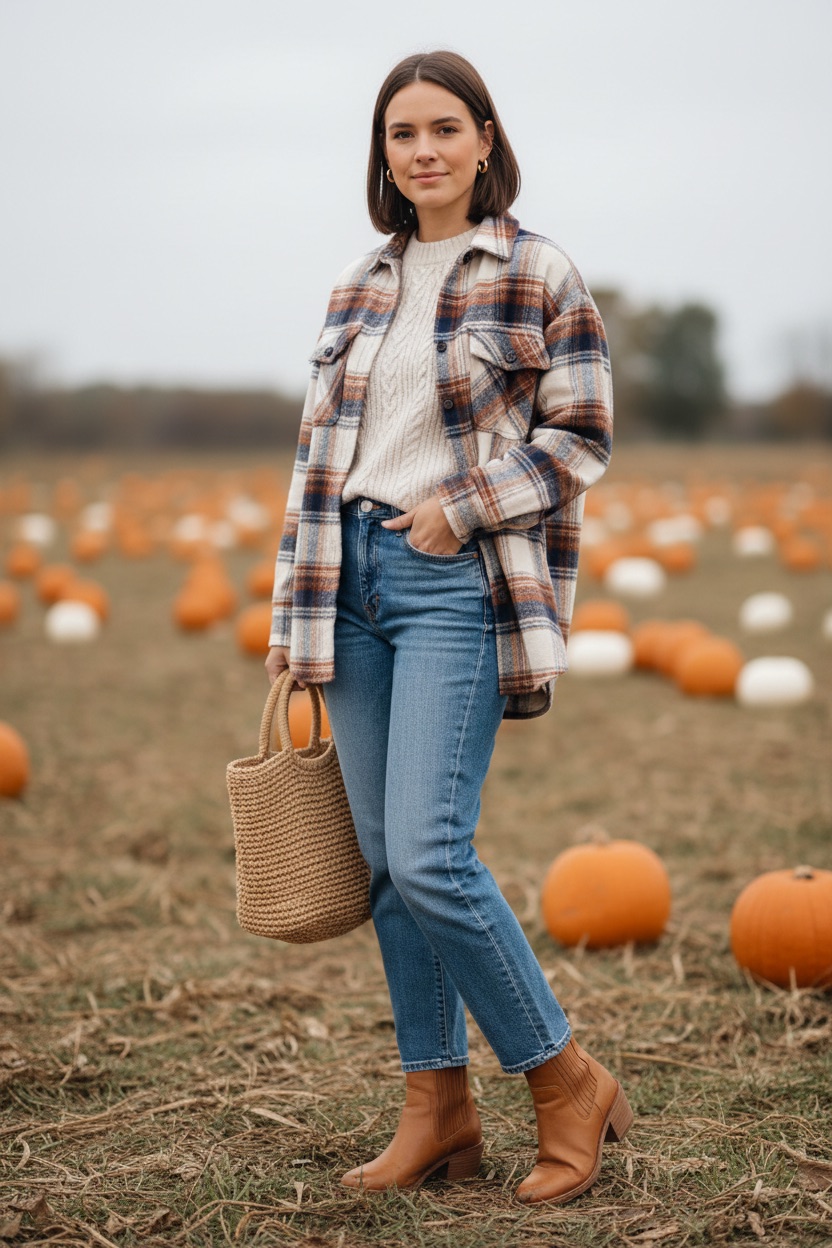
Generated output. Flat overcast light on purpose: every layer stays legible, which is what you want from a clothing reference rather than a photograph. The cream knit also separates cleanly from the orange field behind it.
▶ Try this as a fill-in template →
The temperature line is the one people skip and shouldn't. Tell it 24°C and it stops handing you a wool coat you'd sweat through — most pumpkin patch visits are warmer than the photos suggest.
Family pumpkin patch photos
Coordinated, not matching. And lit so you can actually see everyone.
Warm family lifestyle photograph at a pumpkin patch featuring a mother and her toddler.
4K ultra-high definition.
Outfit coordination: a shared cream and rust palette in different garments — never identical
matching outfits. Chunky knits, jeans and tan boots for the adult, a cream cord pinafore
for the child.
Arrangement: the adult crouched down to the child's height, heights staggered so every face
is clear and nobody is blocked.
Interaction: the adult watching the child reach for a pumpkin, both mid-laugh — genuine and
mid-moment, adults looking at the child rather than everyone staring down the lens.
Lens: 50mm, f/4, stopped down enough to keep every face sharp across the group's depth.
Lighting: low golden sun from behind and to one side, rim-lighting hair, with a large soft
bounce filling every face evenly from the front. No face may sit in shadow.
Colors: cream, rust and warm ochre — warm and gently desaturated, film-like.
Negative: identical matching outfits, faces in shadow, distorted faces, oversaturated orange.
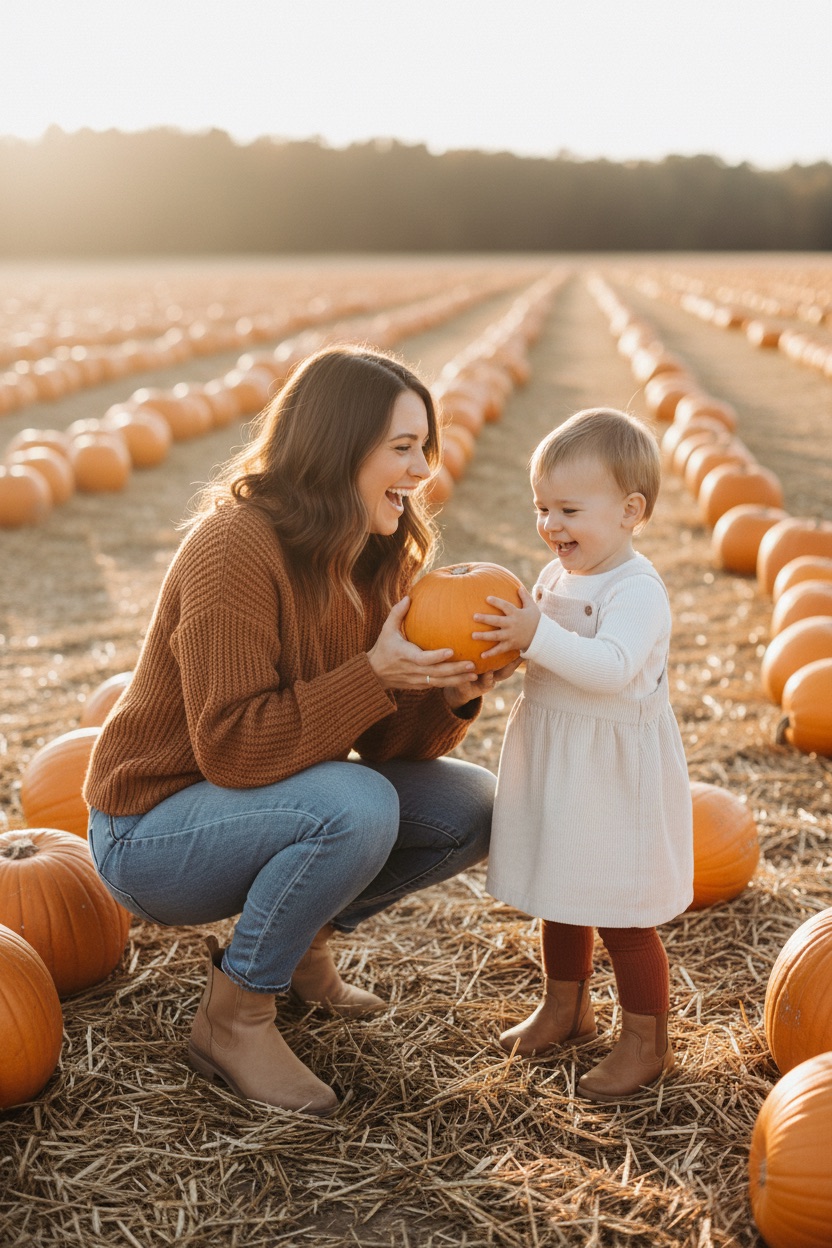
Generated output. Coordinated, not matching — rust knit on one, cream pinafore on the other. Both faces are turned into the fill light, which is the part that goes wrong most often when you shoot into the sun.
▶ Try this as a fill-in template →
"No face may sit in shadow" is a blunt instruction and it needs to be. Backlighting is what makes these photos beautiful and also what makes half of them unusable.
Halloween photoshoot ideas
For portraits that look styled rather than costumed.
Editorial Halloween portrait of a woman in her late 20s. 4K ultra-high definition.
Character direction: a modern witch — interpreted as fashion styling rather than a
costume-shop outfit, so the clothing reads as real tailored garments with weight and drape.
Wardrobe: a black high-neck dress in heavy lace with structured shoulders.
Lens: 85mm, f/1.4.
Lighting: a single candle held just below the chin, low and slightly to camera left, as the
only dominant source — falling off fast into deep shadow so half the face carries shape and
the other half sits in darkness. Warm light against cold shadow is the entire mood;
do not flatten it with fill.
Atmosphere: faint drifting haze catching the candlelight, visible as distinct volumetric layers.
Setting: a dark panelled room with the far wall lost in shadow.
Expression: unsmiling, looking directly down the lens — composed and still, never mugging.
Colors: candle amber against blue-black shadow.
Negative: gore, cheap plastic costume, party shop props, flat on-camera flash, airbrushed skin.
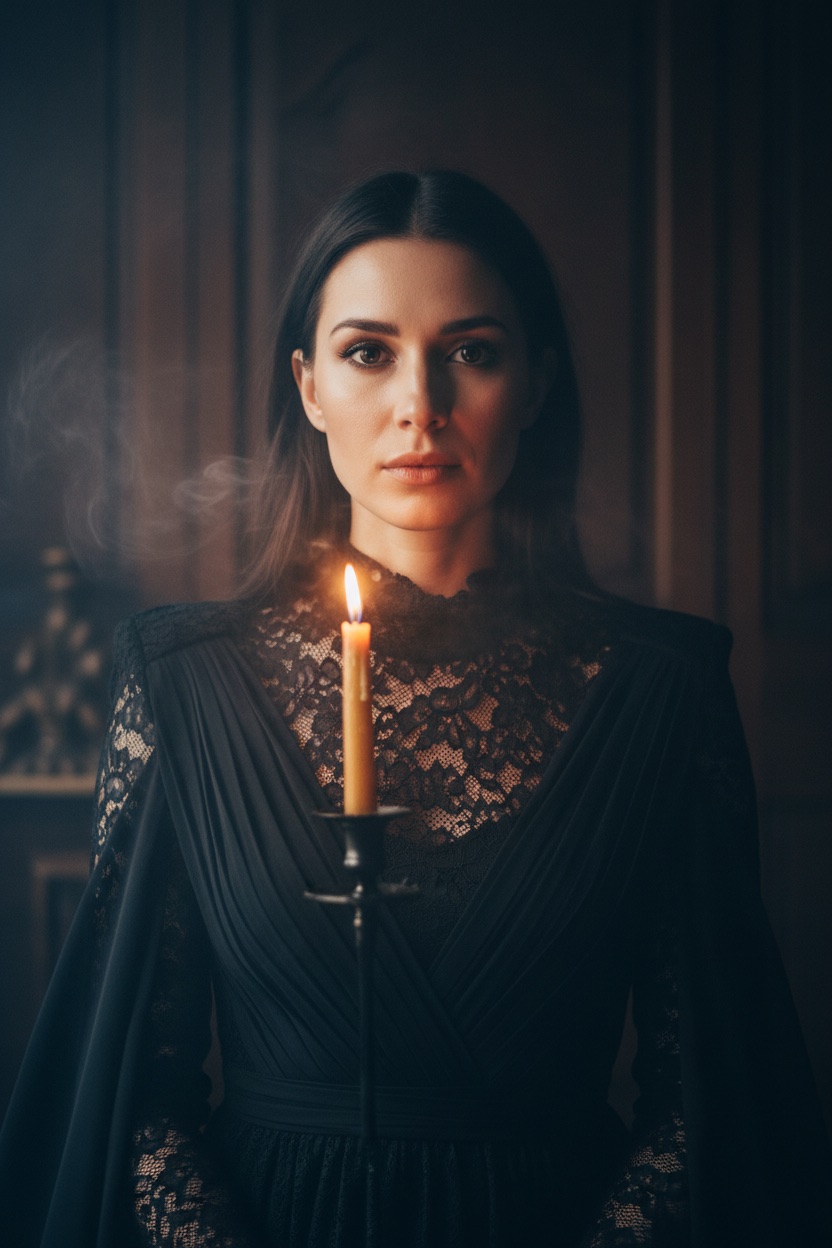
Generated output. One candle, no fill, and the haze made visible where the light passes through it. The dress reads as a real garment with weight and lace detail rather than a costume, which is what "interpreted as fashion styling" buys you.
▶ Try this as a fill-in template →
"Interpreted as fashion styling rather than a costume-shop outfit" is the whole difference between an editorial image and a photo of someone in a packet costume. Say it every time.
Scary Halloween photoshoot
Frightening without a drop of blood. This one works by subtraction.
Unsettling Halloween photograph of a lone figure standing at the far end of a hallway.
4K ultra-high definition.
The fear comes from a figure standing too far away and too still to read clearly — not from
gore, injury or blood, none of which appear anywhere in this image.
Framing: wide, subject small and pushed to the edge of frame, composed so the viewer's eye
keeps going to the part of the frame that is wrong.
Lens: 24mm wide, f/5.6.
Lighting: a single bare bulb overhead, far behind the subject — harsh and directional, leaving
large areas of the frame completely unreadable. What you cannot see is doing more work
than what you can.
Atmosphere: dust hanging visibly in the light.
Subject state: standing perfectly still, facing away from camera — held quiet rather than
screaming or lunging; stillness reads as far more wrong than action.
Colors: desaturated grey-green with a single warm bulb, drained toward monochrome.
Heavy true black in the shadows, no lifted haze.
Negative: gore, blood, wounds, jump-scare face, cheap plastic masks, flat lighting.
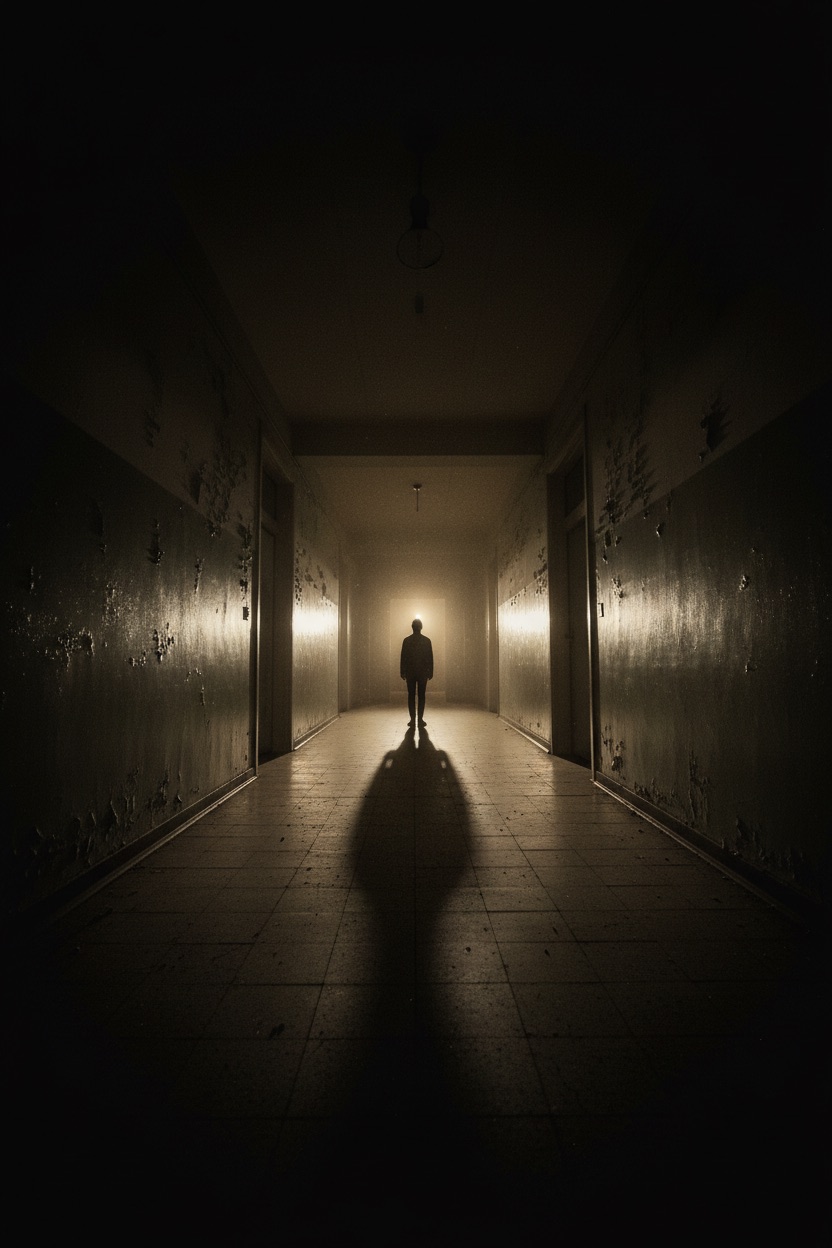
Generated output, and there is no blood in it. The figure is too far away to resolve, most of the frame is unreadable black, and the shadow reaches toward you. Subtraction doing the work.
▶ Try this as a fill-in template →
Every instinct says go closer and add something. Do the opposite. The generated version of this — a small silhouette at the end of a corridor throwing a long shadow — is more unsettling than anything with a face in it.
Couples and group Halloween photos
Halloween group photograph of two best friends in their 20s. 4K ultra-high definition.
Coordination: a single dark palette interpreted differently by each person — the outfits must
read as a deliberate set from across the room while each person still looks like an individual,
never identical.
Costumes: two witches in completely different silhouettes, one long and one short, styled as
real garments with genuine fabric weight rather than packet costumes.
Arrangement: staggered in depth, one half a step ahead of the other, so the group reads as a
shape rather than a line.
Interaction: mid-laugh, looking at each other rather than the camera.
Lens: 35mm, f/4, enough depth of field that every face stays sharp.
Lighting: warm string lights overhead with cool blue hour ambient behind, wrapping the group
evenly — no one may fall into shadow while another is lit.
Colors: oxblood and black with small gold accents, tied together by a shared accent that
appears somewhere on every person.
Negative: identical clone faces, merged bodies, uneven exposure across the group, extra limbs.
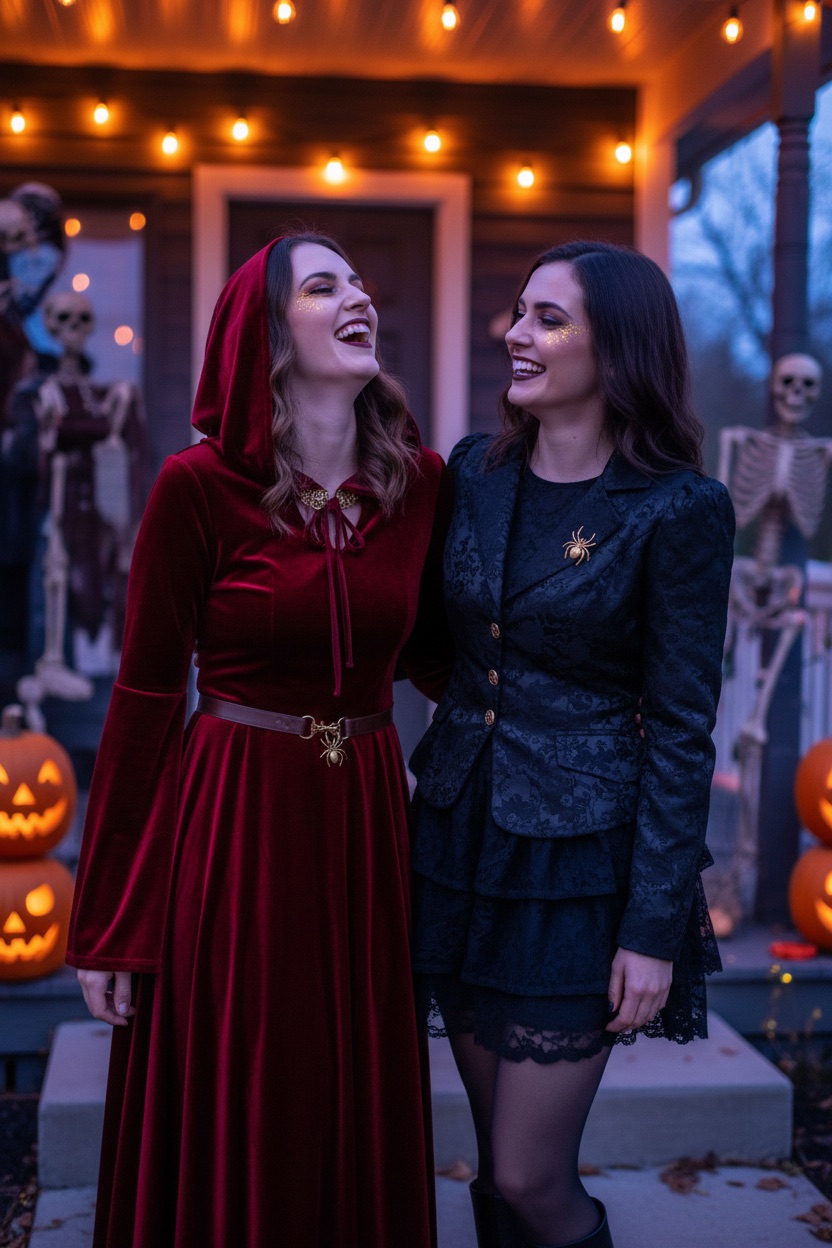
Generated output. Completely different silhouettes, one palette, and a small gold spider on each of them. That shared accent is what makes the pair read as deliberate instead of coincidental.
▶ Try this as a fill-in template →
The shared-accent trick is the one to steal for real life. One gold detail on each person does more to make a group look coordinated than matching costumes ever will.
Halloween costume try-on
The one that's genuinely worth doing before you spend money. Upload a photo of yourself.
Restyle only the costume and styling in this photo to a classic vampire.
Silhouette: sharply tailored with a high collar and a long cape.
Fabrics: black velvet and deep oxblood silk, rendered with real weight, drape and visible
texture rather than a flat printed-on look.
Makeup: pale base, deep berry lip and subtle grey socket shadow.
Hair: slicked back away from the face.
Preserve my facial identity, bone structure, eye colour, skin tone, and natural skin texture
completely — do not alter any facial feature, do not slim my face or jaw, and do not lighten
my skin. Keep the same head position, body pose, framing and lighting direction as the original.
Fit the costume to my actual body proportions as they appear in the photo rather than an
idealised figure.
Render the costume honestly, showing how the fabric would really sit and fold on a real
person, including where it would bunch or pull.
Negative: changed facial features, slimmed face, lightened skin tone, different person,
trademarked characters, superhero logos, plastic packet costume.
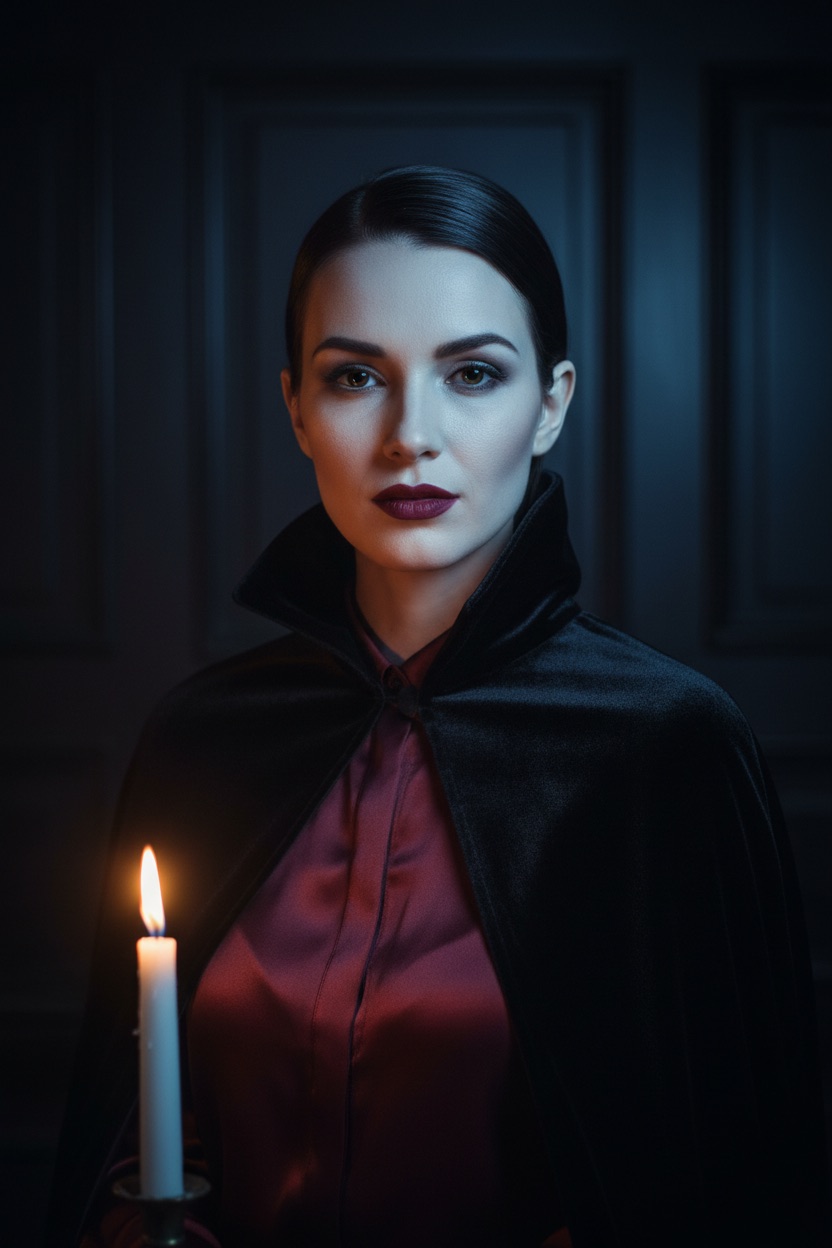
This is the reference render, not a try-on — it shows what the costume description produces. Run it on your own photo with the preserve clause and you get this styling on your own face, unchanged.
▶ Try this as a fill-in template →
Two things here. The preserve clause is not optional — without it the model redesigns your face along with the outfit, and you end up evaluating a costume on somebody else. And "including where it would bunch or pull" is what stops the render looking like a video game character; real fabric on a real body is never perfectly smooth.
Stick to public-domain archetypes — vampire, witch, skeleton, 1920s, scarecrow, classic monster. Named characters from films and comics are trademarked, and the model will either refuse or produce something you can't post.
Halloween makeup ideas
Shot as a reference you can actually work from.
Close-up beauty photograph of a Halloween makeup look on a woman in her 20s.
4K ultra-high definition.
Look: a smudged gothic eye with sharp contour, executed editorial and graphic — wearable
at a party.
Technique: hard graphic liner edges against a heavily diffused smoked socket. Every blend,
edge and line must be legible, because this image is a reference someone will work from.
Eyes: a deep charcoal smoked socket with a sharp black wing.
Lips: a blurred oxblood stain, darkest at the centre.
Skin finish: matte and slightly paled, with the model's own skin texture, pores and fine lines
fully visible beneath the product — makeup sits on skin, it does not replace it.
Embellishments: a scatter of tiny black rhinestones along the inner eye corner, sitting
dimensionally with their own soft shadow.
Lens: 100mm macro, f/5.6, face filling the frame, tack sharp throughout.
Lighting: a large soft beauty dish straight on with fill below, even and shadow-free enough
that every colour transition reads accurately.
Negative: gore, prosthetic injury, airbrushed poreless skin, blurred makeup edges.
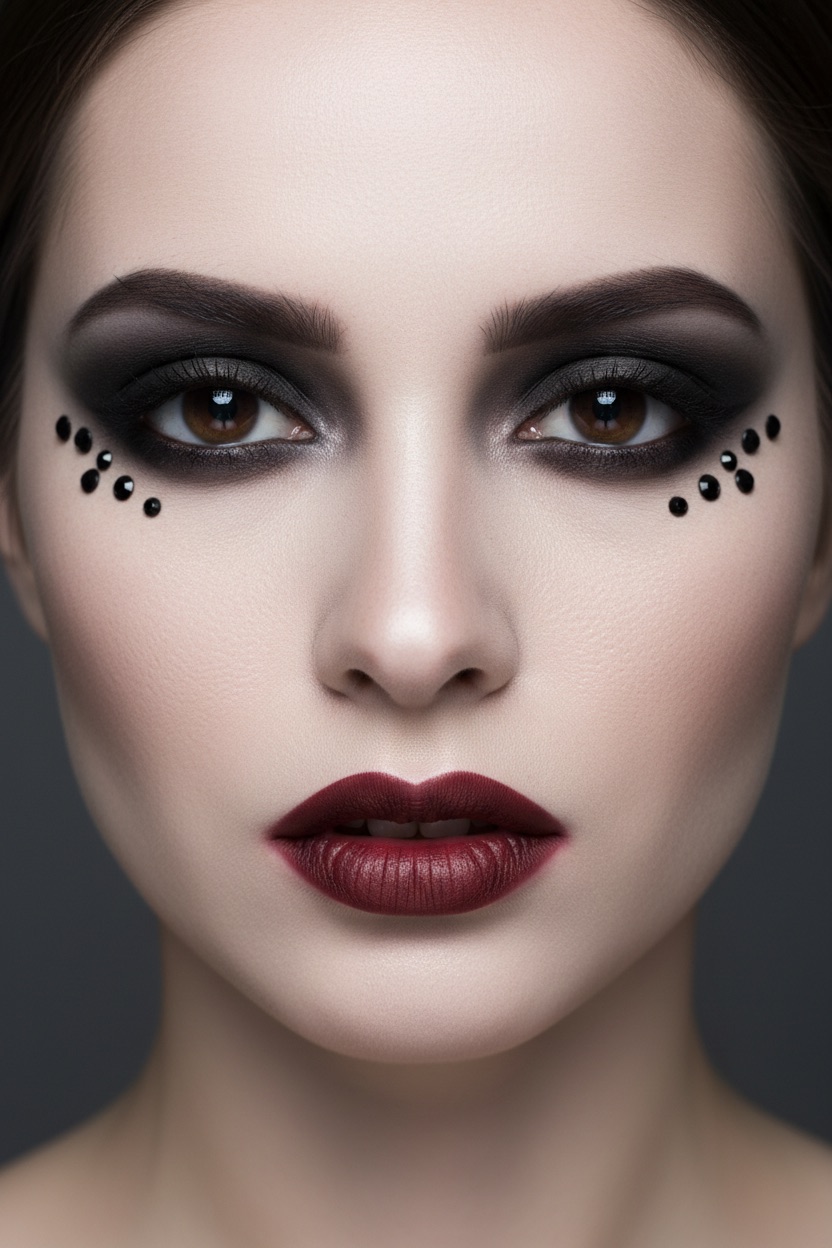
Generated output. Look closely at the cheeks and forehead: pores and texture are still visible under the product. That's the difference between a look you can copy and a plastic render you can't learn anything from.
▶ Try this as a fill-in template →
"Makeup sits on skin, it does not replace it" fixes the single most common failure in AI beauty images — the poreless plastic finish that makes a look impossible to copy, because you can't see how anything was actually applied.
Halloween party decorating ideas
See the room before you buy anything for it.
Interior photograph of a room decorated for a Halloween party. 4K ultra-high definition.
Room: a living room with a fireplace.
Approach: elegant and dark rather than spooky — a small number of decisions repeated with
intent, so the room reads as styled rather than as scattered decorations.
Key elements: clustered pillar candles, uncarved white and green pumpkins, dried branches and
black taper candles, placed at varying heights so the eye travels up and around the room.
Lighting plan: clustered candles at three different heights plus one low warm lamp — multiple
small warm sources at low level rather than one overhead light, each pooling close and falling
off into shadow. The unlit areas matter as much as the lit ones.
Textures: velvet, dried foliage and aged brass, rendered as real materials with weight and
grain — nothing shiny plastic.
Colors: black, oxblood and antique gold, deep in the warm pools, desaturated toward black
in the shadows.
Composition: shot from the doorway at standing eye level, showing enough to read as a space.
Negative: cheap plastic decorations, flat overhead lighting, cluttered, party shop banners.
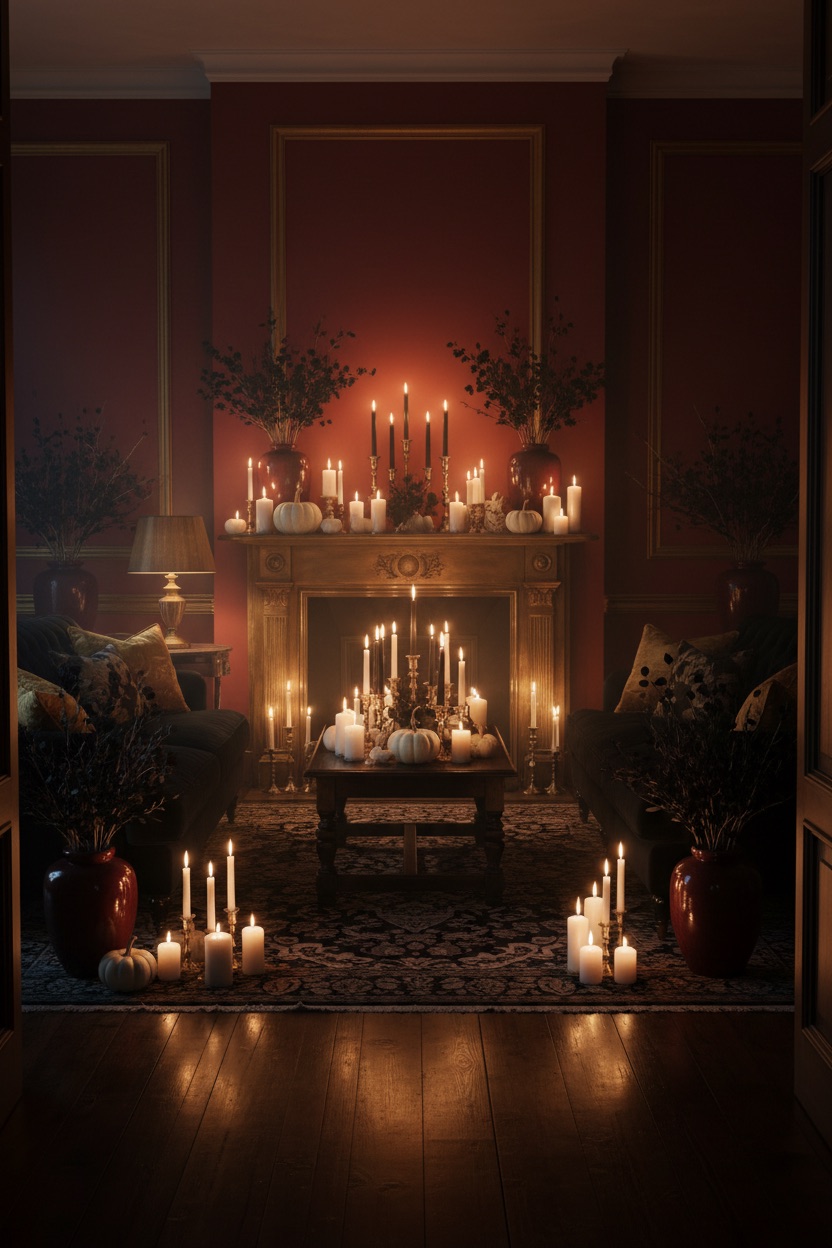
Generated output. Roughly forty small flames at three different heights and not one overhead light — which is why the room has depth and genuinely dark corners. The pumpkins are white and pale green, not orange.
▶ Try this as a fill-in template →
Uncarved pumpkins in white and green look considerably more expensive than carved orange ones, and they last the whole season. That's a real decorating note, not a prompt trick.
Halloween tablescape and dessert table
Overhead-angled photograph of a Halloween dessert table. 4K ultra-high definition.
Styling: dark and elegant, closer to a wine bar than a party shop — the spread must look
genuinely appetising first and Halloween second, so nothing is coloured a shade real food
never is.
Food: a dark chocolate layer cake, blackberry tarts and salted caramel truffles, rendered with
honest texture — crumb structure, glaze sheen, powdered sugar sitting as individual grains.
Serving pieces: matte black ceramics, smoked glass and brass cake stands, arranged in three
distinct height tiers with one tall anchor at the back.
Dressing: a black linen runner with dried foliage and low taper candles.
Lighting: warm candlelight raking hard from camera left so every texture picks up an edge and
casts a soft directional shadow — flat frontal light kills food photography.
Colors: black, oxblood and antique gold — deep and warm rather than novelty orange and lime.
Composition: 45 degrees from table height, nearest items fully resolved, far end falling
gently out of focus.
Negative: novelty green food colouring, fake blood, flat frontal lighting, unappetising.
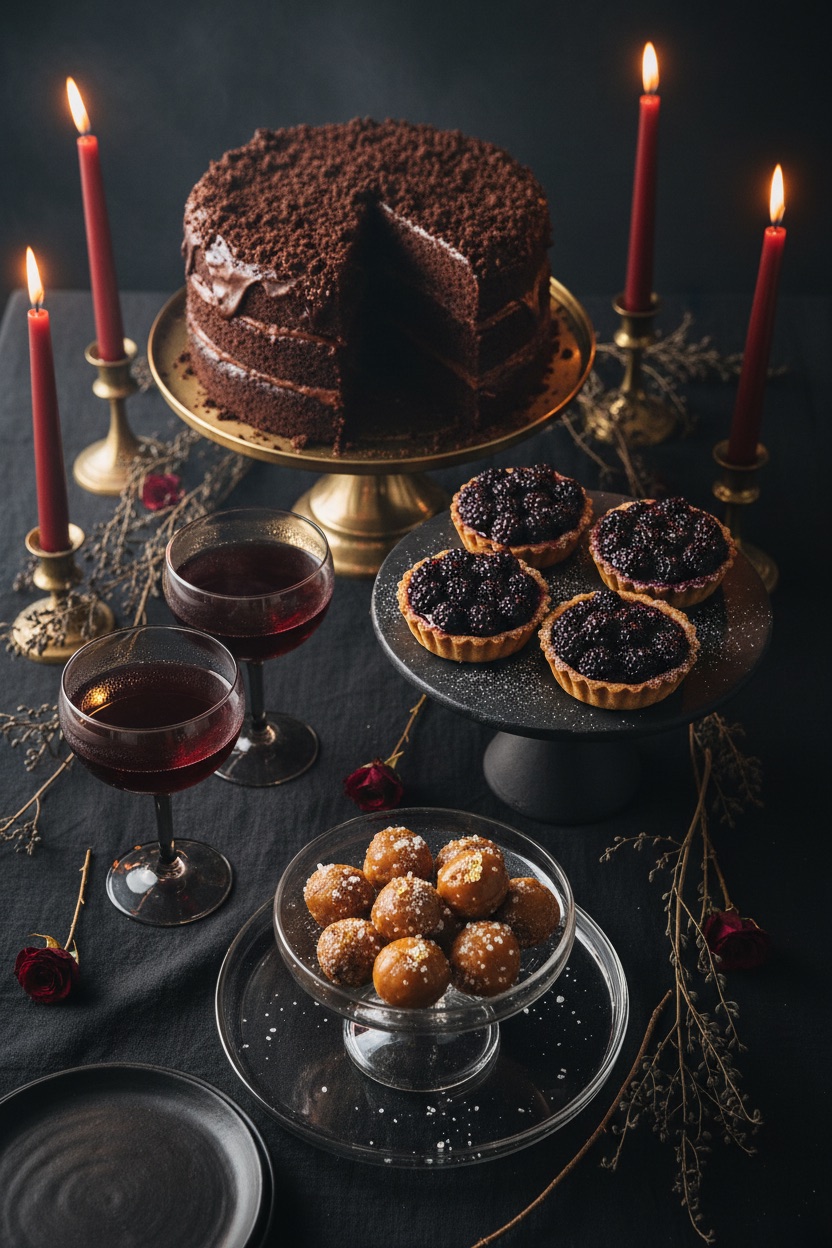
Generated output. Every colour here is one real food actually comes in — deep purple, near-black, oxblood. Candlelight rakes in from the left so the crumb, the sugar and the glass edges all pick up a defined edge.
▶ Try this as a fill-in template →
The rule that saves Halloween food photography: never colour food a shade real food doesn't come in. Deep purple, near-black, oxblood and burnt orange all photograph beautifully. Lime green reads as inedible, which it usually is.
What to do with these
Generate the pumpkin patch outfit first — it's the decision with a deadline attached, and the field gets picked over and muddy fast. Then the costume try-on, before anything gets bought.
The rest are planning tools. A room you've seen is much easier to shop for than a room you've imagined, and a photo you've already composed is much faster to take when you've got twenty minutes of good light and everyone is getting cold.
All ten templates:
- Pumpkin Patch Photoshoot Generator
- Pumpkin Patch Outfit Generator
- Family Pumpkin Patch Photoshoot
- Halloween Portrait Photoshoot Generator
- Scary Halloween Photoshoot Generator
- Couples and Group Halloween Photoshoot
- Halloween Costume Try-On — Your Own Photo
- Halloween Makeup Look Generator
- Halloween Party Decor Generator
- Halloween Tablescape and Dessert Table
Related:
- Browse all Halloween prompts
- Seasonal and holiday prompts — Christmas, Thanksgiving and more
- Halloween and Christmas wallpaper prompts — the scene and wallpaper side of the same season
- Halloween nail set generator