
Indian weddings have several separate ceremonies over a few days, and each one has its own look. The haldi is yellow and messy, the mehndi is green and pastel, the sangeet is all sequins and stage lights, and the wedding day itself is red and gold or Kanjeevaram silk. Searches follow that pattern: "haldi ceremony" climbs to about 40,000 a month in November, and "sangeet outfit" more than doubles over the same weeks.
This guide has one prompt for each part of the wedding. Upload a photo and the model changes the setting, outfit and light while keeping your face, skin tone and build exactly as they are. Use them to plan outfits, brief your photographer, or make something to share before the real photos arrive.
If you're planning the shoot before the wedding, start with our pre-wedding shoot ideas. This guide covers the wedding itself.
The two lines every wedding prompt needs
Indian wedding edits go wrong in a predictable way. Ask for a "beautiful bride" and the model lightens the skin, smooths the face and slims the jaw. So every prompt below includes:
Keep the face, facial features, skin tone, hairstyle and body proportions exactly as
they are — do not beautify, lighten skin, slim, or change their age.
and puts lightened skin, beautified, airbrushed, plastic skin in the negative prompt. The second rule is about clothes: name the craft, not just the garment. "Red lehenga" gets you a costume. "Deep red velvet lehenga with heavy gold zardozi, every thread resolved" gets you couture. The same goes for zari, gota-patti, mirror work, chikankari and temple jewellery. The specific word is what makes the model render the detail.
Haldi
1. Candid haldi: the turmeric splash
The haldi photo everyone wants is the messy, laughing one.
Edit this photo into a candid haldi ceremony moment: the bride seated on a low wooden
chowki while her cousins and aunt smear thick turmeric paste on her cheeks and arms,
her head thrown back laughing. [Keep every face clause]
Outfit: a simple yellow cotton lehenga with a floral dupatta and fresh-flower jewellery.
Turmeric paste rendered realistically — thick, slightly grainy, bright yellow streaks on
cheeks and arms, not a flat yellow filter over the skin.
Setting: a sunlit home courtyard, marigold garlands, banana leaves around the edges.
Lens: 35mm, f/2.8, fast shutter freezing marigold petals mid-air.
Lighting: bright soft daylight filtering through a canopy of marigold strings.
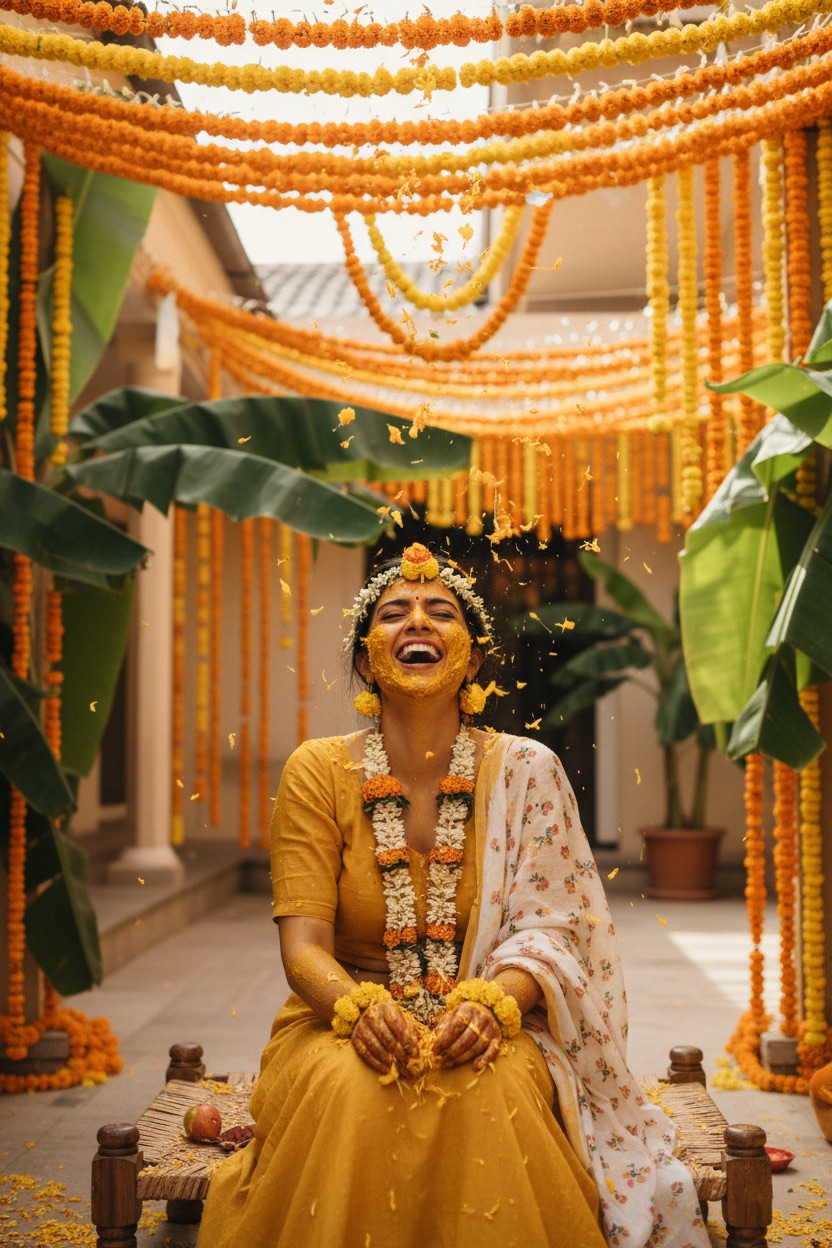
Generated output. The turmeric looks like paste on the skin, not a yellow tint over the whole picture, which is what "not a flat yellow filter" prevents. In this example the model left out the cousins. If you upload a group photo, they stay in.
▶ Try this as a fill-in template →
2. Haldi bride portrait
The calm version: pale yellow, fresh flowers, and only a small smear of turmeric.
Edit this photo into a haldi ceremony portrait of the bride. [Keep the face clause]
Outfit: a pale yellow mul cotton anarkali with a white chikankari dupatta.
Jewellery: fresh-flower jewellery of white mogra buds and yellow marigold — earrings,
a maang tikka and wrist bands, petals and buds rendered individually.
A small smear of turmeric on one cheek. Background: a wall of hanging marigold strings.
Lens: 85mm, f/1.8. Lighting: soft morning window light.
Colors: soft yellow, white and green — fresh, not neon.
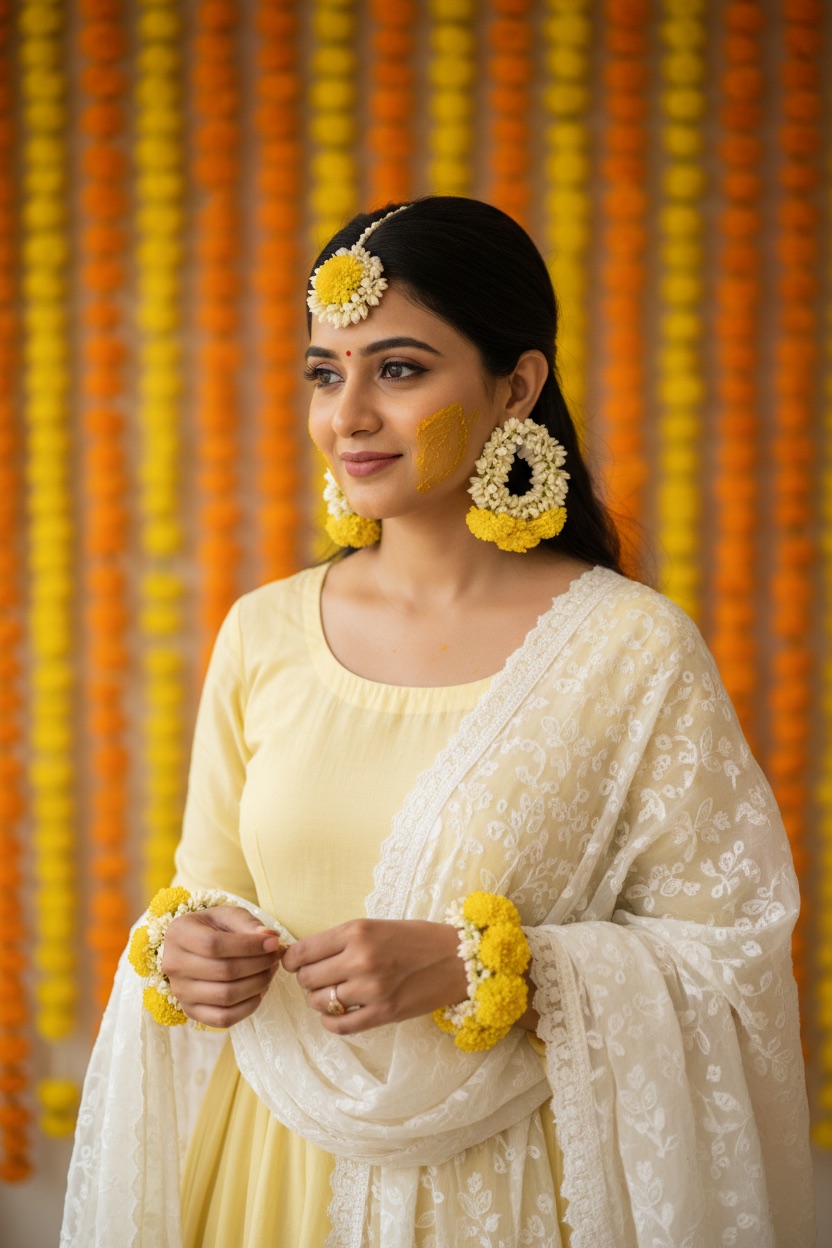
Generated output. "Fresh, not neon" matters. Yellow is the colour image models oversaturate most easily, and a neon haldi photo looks cheap.
▶ Try this as a fill-in template →
Mehndi
3. Bridal mehndi hands
This is the detail shot. Hands are where AI fails most often, so the prompt is strict about them.
Edit this photo into a bridal mehndi detail photograph of the hands: apply intricate
traditional Rajasthani bridal mehndi — paisleys, peacocks, lattice and a small
bride-and-groom motif — to both hands and forearms, following the real shape, size and
skin tone of the hands in the photo. Do not change the hands themselves, the number of
fingers, or the skin tone.
Henna stain: a deep fresh maroon-brown, fine lines that look hand-piped, slightly
uneven, never printed or stamped.
Styling: red and gold glass bangles and a thin gold ring; hands resting palms up on a
red silk lehenga with gold zari, a few rose petals scattered.
Lens: 100mm macro, f/2.8.
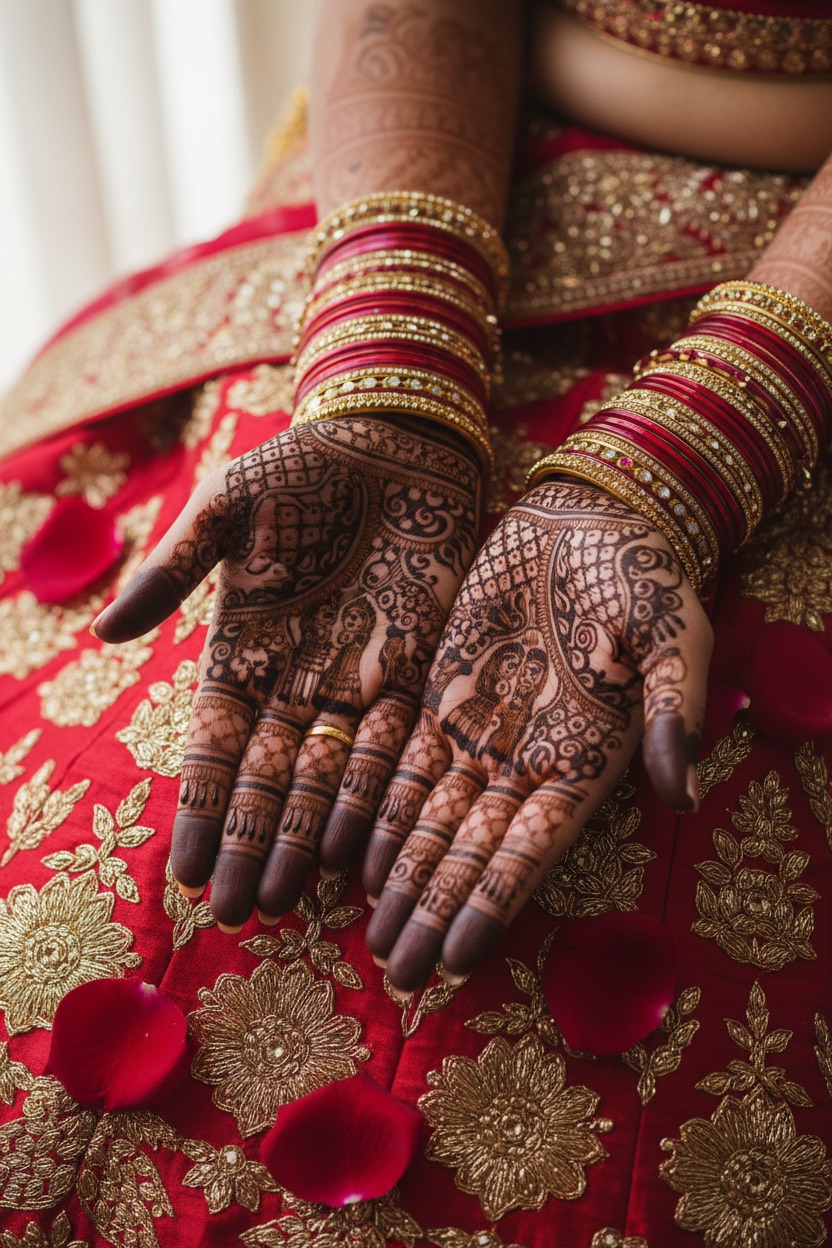
Generated output. "Slightly uneven, never printed or stamped" is what makes the lines look piped by hand. Perfectly clean lines look like a sticker. Always count the fingers before you share an AI hand photo.
▶ Try this as a fill-in template →
4. Mehndi ceremony portrait
Mint, pink and marigold, a jhoola wrapped in flowers, and freshly hennaed hands held up to show them.
Edit this photo into a mehndi ceremony portrait of the bride. [Keep the face clause]
Outfit: a mint-green lehenga with mirror work and a pink gota-patti dupatta, mirror work
catching small points of light. Fresh mehndi on both hands, drying.
Setting: a garden lounge — a wooden swing wrapped in white jasmine and pink roses,
floor cushions and brass lanterns.
Pose: sitting on the swing holding up her freshly hennaed hands, laughing.
Lens: 50mm, f/2. Lighting: late-afternoon light under a white canopy.
Colors: mint, blush pink and marigold, fresh and soft.
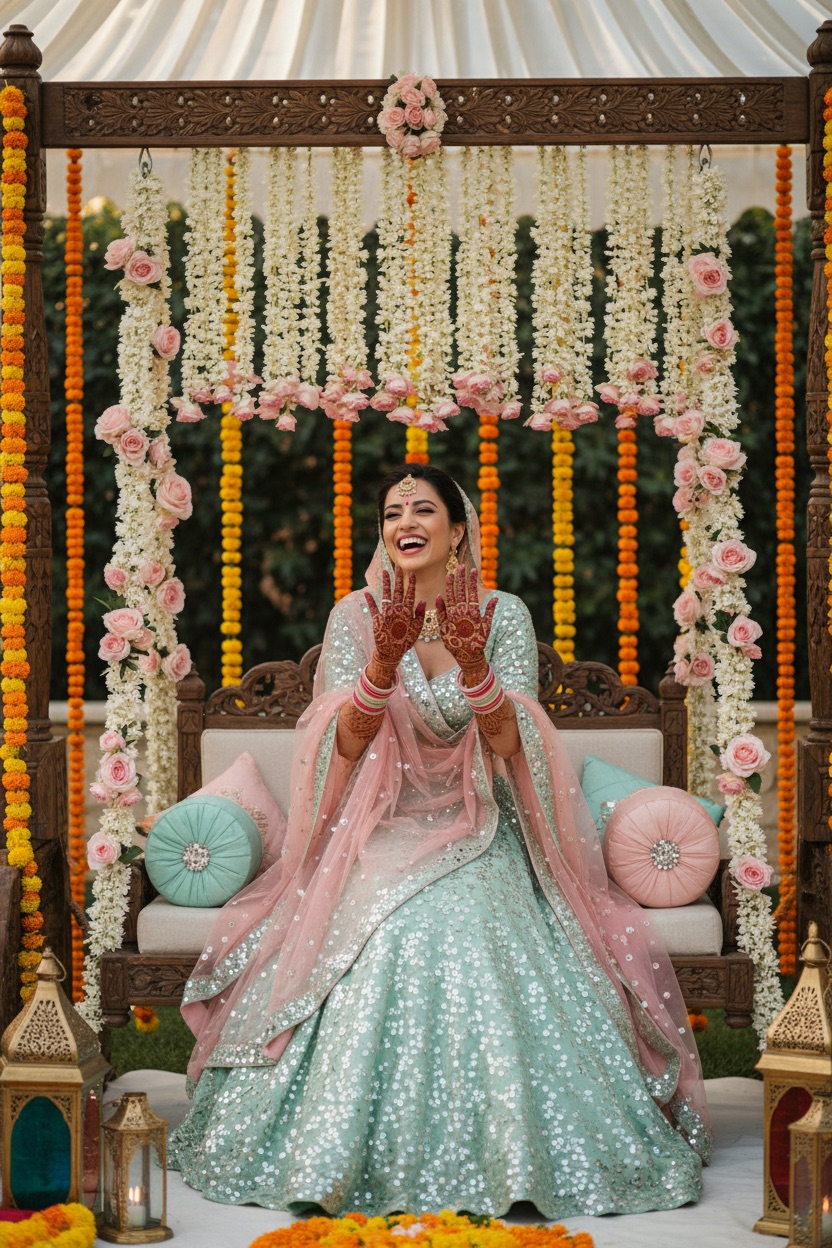
Generated output. Mirror work and sequins only look real when they catch "small points of light". Without that phrase the embroidery looks flat and printed.
▶ Try this as a fill-in template →
Sangeet
5. Sangeet outfit try-on
The most practical prompt in this guide. Searches for "sangeet outfit" more than double in November, because that's when people are deciding what to buy. Try the outfit on your own photo first.
Change only the outfit in this photo to a sangeet look: a champagne-gold sequinned
lehenga with a sheer sequinned dupatta and a structured blouse. Keep the face, facial
features, skin tone, hairstyle, pose and body proportions exactly as they are — do not
slim, reshape, beautify, lighten skin, or change their age. Fit the outfit to the body
as it actually appears in the photo.
Fabric: sequins catching individual points of light, real weight and drape.
Accessories: statement chandbali earrings and a sleek low bun.
Background: a sangeet stage with warm fairy-light curtains, softly blurred.
Relight to match: warm stage spotlights from the front-left, matching shadow direction.
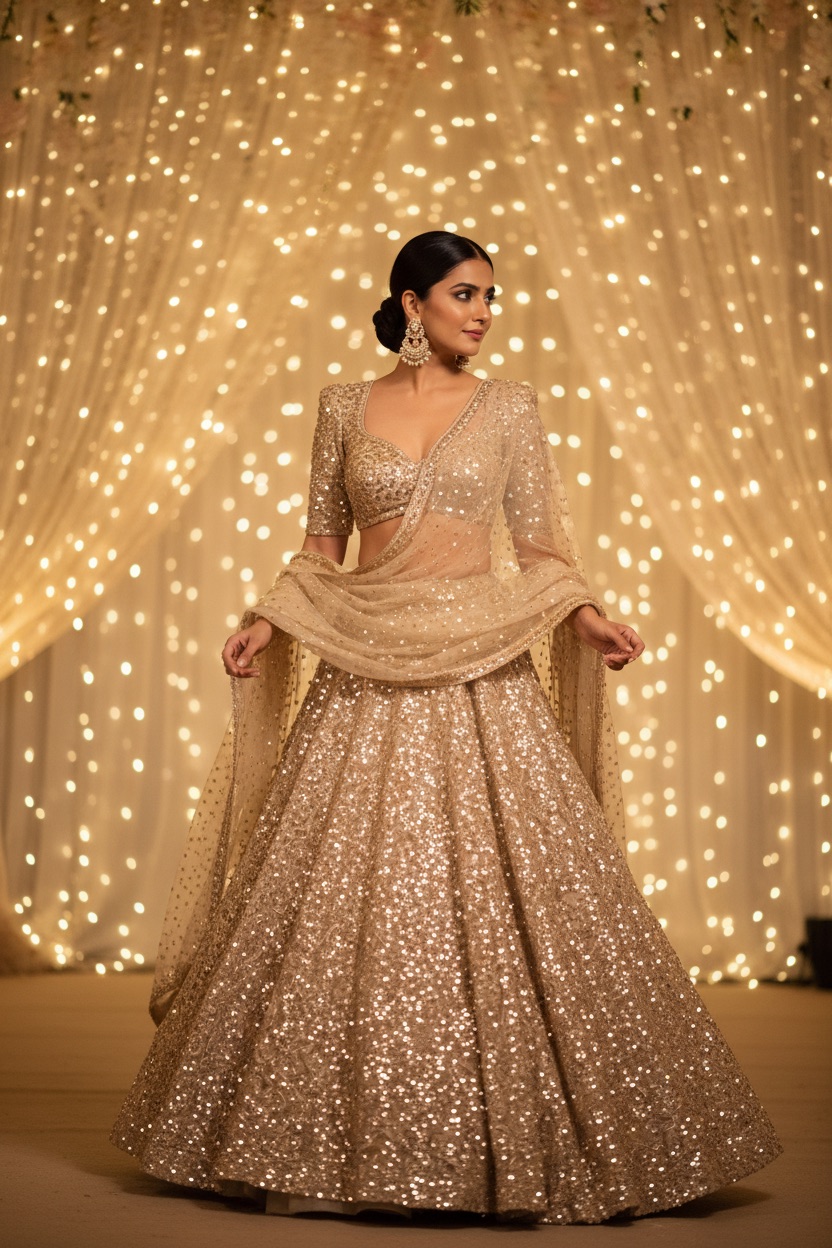
Generated output. "Fit the outfit to the body as it actually appears in the photo" is the most important line. Without it the model puts the outfit on an idealised figure, which won't tell you how it will look on you.
▶ Try this as a fill-in template →
6. Sangeet night: the dance
Upload a group photo of your dance crew and get the performance shot, complete with phones raised in the audience.
Edit this photo into a sangeet night dance performance: the bride and four of her
cousins mid-choreography on a stage, all spinning with arms raised, lehengas flaring.
[Keep every face clause]
Outfits: coordinated jewel tones — emerald, fuchsia, sapphire, gold and plum — with
mirror work. Stage: fairy-light curtains and marigold strings.
Lens: 35mm, f/2, shutter fast enough to freeze faces but leaving a little motion blur
in swinging fabric. Lighting: warm pink and amber stage beams, haze catching the beams.
Audience: family silhouettes in the foreground, a few phones raised.
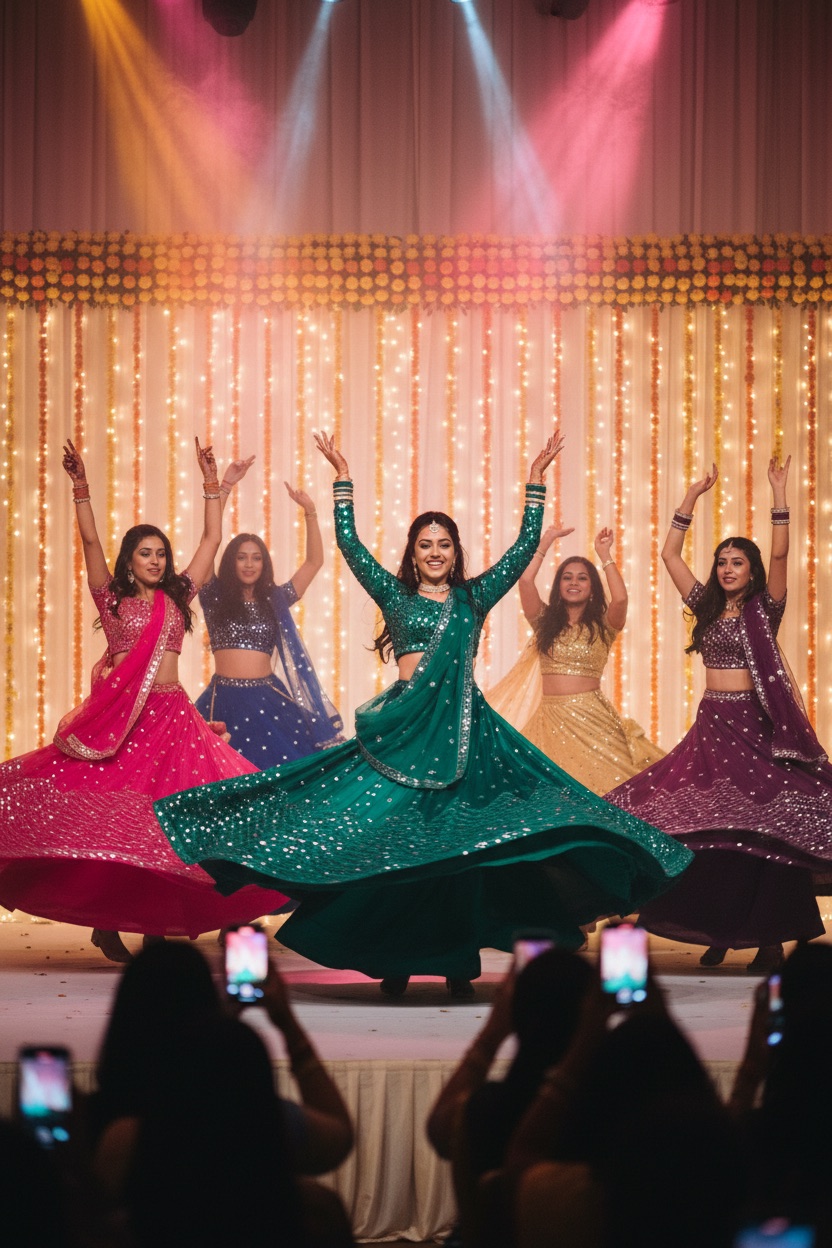
Generated output. Faces sharp with a little blur in the skirts is what makes it look like a moment rather than a pose. The audience silhouettes in the foreground make it feel like a real event.
▶ Try this as a fill-in template →
The wedding day
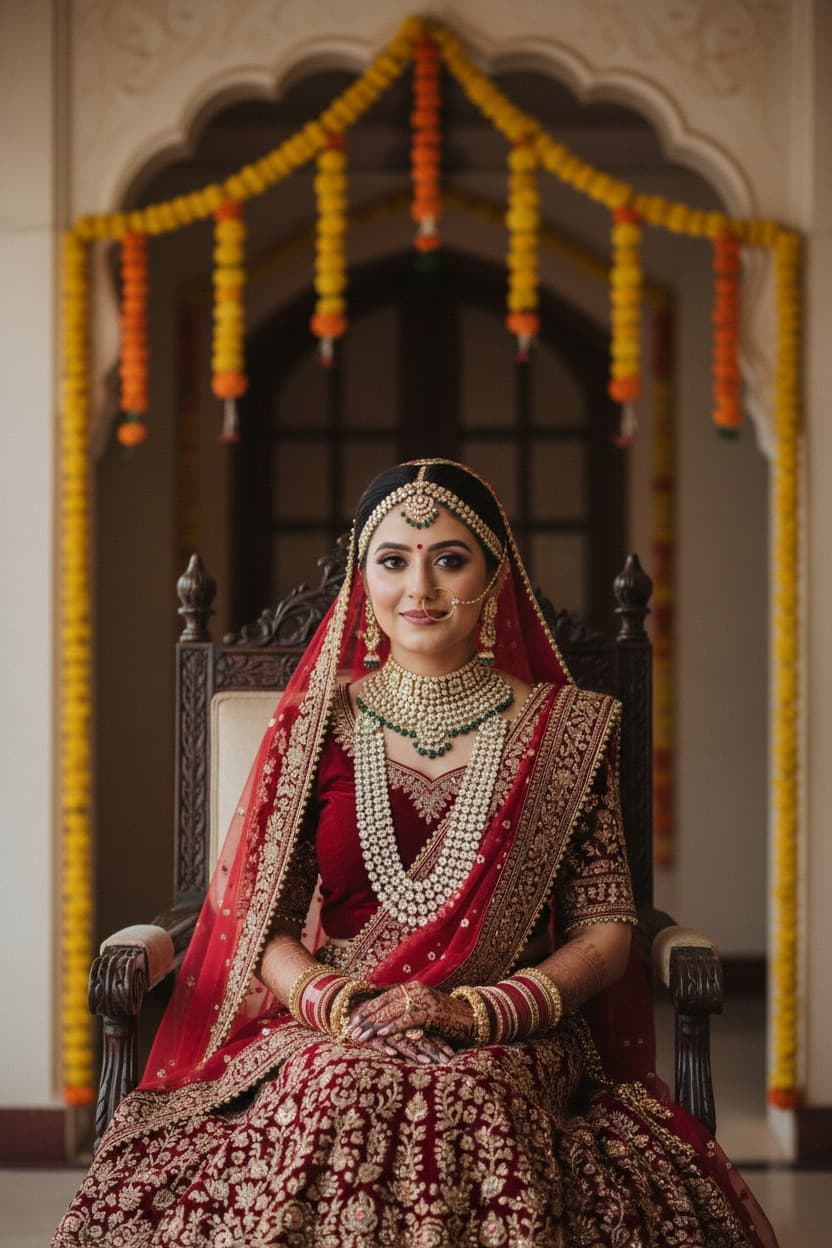
7. Red bridal lehenga portrait
The classic North Indian bridal portrait. This prompt depends on naming the craft and the jewellery precisely.
Edit this photo into a wedding-day bridal portrait of the bride in a deep red velvet
lehenga. [Keep the face clause]
Embroidery: heavy gold zardozi, every thread and sequin resolved at 4K.
Dupatta: a sheer red net dupatta with a scalloped gold border draped over her head.
Jewellery: kundan and polki choker, layered rani haar, maang tikka, nath and a
red-and-gold chooda. Makeup: soft classic, natural skin texture visible underneath.
Pose: seated on a carved wooden chair, hennaed hands folded in her lap.
Background: a haveli doorway with marigold strings. Lens: 85mm, f/1.8.
Colors: deep bridal red and antique gold, rich but not oversaturated.
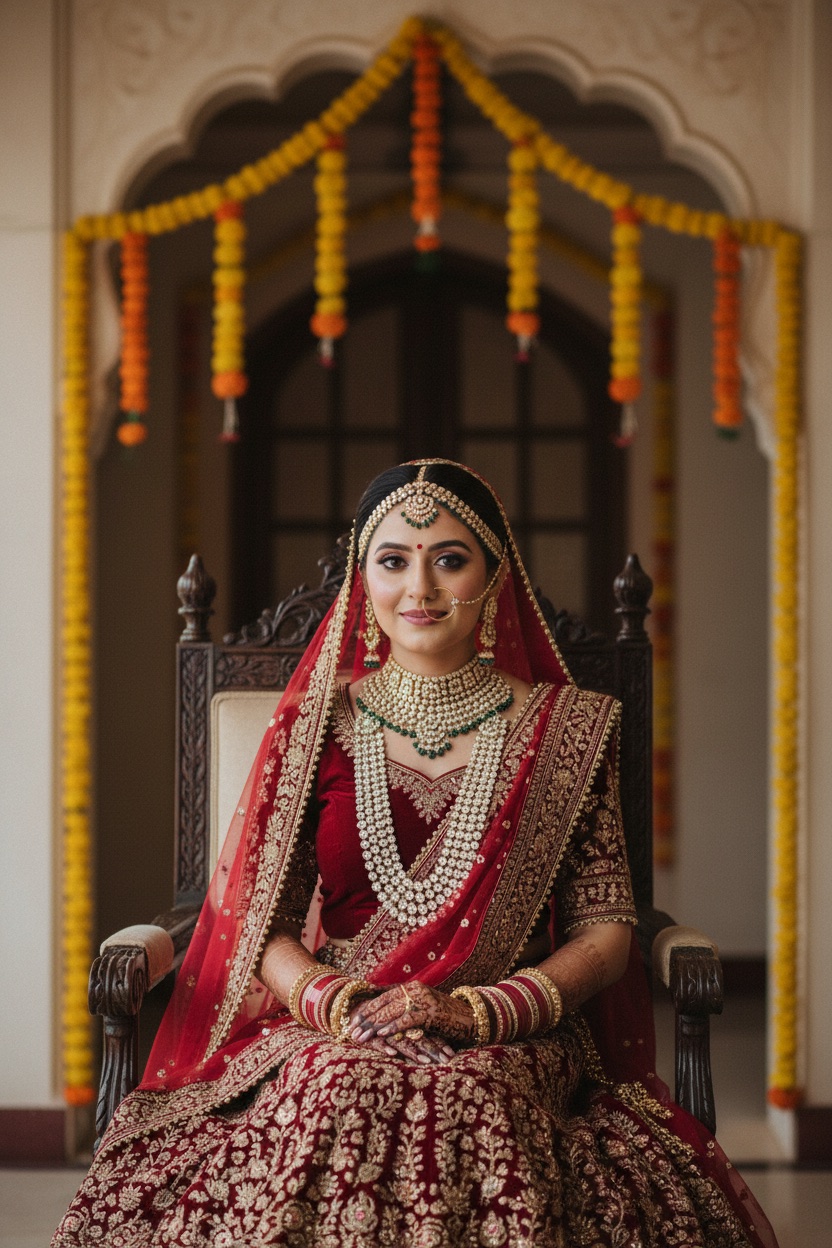
Generated output. Naming each piece (choker, rani haar, maang tikka, nath, chooda) gets you a complete bridal set. "Bridal jewellery" alone usually gets you one generic necklace.
▶ Try this as a fill-in template →
8. South Indian bride: Kanjeevaram and temple jewellery
Mustard and maroon silk, temple gold and a braid woven with jasmine. This is also the look behind the Gemini saree trend, which keeps coming back.
Edit this photo into a South Indian bridal portrait of the bride in a mustard-gold and
deep maroon Kanjeevaram silk saree with a wide temple-pattern zari border.
[Keep the face clause]
Silk with real weight and sheen, the zari border resolved thread by thread.
Jewellery: antique gold temple jewellery — a lakshmi kasu mala, a long haram, jhumkas,
a nethi chutti and a vanki armlet.
Hair: a long braid fully woven with white jasmine, topped with a jadanagam.
Pose: seated on a brass-studded wooden swing, one hand on the chain.
Background: a Chettinad mansion pillar hall with Athangudi tiles. Lens: 85mm, f/1.8.
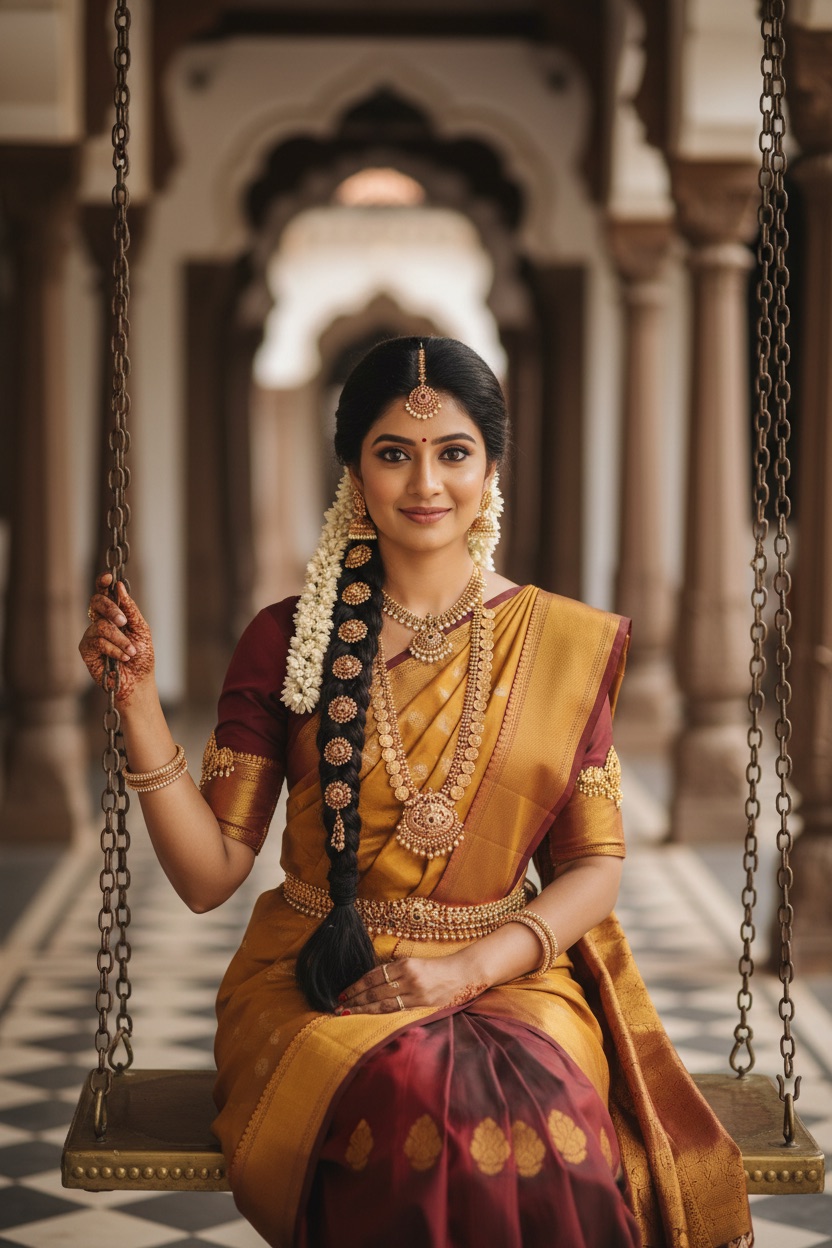
Generated output. The swing and the Chettinad pillars set the scene without needing a temple. For a Kerala bride, change the saree to an ivory-and-gold kasavu pattu and the jewellery to a palakka necklace.
▶ Try this as a fill-in template →
9. The groom at the baraat
Grooms get far fewer AI prompts than brides. This one puts him in an ivory sherwani with a safa, in the middle of his own procession.
Edit this photo into a groom portrait at the baraat: the groom in an ivory raw-silk
sherwani with subtle gold threadwork and a pastel pink safa with a kalgi brooch.
Keep the face, facial features, skin tone, hairstyle, beard and body build exactly as
they are — do not beautify, lighten skin, slim, bulk up, or change their age.
Accessories: a layered pearl mala, a sheathed ceremonial sword, mojari shoes.
Moment: smiling broadly, looking back over his shoulder as his friends dance around him.
Background: the procession at dusk with a dhol player, a marigold-draped white horse
and string lights, softly blurred with motion.
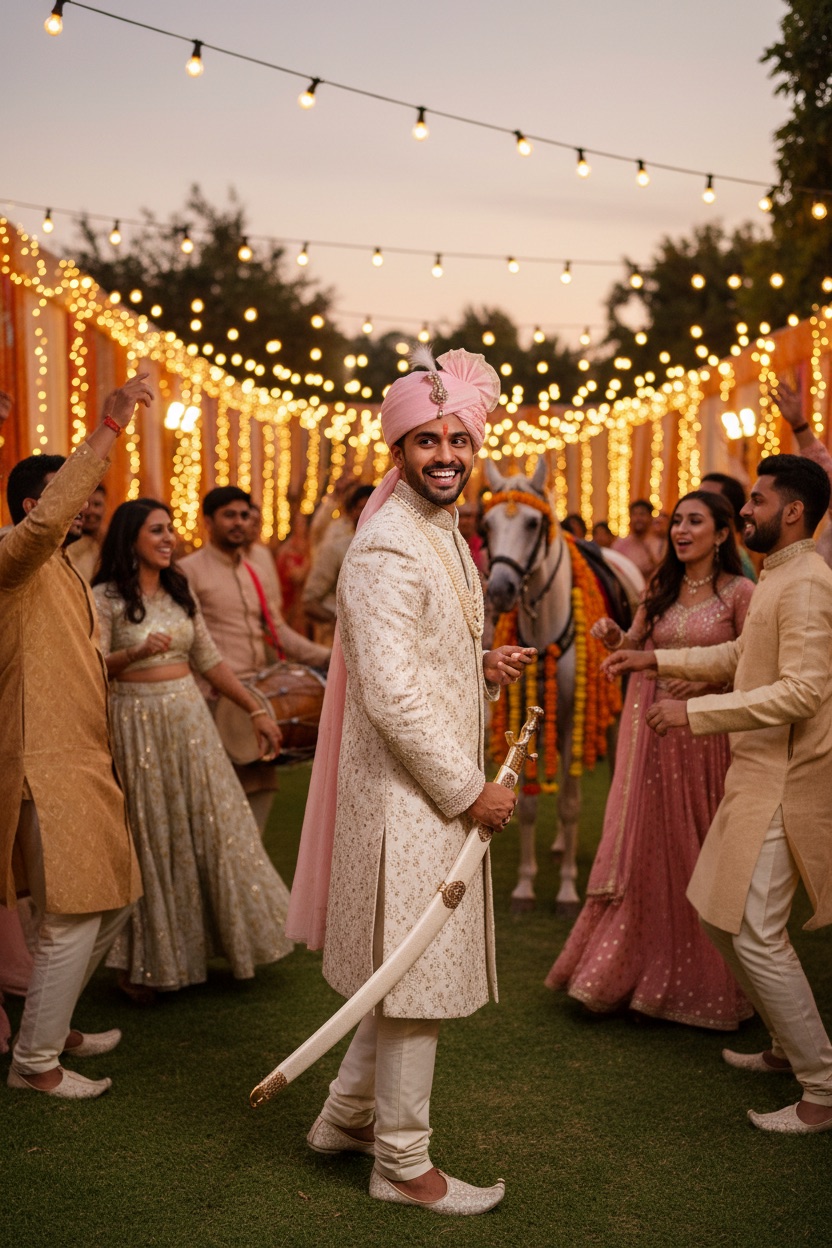
Generated output. For grooms the clause adds "bulk up" as well as "slim". Models change men's builds just as readily. The sword came out held like a walking stick, so if that matters to you, say "sword sheathed at the hip, hands free".
▶ Try this as a fill-in template →
10. The family portrait
The formal group photo, usually taken in a rush between rituals with someone's eyes closed. Arranged properly, everyone's face is lit.
Edit this photo into a formal Indian wedding family portrait: the couple at the centre
in their wedding outfits, surrounded by both sets of parents, two grandmothers and four
siblings. [Keep every face clause]
Arrangement: grandmothers seated on carved chairs either side of the couple, parents
standing behind, siblings at the ends with the youngest cousin sitting at the front —
varied heights so the group forms a shape rather than a straight line.
Setting: in front of a mandap decorated with marigold and white roses.
Lens: 35mm, f/5.6 so every row is sharp.
Lighting: soft even daylight across every face so nobody falls into shadow.
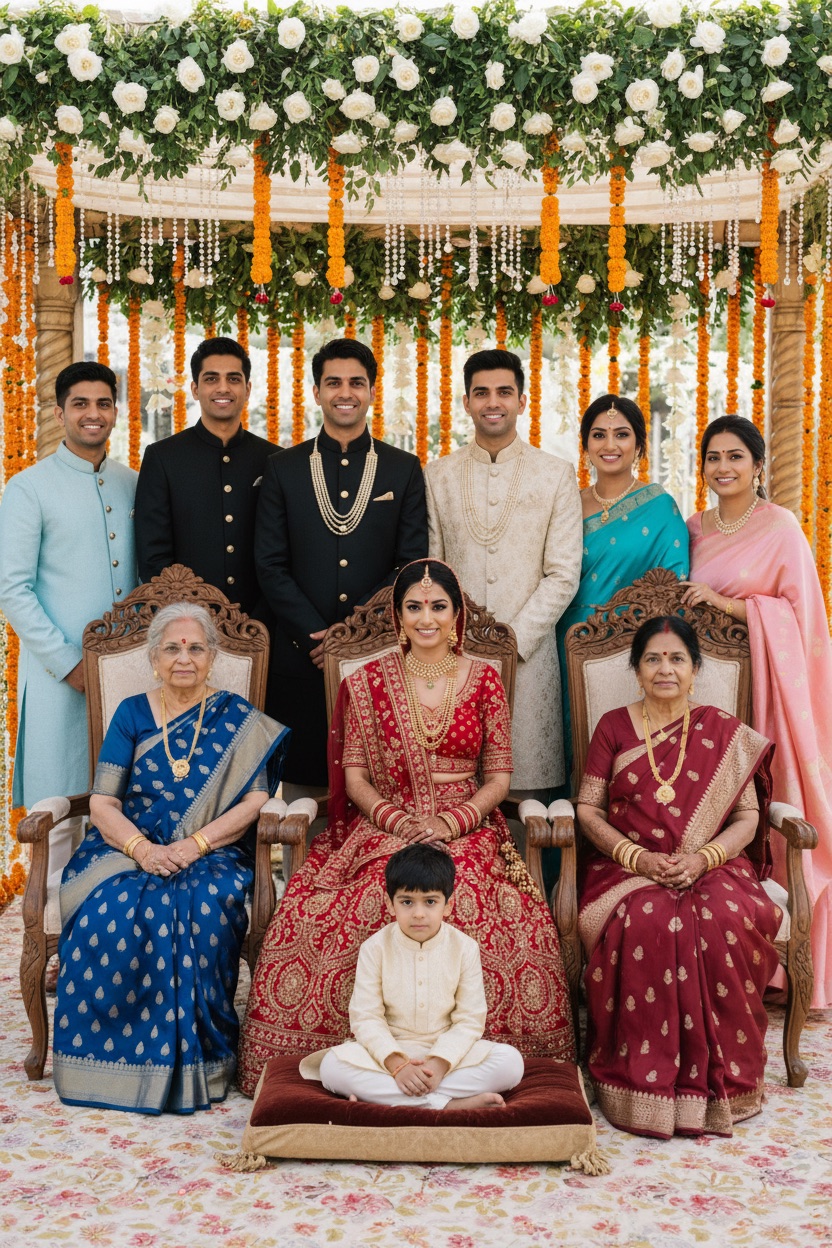
Generated output. f/5.6 rather than the f/1.8 used in the portraits, because in a group photo the back row needs to be sharp too. In this example the model put the groom standing behind the bride rather than next to her. Upload your own family photo and it keeps your arrangement.
▶ Try this as a fill-in template →
Using these during wedding planning
- Outfits first. The sangeet try-on and the lehenga portrait are the two that save money. They show you a colour or silhouette that doesn't suit you before you've paid for it.
- Mehndi design next. Show your artist two or three styles on your own hands. It's quicker than flipping through a design book.
- Then the shot list. Give your photographer the candid haldi, the sangeet dance and the family arrangement as references, so they know what matters to you.
These are previews to help you plan the real wedding photos, not a replacement for them.
All ten templates:
- Candid Haldi — Turmeric Splash
- Haldi Bride Portrait
- Bridal Mehndi Hands
- Mehndi Ceremony Portrait
- Sangeet Outfit Try-On
- Sangeet Dance Performance
- Red Bridal Lehenga Portrait
- South Indian Bride — Kanjeevaram
- Groom at the Baraat
- Indian Wedding Family Portrait
Related:
- Pre-Wedding Shoot Ideas: 8 AI Prompts: palace, backwaters, snow, beach, temple and 90s Bollywood looks
- Browse all Indian wedding prompts
- Diwali and Navratri AI photo editing prompts: festival portraits with the same keep-the-face technique
- Bridal hairstyle try-on: test a wedding hairstyle on your own photo