
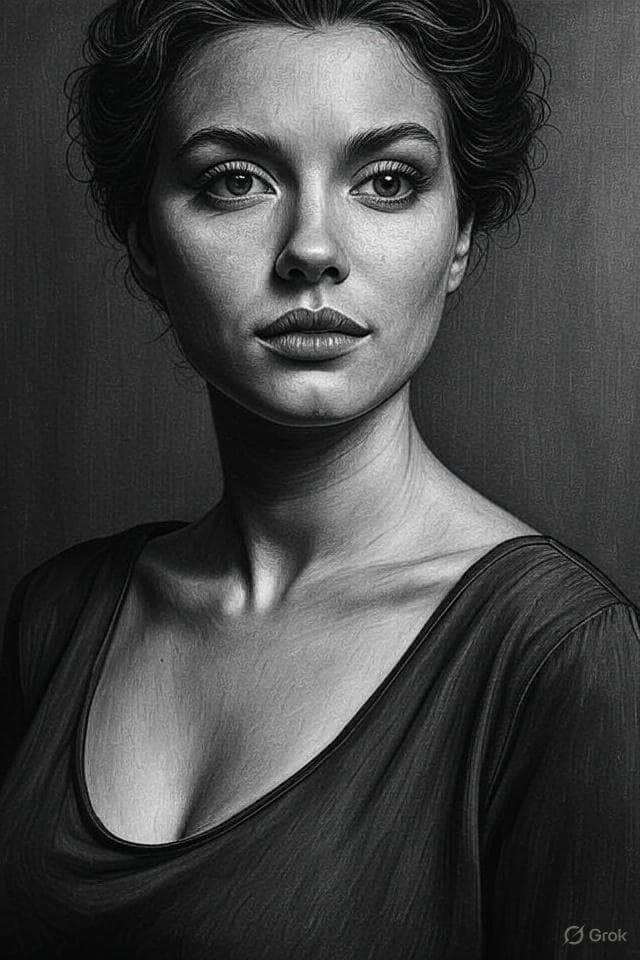
Pencil drawing occupies a special place in art history — it's the medium of preparation, study, and intimate observation. From Leonardo's anatomical sketches to contemporary hyperrealist graphite portraits, drawing with graphite or pencil represents the foundation of visual art mastery. These 15 advanced ChatGPT prompts capture the full range of pencil and graphite aesthetics, from quick gestural sketches to painstaking hyperrealist work.
Understanding Pencil Drawing Visual Language
The Vocabulary of Graphite
Pencil and graphite art has its own rich visual vocabulary. Including these terms in your prompts dramatically improves authenticity:
Mark Types:
- Hatching: Parallel lines creating tone and shadow
- Crosshatching: Perpendicular layers of hatching for deeper shadow
- Contour lines: Lines that follow the form's surface
- Gesture lines: Quick, fluid marks capturing movement and energy
- Stippling: Dots creating tone through density variation
- Scumbling: Circular scribble marks blending into tone
Paper and Surface:
- Hot press paper (smooth, for fine detail)
- Cold press (textured, for expressive work)
- Toned paper (gray or tan midtone base)
- Newsprint (for gesture work — visible in color)
Graphite Types:
- HB to 2B: Harder, lighter, precise
- 4B to 8B: Softer, darker, more expressive
- 9H to 6H: Very hard, barely visible, architectural
- Graphite wash: Dissolved graphite for painterly effects
15 Advanced Pencil Drawing Prompts
1. Hyperrealist Graphite Portrait
Create a hyperrealist graphite pencil portrait drawing of [subject] in the style
of Paul Cadden, Diego Fazio, or Dirk Dzimirsky. Medium: Graphite pencil on
smooth hot-press paper. Technique: Hyperrealist rendering where the image is
indistinguishable from black-and-white photography at first glance. Detail:
Every eyelash individually rendered, skin pores visible, hair strands defined.
Tonal range: Full range from pure white (paper surface) to deepest black (6B
graphite). Shading: Smooth gradient transitions with no visible strokes in skin
areas. Composition: [head and shoulders/close face/three-quarter view].
Background: [simple neutral ground/white paper/subtle environmental context].
Quality: Museum-level graphite mastery. Evidence of technique: visible only
on extreme close inspection.
2. Gesture Drawing — Figure Study
Create a gestural figure drawing in pencil capturing [pose/action — running
dancer/stretching athlete/seated figure]. Style: Rapid gesture drawing capturing
energy and movement, not photographic accuracy. Lines: Confident, flowing marks
showing the body's kinetic energy. Multiple lines: Layered searching lines
where the artist found and confirmed the form. Proportion: Slightly exaggerated
for dynamic effect — elongated limbs, emphasized gesture. Tool: Soft graphite
(4B-6B) or charcoal on [cream/newsprint/toned gray paper]. Time capture: Should
feel like a 30-second to 2-minute gesture study. C-curve and S-curve: Body shows
elegant rhythmic curves. Energy line: Clear line of action running through entire
figure. Background: Minimal or absent, focus entirely on figure.
3. Architectural Sketch — Perspective Drawing
Create a detailed architectural pencil sketch of [building or space] in the
tradition of architectural illustration. Perspective: [one-point/two-point/
three-point perspective] showing the structure's three-dimensional quality.
Lines: Clean, confident architectural linework with ruler-straight major
elements and slightly hand-drawn warmth. Hatching: Shadow areas developed
with neat parallel hatching suggesting depth and surface texture. Details:
[windows/ornament/structural elements] rendered with understanding of
construction logic. Foreground: [trees/people/landscaping] added with looser
sketching style. Medium: Technical pencil (HB to 2H) for structural lines,
softer grades for shadows. Notes: [Optional: handwritten annotations in
architect's script]. Paper: Cream drafting paper implied. Quality: Professional
architectural presentation drawing.
Try our Pencil Portrait Study Generator →
4. Botanical Illustration — Scientific Style
Create a detailed botanical pencil illustration of [plant/flower/botanical subject]
in the tradition of scientific illustration (Audubon, Margaret Mee, or Kew Gardens
illustrators). Accuracy: Botanically accurate representation of every structure —
petals, stamens, leaves, veins, stems. Multiple views: Include [full plant/flower
detail/cross-section/leaf detail] as separate studies on the same composition.
Technique: Clean contour lines defining every element, gentle hatching suggesting
three-dimensional form and surface texture. Labels: [Optional: handwritten species
names and notes in italic script]. Background: White paper, specimen-study aesthetic.
Tone: Minimal shading — scientific illustration prioritizes accuracy and clarity
over atmospheric effect. Medium: Fine liner or hard graphite (H to 2H) for
precise, reproducible rendering.
5. Crosshatching Study — Old Masters Technique
Create a drawing using traditional crosshatching technique in the style of
[Albrecht Dürer/Rembrandt's drawings/Leonardo da Vinci's studies]. Subject:
[portrait/hand study/drapery/figure detail]. Technique: Pure crosshatching —
first layer of parallel lines establishing primary shadow direction, second
perpendicular layer deepening shadow, additional layers for deepest darks.
No blending, no smudging — tone created entirely through line density.
Line quality: Confident, even pressure, parallel lines with slight organic
variation showing hand-drawn quality. Highlights: Pure white paper left for
brightest areas. Medium impression: Pen and ink or fine hard pencil. Tonal
range: Full range achieved through line density alone. Historical quality:
Should resemble a careful old masters drawing study.
6. Urban Sketching — City Scene
Create an urban sketch of [city scene — café, street corner, market, station]
in the spontaneous urban sketching tradition. Style: On-location drawing with
the freshness of a real sketcher capturing a scene. Lines: Confident, slightly
imperfect, showing real-time decision-making rather than planned composition.
Perspective: Slightly imperfect — the organic perspective of direct observation.
Figures: People in motion captured with quick gestural marks, simplified but
readable. Architecture: More carefully rendered than figures, showing structural
understanding. Color wash: [Optional: light watercolor washes over pencil lines].
Details: Selective — some areas lavishly detailed, others barely suggested.
Signature: Small scale, feeling of pages from a travel sketchbook. Artists
reference: Urban Sketchers community aesthetic, Liz Steel, Marc Holmes style.
7. Fashion Design Sketch
Create a fashion design sketch in the elongated, stylized tradition of fashion
illustration. Figure: Fashion croquis proportion — approximately 9-10 heads tall
with elongated legs. Pose: Elegant model pose — [walking/static/dramatic].
Clothing: [design description] rendered with understanding of how fabric falls
and moves. Fabric detail: Sketched to suggest material quality — [silk/denim/
wool/chiffon]. Line quality: Confident, varied weight lines — bold outlines,
light interior details. Shading: Minimal, primarily to suggest volume and
fabric folds. Face: Stylized fashion illustration face — large eyes, simplified
features. Hair: Stylized, fluid marks. Hands and feet: Slightly elongated,
elegant. Background: White or minimal. Medium: Mix of precise pencil outline
and gestural loose lines. Quality: Professional fashion week presentation sketch.
8. Skull and Anatomy Study
Create an anatomical pencil study of [skull/hand/foot/ribcage/muscle group]
in the tradition of fine art anatomy drawing. Style: Leonardo da Vinci or
Vesalius anatomical illustration aesthetic. Accuracy: Anatomically correct
rendering of [structure]. Multiple views: [Front/side/three-quarter/section
view]. Technique: Clean contour lines establishing form, hatching for shadow
and three-dimensional modeling. Labeling: [Optional: handwritten anatomical
terms in italic]. Detail: Complete detail at this magnification — nothing
simplified away. Medium: Hard graphite (H, 2H) for precision. Background:
Cream or white paper, scientific study aesthetic. Context: Shows understanding
of underlying structure as used in figure drawing training. Quality: Medical
illustration or fine arts academy standard.
9. Still Life — Tonal Pencil Study
Create a tonal pencil still life of [objects — glass bottle/ceramic bowl/
fruit/mechanical object]. Technique: Full tonal study exploring the complete
value range. Light source: [Single directional light from left/top/window].
Shadows: Cast shadows carefully rendered, showing understanding of how shadows
behave. Form shadows: Gradual transitions from light to dark on curved surfaces.
Reflected light: Subtle brightness in shadow areas nearest to ground plane.
Texture: Surface texture of each object rendered differently — [smooth glass,
rough ceramic, soft fabric]. Highlights: Pure white paper preserved or lifted
with eraser. Background: Graduated tone suggesting three-dimensional space.
Composition: [Classic triangular arrangement/linear arrangement]. Quality:
Academy-level observational drawing study.
10. Comic/Manga Pencil Art
Create a comic book or manga-style pencil drawing (pre-ink stage) of [scene
or character]. Style: [American superhero pencils/manga storyboard/graphic
novel rough]. Line quality: Confident comic art lines — varying weight from
thick outlines to fine interior detail lines. Hatching: Standard comic crosshatch
for shadow areas. Character: [Description] in dynamic [action/emotional moment].
Background: [Detailed environmental context/simple suggested setting/action
environment]. Panel composition: [Full page/dramatic close-up/establishing wide
shot]. Energy lines: Speed lines, impact stars, and motion effects appropriate
to comic style. Expression: Clear, readable emotional expression. Medium: Blue
pencil underdrawing with graphite finish lines visible. Quality: Professional
comic book pencils ready for inking.
11. Landscape — Tonal Graphite
Create a tonal graphite landscape of [scene — mountains, forest, coastal cliffs,
rolling farmland]. Technique: Pure graphite tonal work — no outlines, only
tonal masses. Atmosphere: Aerial perspective — elements become lighter and less
detailed with distance. Foreground: Darkest, most detailed — individual textures
of [rock/grass/bark] rendered. Midground: Medium tone, slightly less detail.
Background: Light and atmospheric, details dissolved into suggestion. Sky: [Clear
with tone gradation/atmospheric clouds/dramatic storm sky]. Light source: [Specific
directional light] creating clear light and shadow pattern. Medium: Range of
graphite grades — hard grades for distances, soft for foreground shadows.
Blending: Smooth tonal transitions in distance, more textural foreground marks.
Quality: Fine art landscape drawing with expressive use of graphite's full range.
12. Portrait Sketch — Quick Study
Create a portrait sketch in the style of a quick, observational study. Subject:
[person description]. Time feel: Should appear completed in 20-30 minutes from
observation. Lines: Searching, layered — the marks of an artist finding the
form. Not every area equally finished — eyes and focal point most resolved.
Proportional notes: May include construction lines or measurement marks.
Medium: Soft pencil (2B-4B) on cream or white paper. Eraser marks: [Optional:
visible eraser corrections suggesting the working process]. Hair: Quick, gestural
marks rather than each strand. Clothing: Suggested with minimal marks.
Background: Absent or barely indicated. Quality: The beauty of direct observation
and honest mark-making. Reference: Quick portraits by John Singer Sargent or
Käthe Kollwitz sketch aesthetic.
13. Texture Study — Materials in Graphite
Create a graphite texture study demonstrating multiple different material
textures side by side: [select 4-6: wood grain, fabric weave, rough stone,
smooth metal, hair, bark, water surface, fur, glass, rusted metal]. Each
texture: Clearly labeled [if desired] and rendered with the specific technique
most appropriate to that material. Technique variety: Show different approaches —
hatching for fabric, smooth blending for glass, broken texture marks for stone,
flowing parallel lines for wood grain. Page composition: Organized sampling
of techniques like a study page from an artist's sketchbook. Quality: Each
texture convincingly realistic and technically exemplary.
14. Portrait with Toned Paper
Create a pencil and white chalk drawing on toned paper of [subject]. Paper:
Warm gray or tan toned paper providing the midtone. Dark marks: Graphite or
dark pencil building shadows. Light marks: White chalk or white charcoal
pencil building highlights from the middle tone. Technique: Three-value
system — darks from graphite, midtone from paper color, lights from chalk.
Subject: [Portrait/figure/still life]. Detail: Full range of marks from
broad tonal masses to fine detail lines. Paper texture: Visible in less-worked
areas, smooth in blended passages. Composition: [Standard portrait framing].
Style: Traditional academic technique of drawing on toned paper — Renaissance
and Baroque drawing tradition. Examples: Bernardino Luini, Hans Holbein the
Younger portrait studies.
15. Experimental — Graphite Wash
Create an experimental graphite wash drawing of [subject]. Technique: Dissolved
graphite applied with water and brushes creating watercolor-like washes, combined
with dry graphite pencil marks. Wash passages: Atmospheric, fluid areas of
dissolved graphite — dark washes for shadows, lighter for atmosphere. Pencil
marks: Added over washes for definition and detail. Layering: Alternating
wash and dry mark application creating complexity. Medium texture: Mixed —
fluid wash areas, scratchy dry graphite, soft blending. Subject: [Landscape/
figure/portrait/experimental abstract]. Approach: Expressive, process-visible,
showing the artist's exploration. Reference: Turner's graphite and wash studies,
Andrew Wyeth's wash drawings. Quality: Sophisticated experimental drawing that
shows full command of both wet and dry graphite techniques.
Technical Tips for Pencil Drawing Prompts
Getting the Paper Texture Right
Always specify paper type to influence the texture:
- White smooth: "hot press paper, no visible tooth"
- Textured: "cold press or rough paper, visible paper grain in lighter areas"
- Toned: "warm gray Canson Mi-Teintes paper" or "sepia toned sketch paper"
Specifying Pencil Grades
The H/B grade system signals radically different aesthetics:
- Architecture: "technical pencil HB to 2H, precise even pressure"
- Expressive work: "6B-8B graphite, varied pressure, rich blacks"
- Academic portrait: "full range HB to 6B, delicate gradation"
Related Resources
- Pencil Portrait Study Generator — Generate detailed graphite portrait studies
- ChatGPT Fantasy Art Prompts — Apply drawing techniques to fantasy subjects
- Best ChatGPT Photography Prompts — How photography and drawing share compositional principles
Conclusion
Pencil drawing prompts reward specificity about technique. The difference between "pencil drawing" and "hyperrealist graphite on hot press paper, 6B graphite in darks, paper white preserved for highlights, visible hatching in shadow areas" is the difference between a vague result and a convincing simulation of a specific drawing tradition.
Use these 15 templates as starting points, then customize the technique vocabulary to match your specific artistic interest. Whether you're pursuing photorealistic hyperrealism or expressive gestural work, the right technical vocabulary will dramatically improve your results.