
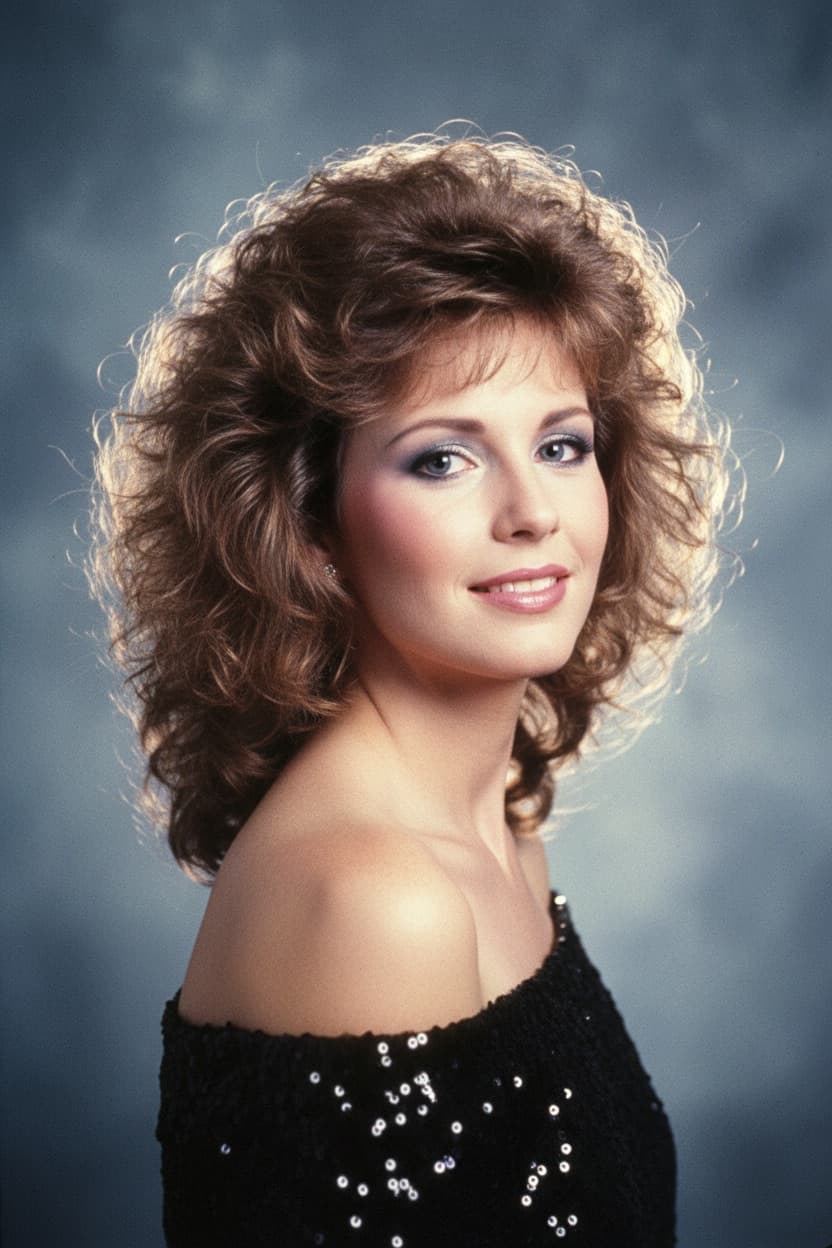
The 80s flashback trend is having its moment again, and most of the results people post are not actually 80s photos. They are modern photos of someone wearing 80s hair.
That gap is the whole article. There is one specific thing that separates a picture that reads as 1987 from one that reads as a themed party last weekend, and it is not the hair, the shoulder pads or the eyeshadow. Get it right and the decade appears almost on its own.
The searches back this up, incidentally: 80s photoshoot and 80s photo each run about 1,900 a month, 80s glamour shot 1,600, 80s prom photo 1,300 — and the fastest-growing variants attached to all of them are awkward, corny and cheesy. People are not looking for a tasteful retro edit. They want the specific, sincere, slightly ridiculous thing their parents have framed in a hallway.
The thing that actually signals the decade
It is the lighting.
Every era of photography has a lighting signature, because every era had different equipment and different conventions about what a good picture looked like. The 1980s had two dominant ones, and almost every photograph you remember from the decade is running one of them.
The studio look: a soft key through heavy diffusion, generous fill so that no shadow ever lands hard on the face, and a strong hair light raking from behind that draws a bright halo around the edges of the hair. Faces come out open and creamy with no modelling at all. This is the glamour shot, the yearbook portrait, the department-store family session.
The snapshot look: a bare on-camera flash as the only real light in the room. The face is bright and flat, there is a crisp shadow thrown low and close behind the shoulder, the whites blow out where the flash lands hardest, and the corners of the frame fall away into total darkness because nothing else is lit. This is the prom photo, the party picture, the holiday snapshot.
Ask for "an 80s look" and you get neither. You get contemporary soft-box lighting on a person in a costume. Name one of those two setups in a sentence and the image changes character completely.
Three things support it:
Name the film, never the word "vintage." "Vintage" is a dead word to an image model — it fetches sepia, torn edges and fake dust. What you want is the behaviour of colour negative film: warm and slightly magenta midtones, blacks lifted a little rather than crushed to true black, mild contrast, and visible fine grain. Describe that and you get a photograph. Ask for "vintage" and you get a filter.
Say what must not change. A restyle request is read as permission to redraw the face, and you will get a stranger with your haircut. Every prompt below names the parts that stay fixed — bone structure, eye shape and spacing, nose, jawline, mouth, any distinguishing marks, and skin tone — and states that only hair, wardrobe, lighting and background may move.
Keep lettering out of it. Yearbook pages have names on them, prom backdrops have banners. Image models still garble small text, and a misspelled word in the corner is the fastest way to make an otherwise convincing photograph look generated. None of these prompts asks for a single word of text, and every negative prompt bars it.
1. The 80s glamour shot
The mall studio portrait — soft focus, enormous hair, shoulder bared, backdrop the colour of a swimming pool. This is the centre of the trend.
Restyle the person in this photo as a 1987 shopping-mall glamour
shot portrait, the kind taken in a department store studio.

Preserve facial identity exactly: keep the bone structure, eye shape
and spacing, nose, jawline, mouth and any distinguishing marks
recognisably the same person, and keep the skin tone exactly as it
appears in the photo. Change only hair, wardrobe, makeup, lighting
and background.

Hair: voluminous feathered and teased, curled back from the face,
lacquered so it holds its shape and catches the rim light.
Wardrobe: an off-the-shoulder black sequinned top.
Makeup: frosted pink lipstick, heavy peach blush swept high on the
cheekbone, blue-grey shimmer on the eyelid.

Lighting: a soft key from the upper left through heavy diffusion, a
strong warm rim light raking the hair from behind so the edges glow,
and enough fill that shadows stay open and creamy — no hard shadow
anywhere on the face.
Background: a mottled blue-grey painted canvas studio backdrop,
thrown well out of focus.
Optics: a medium telephoto portrait lens with a soft-focus filter
over it, so highlights bloom and spread into a gentle halo and fine
skin texture melts away.
Film character: warm Kodak Gold — slightly magenta in the midtones,
a faint hazy lift in the blacks, visible fine grain.
Pose: a closed-lip smile, shoulders turned away from camera, chin
lifted and angled back toward the lens.

Framing: vertical head-and-shoulders portrait, subject slightly
off-centre with room above the hair.
Quality: authentic 1980s studio portrait, sincere rather than
parodic, printed on glossy paper.

Negative: modern smartphone photo, contemporary clothing, HDR,
clinical digital sharpness, hard shadows, different person, altered
facial identity, changed skin tone, brand logos, lettering,
watermark, low quality.
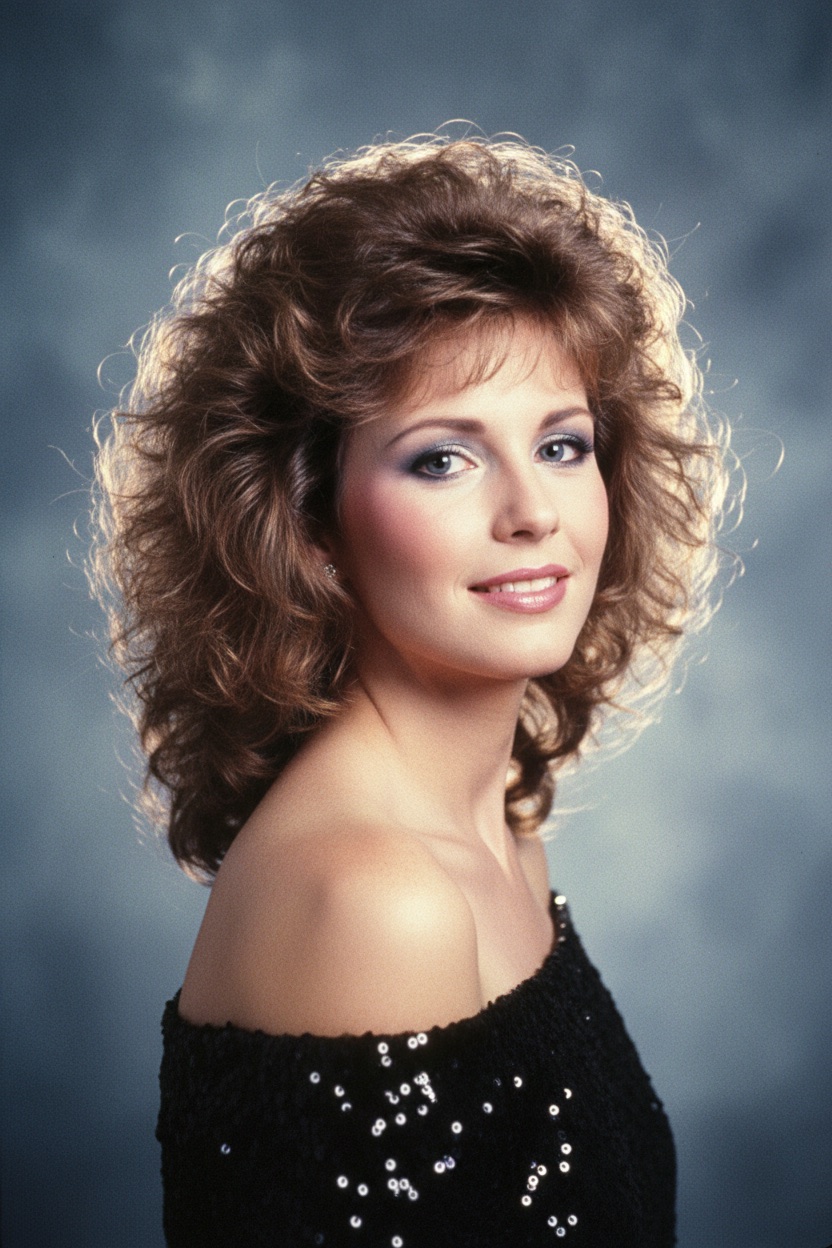
Generated output. The soft-focus filter is doing most of the work — look at how the highlights on the hair bleed outward instead of stopping at an edge. That bloom is a physical property of a diffusion filter in front of a lens, and no amount of "dreamy" or "ethereal" in a prompt will produce it. Naming the filter will.
▶ Try this as a fill-in template →
The word doing the heaviest lifting in this prompt is "sincere." Glamour shots are funny now, and if you do not say otherwise the model will lean into the joke and hand you something knowing and camp. The original photographs were made completely straight, by photographers who thought they were flattering, for customers who framed them. Ask for the straight version and it lands far harder than a parody would.
2. The 80s yearbook photo
Mottled backdrop, three-quarter turn, collar worn outside the sweater vest. The most recognisable photograph format of the decade.
Restyle the person in this photo as a senior class portrait from a
1987 high school yearbook.

Preserve facial identity exactly: bone structure, eye shape and
spacing, nose, jawline, mouth and any distinguishing marks stay
recognisably the same person, and the skin tone stays exactly as it
appears in the photo. Age the face to roughly seventeen if it is not
already there, changing only apparent age and never identity. Change
only hair, wardrobe, lighting and background.

Hair: feathered back from a centre part and blow-dried into wings at
the temples, falling to the collar.
Wardrobe: a grey marl sweater vest over a pale blue button-down
shirt with a wide pointed collar worn outside the vest.
Background: a mottled blue and grey painted canvas studio backdrop.

Lighting: a single soft studio key from the upper left with a broad
fill card on the right, a subtle hair light separating the head from
the background, and a gentle falloff that darkens the lower corners
of the frame.
Pose: body turned three-quarters away from camera with the head
rotated back toward the lens, shoulders squared, hands out of frame,
a small closed-lip smile.
Optics: medium-format studio portrait lens, moderate depth of field
so the ears stay sharp and the backdrop goes soft.
Film character: warm Kodak Gold, slightly warm skin tones, mild
contrast, visible fine grain, printed small on semi-gloss yearbook
stock so the detail is a touch soft.

Framing: vertical head-and-shoulders portrait, cropped just below
the collarbone, generous headroom.
Quality: an earnest, unironic 1980s school photograph.

Negative: modern smartphone photo, contemporary clothing, HDR,
clinical digital sharpness, different person, altered facial
identity, changed skin tone, brand logos, school crest, lettering,
captions, watermark, low quality.
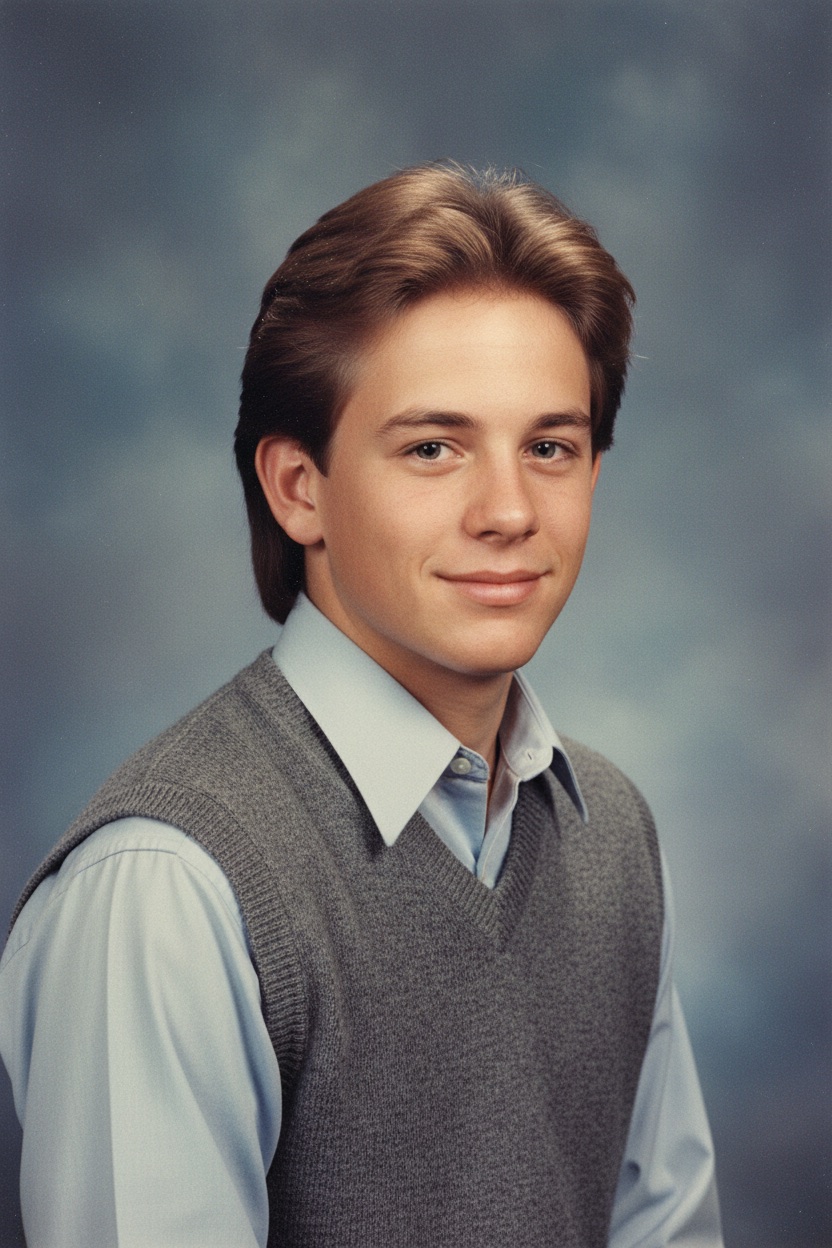
Generated output. Note the collar worn outside the vest — a small, era-specific wardrobe detail that does more period work than the haircut. The three-quarter body turn with the head rotated back is the other one; it was the standard school-portrait pose for two decades and reads instantly.
▶ Try this as a fill-in template →
The instruction to print it "small on semi-gloss yearbook stock" is not decoration. It tells the model the final image is a reproduction rather than a pristine file, and it softens the micro-detail by exactly the right amount. Ask for a sharp studio portrait and you get something that looks scanned at 4000 dpi from a negative nobody ever had.
3. The 80s prom photo
Balloon arch, taffeta, a hard flash and a wall of darkness behind. This is the snapshot lighting signature in its purest form.
Restyle the person in this photo as a prom night portrait taken in a
school gymnasium in 1985.

Preserve facial identity exactly: bone structure, eye shape and
spacing, nose, jawline, mouth and any distinguishing marks stay
recognisably the same person, and the skin tone stays exactly as it
appears in the photo. Change only hair, wardrobe, pose, lighting and
background.

Hair: teased high at the crown and curled into loose ringlets at the
shoulders, held with a wide satin bow.
Wardrobe: a powder-blue taffeta gown with enormous puffed sleeves, a
fitted dropped waist and a full gathered skirt.
Accessories: a white wrist corsage of carnations and a thin gold
chain.
Background: an arch of pastel balloons, standing a few feet behind
the subject so it falls off into shadow at the edges of the frame.

Lighting: a hard direct on-camera flash as the only real light —
bright and flat on the face, a crisp shadow thrown low and close
behind the shoulder, hot specular highlights on satin and skin, and
the corners of the frame dropping quickly into darkness because
nothing else in the room is lit.
Pose: one hand resting on the opposite forearm, a wide closed-lip
smile, standing, weight on one hip, slightly stiff and posed for the
photographer rather than caught naturally.
Film character: consumer colour negative pushed a stop, warm and a
little green in the shadows, noticeable grain, the whites slightly
blown where the flash hits hardest.

Framing: vertical three-quarter-length portrait from mid-thigh up.
Quality: an authentic amateur-feeling 1980s prom photograph, sincere
rather than parodic.

Negative: modern smartphone photo, contemporary clothing, soft even
studio lighting, HDR, clinical digital sharpness, different person,
altered facial identity, changed skin tone, brand logos, lettering,
banners, captions, watermark, low quality.
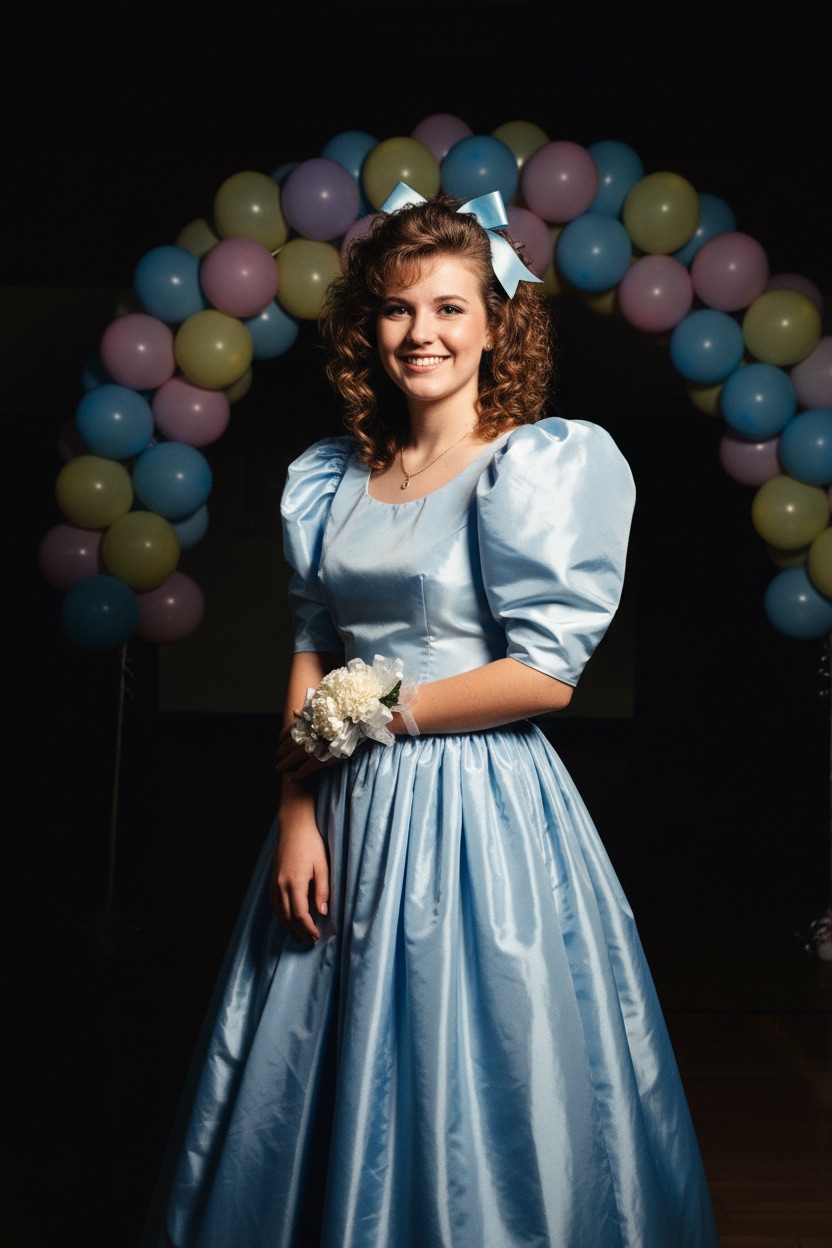
Generated output. The black corners are the point. A modern photographer would light the room; a parent with a point-and-shoot in 1985 lit a cone about eight feet deep and let everything past it disappear. Asking for "the corners of the frame dropping quickly into darkness because nothing else in the room is lit" gives you the period and the amateur hand in one clause.
▶ Try this as a fill-in template →
This one has an easy swap for a second subject: change the wardrobe line to "a powder-blue tuxedo with a ruffled shirt front and velvet bow tie" and run it on a different photo. Two separate generations side by side hold up better than asking for a couple in one pass, because the model handles one face far more reliably than two.
4. The awkward 80s family photoshoot
Matching knitwear, heads stacked on a diagonal, laser starbursts. The most requested version of the trend, and the only one here built for a group photo.
Restyle the people in this photo as a department-store family
portrait taken in 1986, in the cheerfully awkward style those
studios were famous for.

Preserve every face exactly: for each person keep the bone
structure, eye shape and spacing, nose, jawline and mouth
recognisably the same, and keep each person's skin tone exactly as
it appears in the photo. Keep the same number of people as the
original photo and do not add anyone. Change only hair, wardrobe,
arrangement, lighting and background.

Wardrobe: matching chunky knit turtleneck sweaters — coordinated
across the whole group so they visibly match, in cream, rust and
forest green.
Hair: feathered and blow-dried on every one of them, styled with
obvious effort.
Arrangement: stacked on a diagonal leaning inward — heads
deliberately staggered at different heights, everyone leaning in
toward the centre, each person resting a hand on the shoulder of the
one in front.
Expressions: wide committed smiles, held a beat too long.
Background: a black studio backdrop with soft coloured laser
starbursts fanning out behind them.

Lighting: an even two-light studio setup, soft key and near-equal
fill, almost no shadow on any face, plus a hair light that separates
every head cleanly from the background.
Optics: medium telephoto studio lens with enough depth of field that
every face stays sharp.
Film character: warm colour negative with slightly amber midtones,
mild contrast and visible fine grain.

Framing: vertical group portrait, cropped at the waist, everyone
comfortably inside the frame.
Quality: an earnest 1980s studio family photograph, affectionate
rather than mocking.

Negative: modern smartphone photo, contemporary clothing, candid
snapshot, HDR, extra people, missing people, different person,
altered facial identity, changed skin tone, brand logos, lettering,
captions, watermark, low quality.
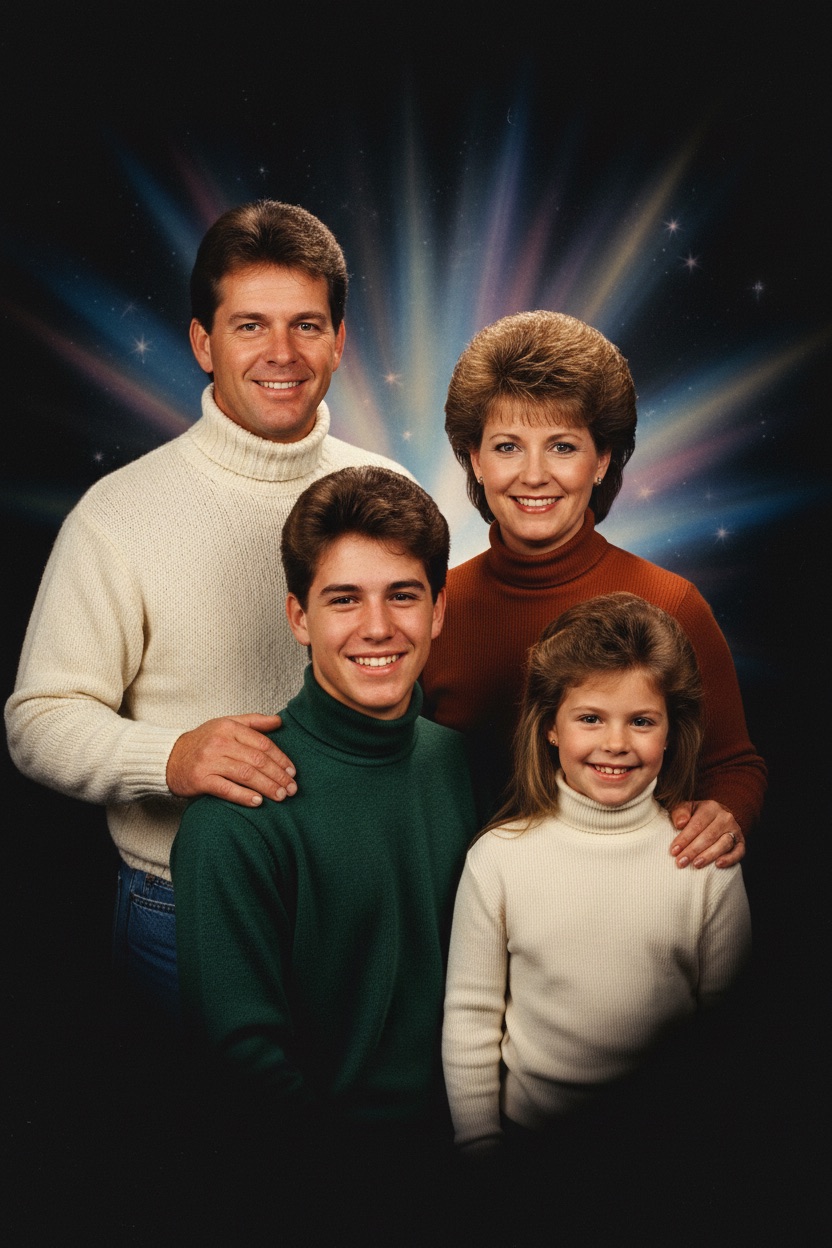
Generated output. "Held a beat too long" is the instruction that produces the specific quality of those smiles — committed, slightly fixed, a fraction past comfortable. Asking simply for "awkward smiles" gets you grimaces, which is a different and much less funny thing.
▶ Try this as a fill-in template →
Two lines here exist purely as guardrails. "Keep the same number of people as the original photo and do not add anyone" is there because image models are genuinely bad at counting figures and will cheerfully add a fifth family member if the arrangement is described loosely. And "affectionate rather than mocking" keeps the result on the right side of a line that matters when the subjects are your actual family — the joke should be the era, not the people in it.
5. The synthwave album cover
The other 80s — not the one that was photographed, but the one the decade imagined it was. Neon rim light, chrome grid, a sun sitting on the horizon.
Restyle the person in this photo as a synthwave portrait set against
an 80s retro-futuristic horizon.

Preserve facial identity exactly: bone structure, eye shape and
spacing, nose, jawline, mouth and any distinguishing marks stay
recognisably the same person, and keep the underlying skin tone as
it appears in the photo, letting the coloured light fall across it
rather than repainting it. Change only wardrobe, lighting, colour
and background.

Wardrobe: a black leather bomber jacket with the collar turned up.

Lighting: two hard coloured rim lights and almost no frontal fill —
hot magenta from the left and electric cyan from the right — raking
the face from behind on both sides so the jawline, cheekbone and
shoulders are drawn in glowing edges while the centre of the face
falls into cool shadow.
Background: an infinite neon grid horizon under a low amber sun,
deep in the frame and well out of focus.
Atmosphere: heavy haze catching the light so every beam is visible
as a soft volumetric shaft, with slow drifting dust motes moving
through it.
Colour grading: crushed blacks lifted just slightly toward navy,
saturated magenta and cyan in the highlights, a warm amber core
where the sun sits on the horizon.
Optics: anamorphic lens character with horizontal flare streaks
pulling off the brightest highlights, shallow depth of field, oval
bokeh.
Pose: chin level, looking directly down the lens, jaw set, shot from
slightly below eye level.

Framing: vertical head-and-shoulders portrait.
Quality: high-resolution cinematic portrait in the style of an 80s
synthwave album cover, crisp edges against soft haze.

Negative: daylight, flat even lighting, natural colour grading,
washed-out colour, different person, altered facial identity,
repainted skin tone, brand logos, lettering, captions, watermark,
low quality.
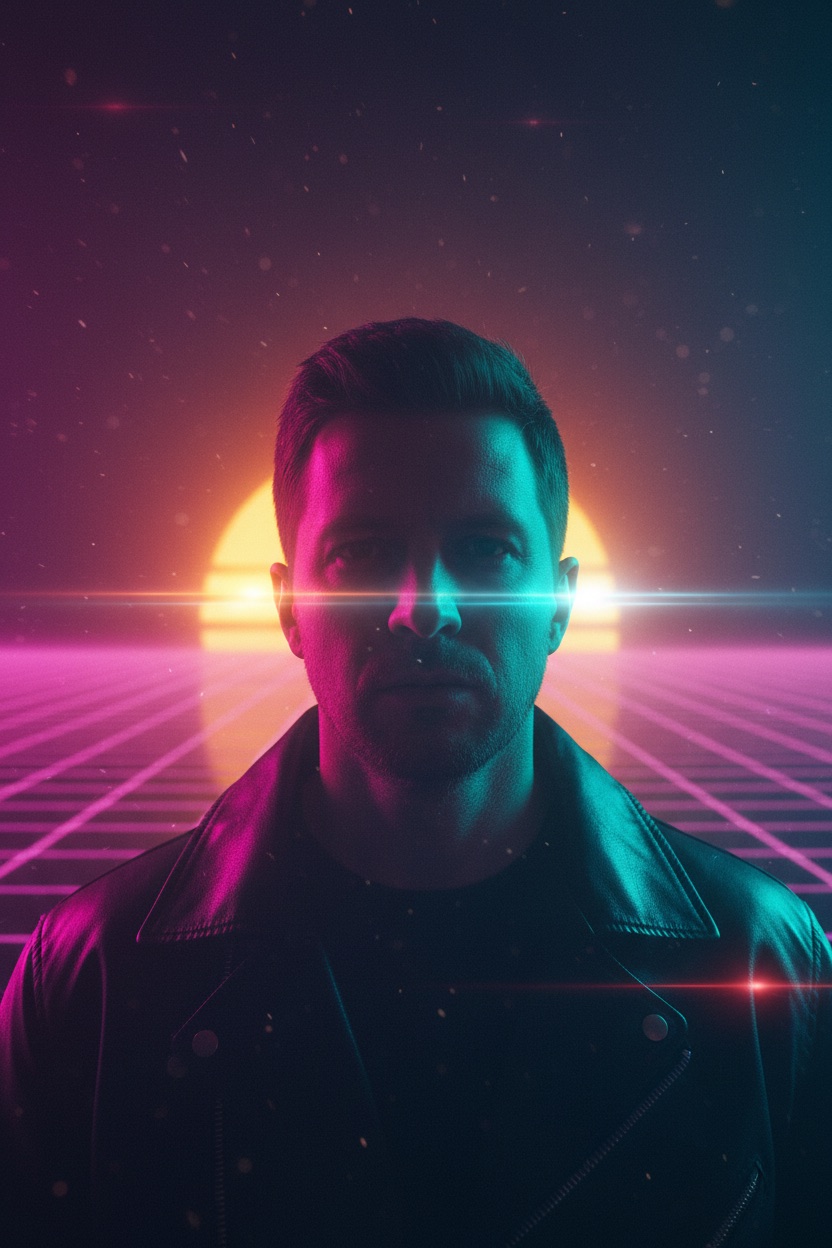
Generated output. The clause that keeps this from turning into a poster of someone else is "letting the coloured light fall across it rather than repainting it." Without it the model reads "magenta and cyan" as instructions about skin, and hands back a purple face — technically on-brief, unrecognisably not you.
▶ Try this as a fill-in template →
Worth knowing that synthwave alone runs around 14,800 searches a month and has done, almost perfectly flat, for over a year. Unlike the glamour shot and the yearbook photo — which surge whenever the trend comes round again and then subside — this one is not a trend at all. It is a permanent aesthetic that happens to be set in the 80s.
Which one to use
| If you have | Use | Why |
|---|---|---|
| A single clear headshot | Glamour shot | The highest hit rate of the five, and the most recognisable |
| A photo of a teenager, or you want to look like one | Yearbook | The age instruction is built in |
| A full-length or half-length photo | Prom photo | It is framed from mid-thigh up and needs the body |
| A group or family photo | Awkward family portrait | The only one of the five designed for multiple faces |
| Any photo, and you want something to actually hang up | Synthwave | It is the one that survives being printed large |
What goes wrong
You gave it a bad source photo. Everything else on this page is downstream of this. The model preserves what it can resolve, so a sharp, evenly lit, front-facing photo where your face fills a decent part of the frame will come back as you. A dim three-quarter shot from across a room will come back as somebody else entirely, and no amount of identity-preservation language will save it.
You asked for "80s" and nothing else. The decade contained the mall studio, the school gym, the synthwave record sleeve and the fashion magazine, and these look nothing like each other. Naming which one is most of the work.
You let it put words in the picture. Adding "Class of 1987" to the yearbook prompt is very tempting and almost always ruins it. Text rendering is still the weakest part of these models at small sizes, and one misspelled word undoes an otherwise flawless photograph.
You fought an unwanted object by banning it harder. If something keeps appearing that you do not want, adding a stronger prohibition usually makes it more prominent, not less — negation tends to fixate the model on exactly the thing you named. Change the scene instead. Swap the backdrop, swap the wardrobe, describe positively what should be there.
You iterated instead of writing it out. Free-tier image generation is rate-limited, so five follow-up corrections will exhaust your allowance before you reach a good picture. These prompts are long on purpose. Paste the whole thing, attach the photo, and you will usually keep the first result.
All five are available as fill-in templates with every variable swappable — hair, wardrobe, backdrop, film stock, pose:
- 80s Glamour Shot Portrait
- 80s Yearbook Photo
- 80s Prom Photo
- Awkward 80s Family Photoshoot
- Synthwave Neon 80s Portrait
Or browse the full Retro 80s collection.
If you want your photo sharpened before you restyle it — which materially improves how well the model holds your likeness — start with the 4K photo enhancement prompts and run the 80s prompt on the cleaned-up result. If you want more on holding a likeness through an edit, the face-safe editing guide covers the preserve clauses in depth.