
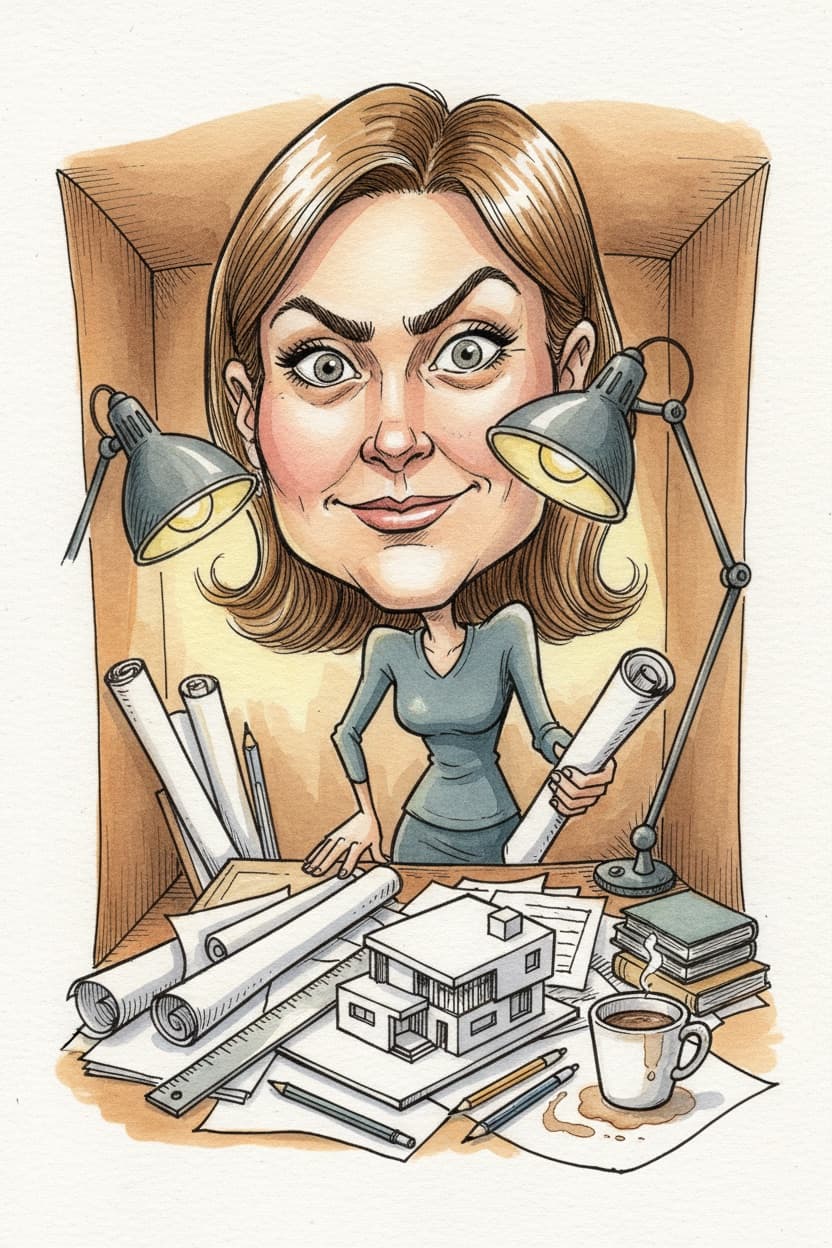
Six of the fifteen fastest-rising Google searches attached to "chatgpt prompt" right now are caricature queries. chatgpt caricature prompt is running about 5,400 searches a month, caricature trend about 6,600, and create a caricature of me about 2,900 — all of them roughly ten times what they were three months ago.
This is the second wave. The trend peaked enormously in February, collapsed by June, and has come back. Which means most of the advice written about it is six months old and was written in a hurry.
The gap in almost all of it is the same: everyone publishes the seven-word viral prompt and nobody explains why the picture that comes back looks like a polite illustrated portrait rather than a caricature. That is the actual problem, it has a specific cause, and it is fixable in one sentence.
How to do the ChatGPT caricature trend
Four steps, and only one of them is interesting.
Attach a clear, close-up photo of your face. Not a full-body shot, not a group photo you plan to crop mentally, not a picture where you are wearing sunglasses. The model is working from what it can actually resolve, and a face that occupies a tenth of the frame gives it almost nothing to exaggerate.
Send the prompt. The viral one is "Create a caricature of me based on everything you know about me," usually posted in the longer form "Create a caricature of me and my job based on everything you know about me."
Understand what that prompt is actually doing. It is not a drawing instruction. It is a memory dump rendered as a picture. Everything specific and uncanny about the good results — the exact messy desk, the running joke about your coffee, the hobby you mentioned once in March — comes out of your stored chat history, not out of your photo. This is why the same prompt produces something eerily personal for one person and a generic stock cartoon for another. If your account is new, or you have memory switched off, the prompt has nothing to read and it will invent filler.
Then fix the exaggeration, which is the step nobody mentions. Asked plainly for a caricature, the model produces a flattering portrait illustration with the proportions barely moved, because being nice to you is the default. You have to name the exaggeration: how much bigger the head is, that the body and hands shrink to match, and — the one that does the most work — that it should find the single most distinctive feature in your face and push that hard while simplifying everything else down to support it.
That last instruction is the whole craft of caricature, compressed. A caricaturist does not exaggerate everything a bit. They find the one thing the face is about and commit to it. Put that sentence in your prompt and the output changes completely.
Every template below has it built in.
Create a caricature of me and my job
The trend proper: you, exaggerated, buried in the tools of your actual work.
Turn the person in this photo into a caricature illustration of
themselves at work.

Exaggeration: this must be unmistakably a caricature and not a
flattering portrait illustration. Find the one feature my face is
actually about — the strongest, most distinctive thing in it — and
push that hard, then simplify everything else down to support it.
Enlarge the head relative to the body to roughly half again as
large as realistic, shrink the body and hands accordingly, amplify
the expression I am already making rather than inventing a new one,
and exaggerate my posture into hunched forward in concentration.

Exaggerate only expression, proportion and posture. Do not alter or
exaggerate ethnic features, and keep my skin tone exactly as it
appears in the photo. Preserve my facial identity: keep the bone
structure, the eye shape and spacing, the nose bridge, the hairline
and the mouth recognisably mine, so that someone who knows me
identifies me immediately.

Job: architect.
Props: rolled blueprints spilling off the desk, a scale ruler, a
half-built foam model, three mechanical pencils and a cold mug of
coffee — objects rendered with actual weight and material, sitting
where they would really sit, some worn or half-used rather than
showroom-new.
Setting: a cluttered studio desk under a drafting lamp, drawn
slightly warped with playful perspective so the room bends toward me.
Expression: absorbed, one eyebrow raised, a faint smile at the corner
of the mouth.
Art style: hand-drawn ink and watercolour caricature, confident
varied line weight — heavier on the contour and the shadow side,
lighter inside the form — flat shading rather than airbrushed
gradients.
Colors: warm ochre, slate blue and paper cream.
Composition: me large and central, the job evidence fanning out
around and behind me, one clear focal object in my hands.

Negative: racial or ethnic feature exaggeration, altered skin tone,
different person, unrecognisable face, real person likeness,
trademarked characters, brand logos, demeaning or mocking depiction,
distorted hands, extra fingers, watermark, text, low quality.
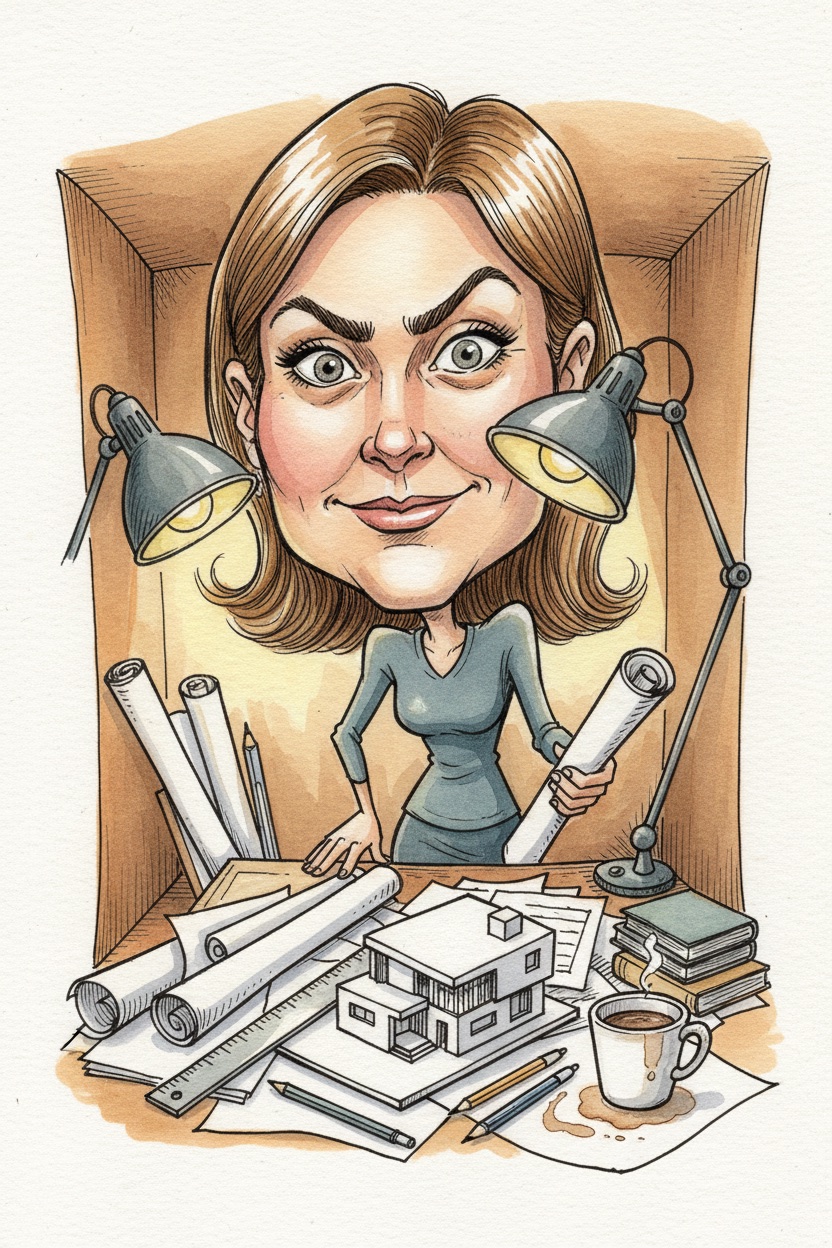
Generated output. Note what the props are doing: the blueprints are unrolled and overlapping, the coffee has left a ring on the paper, the pencils are scattered rather than lined up. Asking for "some of them worn or half-used rather than showroom-new" is what stops a work scene reading like a product catalogue.
▶ Try this as a fill-in template →
The mistake people make here is naming a job title and stopping. "Software engineer" gets you a laptop. What you want is the specific debris of your particular version of that job — the third monitor, the mechanical keyboard, the sticker-covered water bottle. Job titles are generic; job clutter is personal, and the clutter is what makes people recognise you in it.
Turn a photo into a caricature
For when you want the conversion itself, with the exaggeration dialled precisely — subtle enough for a work profile picture, or pushed all the way to a seaside sketch.
Convert the person in this photo into a caricature.

Exaggeration level: moderate — clearly a caricature but still
comfortably recognisable.
Push these specific features: a strong jaw pushed wider, expressive
eyebrows raised higher than life, a warm smile stretched wider than
realistic. Find what is already distinctive about this face and
amplify that, rather than applying a generic cartoon template.

Exaggerate only proportion, expression and posture. Do not alter or
exaggerate ethnic features, and keep the skin tone exactly as it is
in the photo. Preserve facial identity completely: bone structure,
eye shape and spacing, nose bridge, hairline, mouth shape and any
distinguishing marks stay recognisably the same person. Keep the
same head angle and gaze direction as the original photo.

Medium: pen and ink with a watercolour wash, line weight varying
deliberately — heaviest along the jaw and the shadow side of the
nose, lightest across the forehead and the cheek — shading built
from flat shapes rather than smooth gradients.
Background: plain warm cream paper with a loose wash behind the head.
Colors: warm skin tones, navy and cream.

Render the face with real structure underneath the exaggeration: the
skull still has to make sense, the eyes still have to sit in sockets,
the smile still has to attach to the cheek muscles.

Negative: racial or ethnic feature exaggeration, altered skin tone,
different person, generic cartoon face, real person likeness,
trademarked characters, brand logos, demeaning or mocking depiction,
distorted hands, extra fingers, watermark, text, low quality.
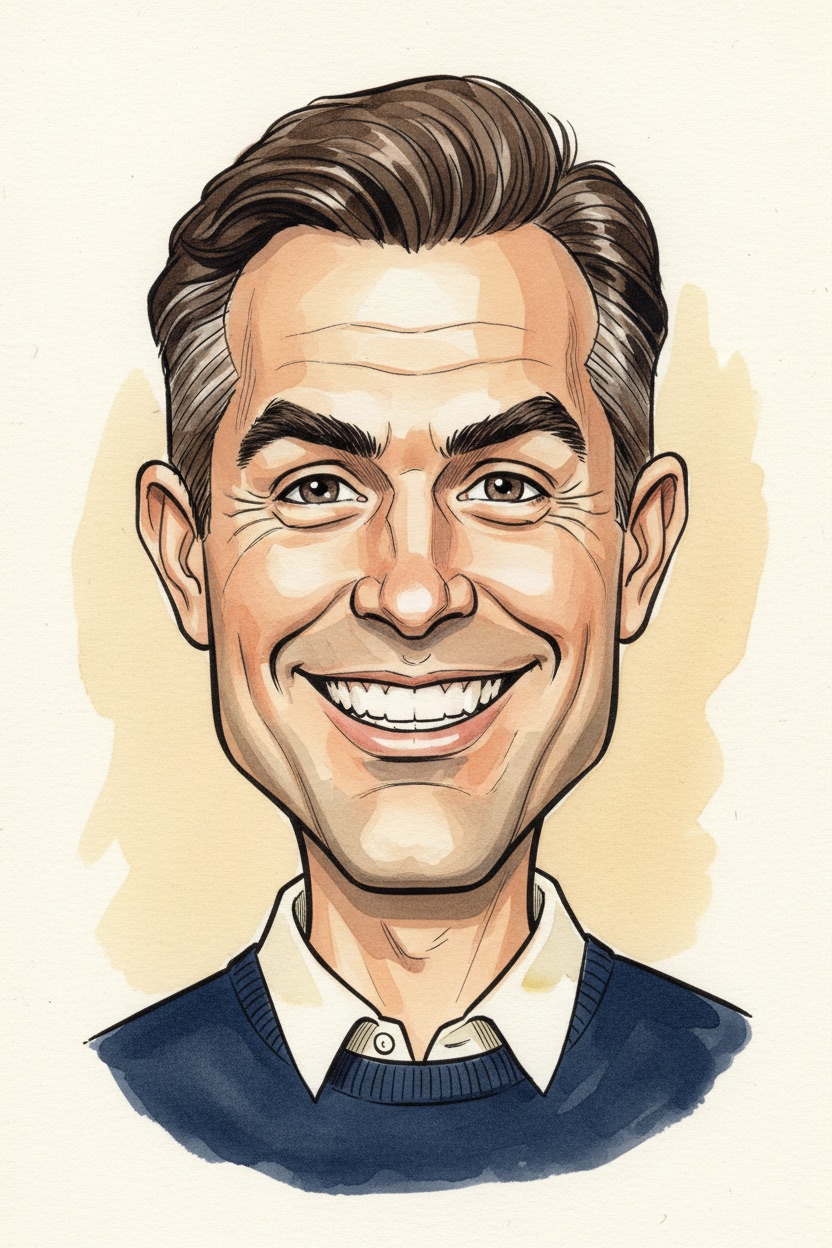
Generated output. The exaggeration here is deliberately restrained — this is the level that still works as a profile picture. The three named features do all the work; everything else in the face is left where it was.
▶ Try this as a fill-in template →
"The skull still has to make sense" sounds like a strange thing to put in a prompt, and it is the line that keeps this from going wrong. Exaggeration without underlying structure produces the melted, boneless look that makes bad AI caricatures unsettling rather than funny. Naming the structure explicitly holds it together.
Create a caricature from what ChatGPT knows about me
The version that unnerves people. Instead of your job, it draws your habits, your hobbies and your running jokes into the room around you.
Turn the person in this photo into a caricature illustration
surrounded by evidence of who they are rather than what they do for
work.

Exaggeration: amplify proportion, expression and posture — head
enlarged relative to the body, my characteristic expression pushed
further, my habitual posture exaggerated into a deep slouch in an
armchair with legs crossed. Exaggerate only expression, proportion
and posture. Do not alter or exaggerate ethnic features, and keep my
skin tone exactly as it appears in the photo. Preserve my facial
identity: bone structure, eye shape and spacing, nose bridge,
hairline and mouth stay recognisably mine.

Traits to make visible: always reading three books at once, never
finishes a cup of tea, cannot say no to a stray cat. Render each one
as a physical object, a piece of styling or a detail of the
environment rather than as a written label, so the picture tells
someone about me without a single word in it.
Hobbies and habits in frame: playing an old acoustic guitar, long
runs, letting the cat win the armchair — drawn as real used objects
with wear on them, not clean icons.
Setting: a small warm living room, warped slightly so the space
curves around me.
Mood: contentedly overwhelmed, half-smiling with eyebrows raised.
Art style: hand-drawn ink and watercolour caricature, confident
varied line weight and flat shading.
Colors: burnt orange, sage green and warm paper cream.
Composition: me large and central with the personal detail layered
in depth behind and around me, close objects sharp and heavy-lined,
distant ones lighter.

Negative: racial or ethnic feature exaggeration, altered skin tone,
different person, generic cartoon face, real person likeness,
trademarked characters, brand logos, written labels, captions,
demeaning or mocking depiction, distorted hands, extra fingers,
watermark, text, low quality.
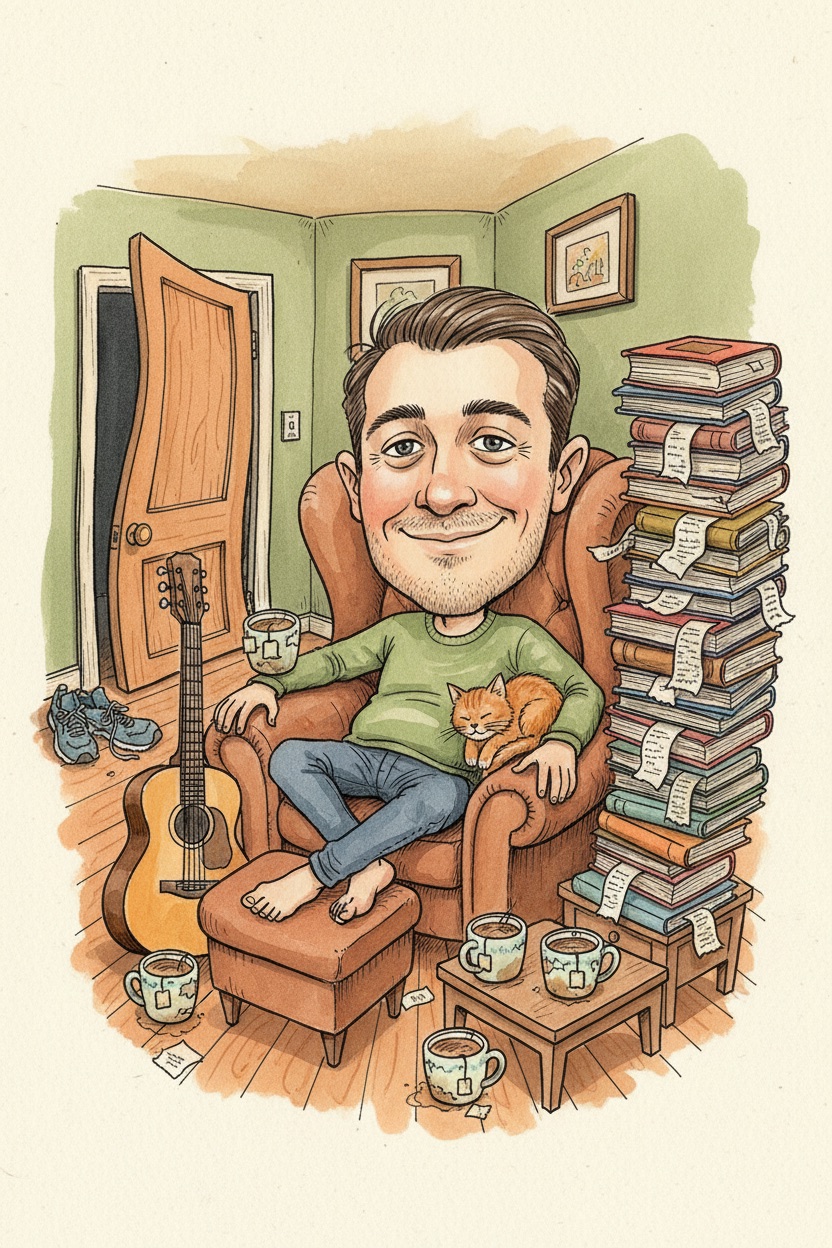
Generated output. Four separate mugs of half-drunk tea, receipts used as bookmarks in a stack of books, running shoes kicked off by the door — every trait rendered as an object rather than written out. That constraint is why the picture reads as a person instead of an infographic.
▶ Try this as a fill-in template →
Note the explicit ban on written labels in the negative prompt. Without it, image models are strongly inclined to caption your traits directly onto the picture in garbled lettering — "The one who brings snacks" floating in mid-air with a spelling mistake in it. Barring labels forces the traits into objects, which is what you actually wanted.
Caricature vs cartoon — what's actually different
Worth thirty seconds, because it explains most disappointing results.
A cartoon simplifies. It reduces a face to a few clean shapes that could belong to anyone, which is exactly why cartoon styling maps so easily onto any photo — it is not really looking at your face, it is replacing it with a well-drawn generic one.
A caricature exaggerates a specific person. It starts from one real face, identifies the single thing that face is actually about, and pushes that past realism while leaving the rest alone.
The practical consequence: a good caricature is more recognisable than a photograph, and a cartoon of you usually is not recognisable at all. When someone says their caricature "doesn't look like me," nine times out of ten what they have generated is a cartoon.
If you want the cartoon look deliberately — bold flat colour, heavy outline, built for a profile picture — that is a legitimate thing to want, and there is a template for it further down. Just know which one you are asking for.
Wedding and couple caricature
The one couples actually print: save-the-dates, table cards, anniversary gifts. Exaggerated, but flattering, because it is going on an invitation.
Caricature illustration of a bride and groom in their early thirties.

Exaggeration: heads enlarged relative to bodies, expressions
amplified, postures pushed into mid-laugh with foreheads almost
touching. Exaggerate proportion, expression and posture only, never
ethnic features, and keep both skin tones natural and unaltered.
Both faces must stay individually recognisable and, importantly,
flattering: this is going on an invitation, so push the charm and
the warmth rather than the flaws.

Attire: an ivory A-line dress with lace detail and a navy
three-piece suit, with fabric drawn as real cloth — the weight of
the skirt, the break of the trouser, visible texture in the lace
rather than flat printed colour.
Shared detail that ties them together: their scruffy terrier wedged
between their feet, looking up — drawn small and specific, the sort
of thing only the two of them would notice.
Setting: a simplified garden arch reduced to a few strong shapes so
the couple stays dominant in the frame.
Medium: pen and ink with a soft watercolour wash, confident varied
line weight — heavy on the contours and where the two figures
overlap, light inside the forms.
Colors: blush, ivory and sage green.
Composition: the two figures leaning into each other so their
silhouette reads as one connected shape rather than two people
standing side by side, with generous clean space around them for
text to sit later.

Negative: racial or ethnic feature exaggeration, altered skin tone,
unflattering rendering, real person likeness, trademarked characters,
brand logos, distorted hands, extra fingers, merged limbs, blurry,
watermark, text, low quality.
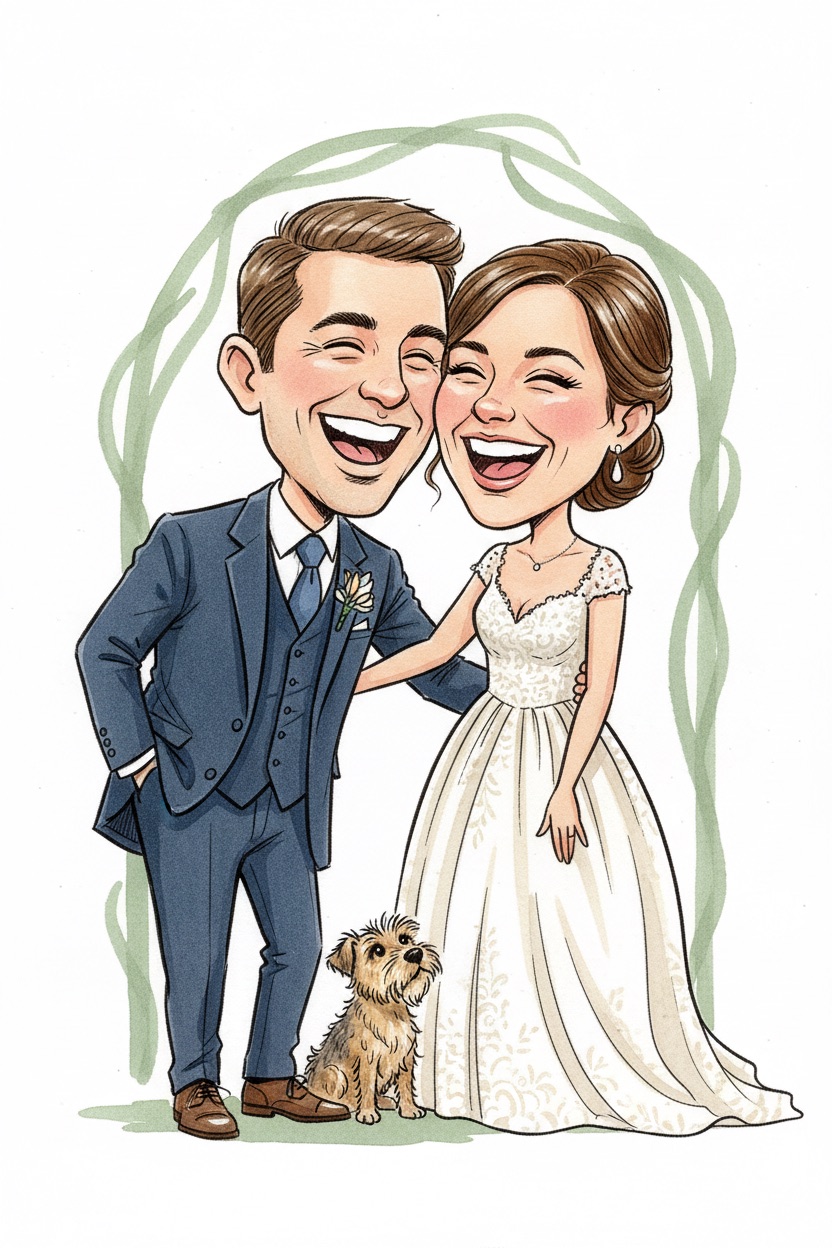
Generated output. The instruction that matters is "one connected shape rather than two people standing side by side" — it is the difference between a couple's caricature and two separate caricatures that happen to share a page.
▶ Try this as a fill-in template →
Leave the space. Asking for "generous clean space around them for text to sit later" costs you nothing and saves the whole image, because a caricature composed edge-to-edge cannot become a save-the-date without cropping someone's head off.
Pet caricature
Your dog or cat, exaggerated the way a caricaturist would actually do it — breed traits pushed hard, personality pushed harder.
Caricature illustration of a golden retriever.

Exaggeration: enlarge the head relative to the body, push the eyes
larger and the expression further, and amplify the breed's own
distinctive features — the broad open grin, the heavy feathered tail
and the soft dropped ears — so the exaggeration comes from what this
animal actually looks like rather than from a generic cute-animal
template.

Personality to make visible in the face and posture: relentlessly
optimistic, ears up, tail mid-swing — expressed through the set of
the ears, the angle of the head and the weight distribution of the
stance rather than through any human facial expression pasted on.

Keep real animal anatomy underneath: the skull structure holds, the
eyes sit properly, the legs attach where legs attach, the fur grows
in the direction fur grows.
Fur and coat: rendered with visible direction and texture — soft
where the undercoat is, wiry where the guard hairs are — not a flat
colour fill.
Styling: a small red bandana.
Setting: plain warm cream paper with a loose wash behind.
Medium: pen and ink with a watercolour wash, confident varied line
weight, heaviest along the back and under the jaw.
Colors: warm golds, russet and cream.
Composition: head large and slightly turned toward camera, body
foreshortened behind it, one clear focal detail.

Negative: human facial expression on an animal, broken anatomy,
wrong number of legs, flat colour fur, trademarked characters, brand
logos, grotesque rendering, blurry, watermark, text, low quality.
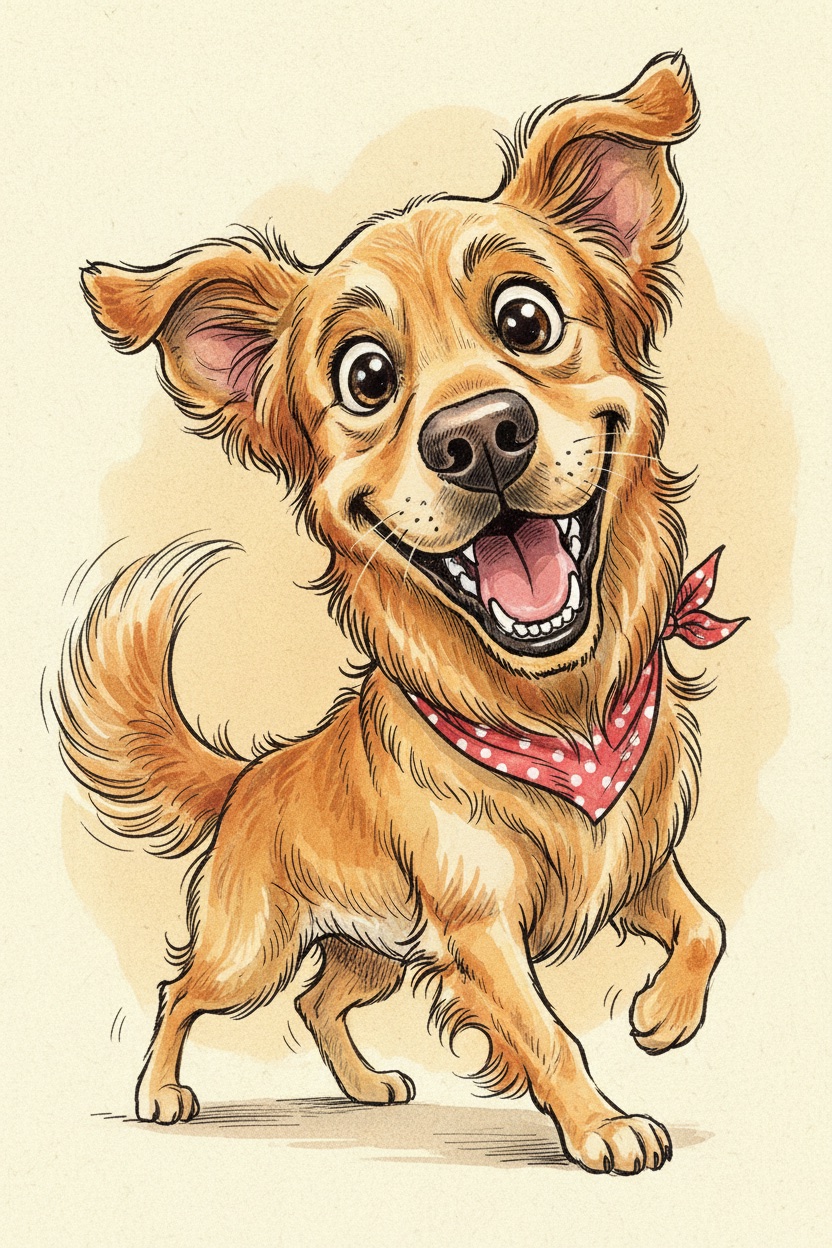
Generated output. The fur is drawn with direction — you can see which way it lies on the chest versus the tail. That single instruction is most of the difference between a pet caricature and a sticker.
▶ Try this as a fill-in template →
"No human facial expression on an animal" is in the negative prompt for a reason. Left to itself the model will give your dog human eyebrows and a human smile, which is the uncanny end of pet art. Personality has to come from ears, head angle and stance — the things that actually carry expression in animals.
Caricature drawing and sketch styles
The classic newspaper caricature: pure pen line, no colour, every stroke doing work. This is the style that made the form famous, and it is by far the hardest to fake.
Black-and-white editorial caricature sketch of an older man with a
heavy moustache and deep-set eyes, in the tradition of newspaper and
magazine caricature.

Exaggeration: build the entire likeness around one defining feature —
an enormous moustache that dominates the lower half of the face —
pushed hard, with everything else simplified down to support it.
Exaggerate proportion, expression and posture only; never ethnic
features. This is the discipline of the form: find the one thing the
face is actually about, amplify that, and let the rest go quiet.

Line: long confident unbroken contours with a few decisive interior
marks, drawn with a dip pen with a flexible nib. Line weight must
carry the whole image since there is no colour to help — heaviest
along the contour on the shadow side, tapering to nothing where the
form turns into light, with the pen lifted entirely where the eye
can complete the shape on its own.
Shading: cross-hatching and stipple only, no grey wash, density
building where the form turns away from the light. Leave at least a
third of the face as clean untouched paper.
Paper: off-white cartridge paper with visible tooth.
Accent: none — pure black ink on white.
Composition: head and shoulders, three-quarter angle, generous white
space, the drawing sitting slightly off-centre the way a printed
caricature sits in a column.

Negative: racial or ethnic feature exaggeration, grey airbrushed
shading, smooth digital gradient, colour, real person likeness,
politician likeness, political content, trademarked characters,
uniform line weight, distorted hands, watermark, text, low quality.
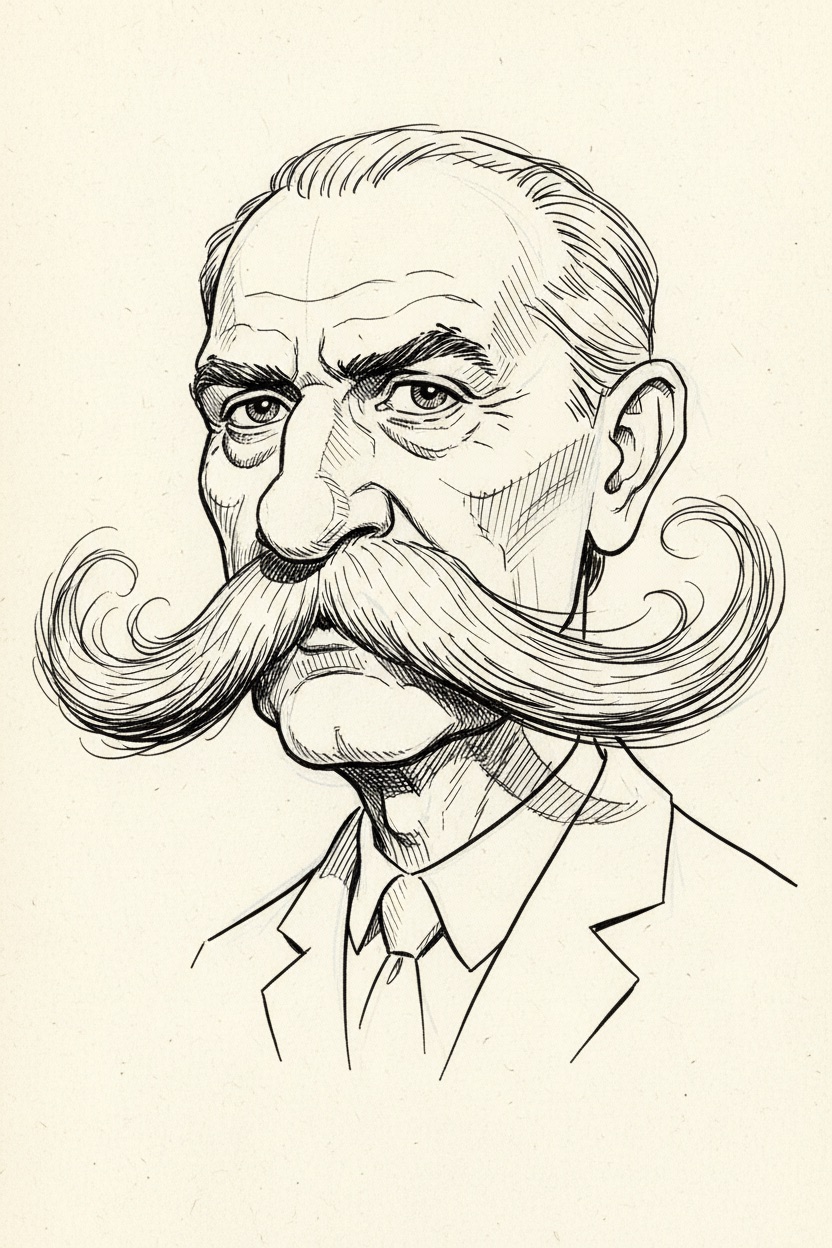
Generated output. Look at how much of the face is left as bare paper — the forehead and the left cheek have almost nothing on them. Restraint is the technique here; the cross-hatching only appears where the form turns away from the light.
▶ Try this as a fill-in template →
Barring grey wash is essential. Ask for a black-and-white caricature without it and you get a soft grey digital airbrush that looks nothing like ink. Cross-hatching and stipple only, and the tonal range has to be built from line density — which is exactly how it was actually done.
3D caricature
A caricature rendered as a physical collectible figure — big head, small body, studio product lighting on material that looks manufactured.
Photorealistic render of a 3D caricature figurine of a woman in her
thirties with short curly hair, photographed as a physical
collectible product.

Proportions: stylised caricature scale — head roughly a third of
total height, hands and feet enlarged, torso and limbs shortened, in
the proportion language of a designer vinyl collectible rather than
a realistic scale model. Exaggerate proportion, expression and
posture only; never ethnic features, and keep skin tone natural.

Props: an oversized coffee cup in one hand and a laptop tucked under
the other arm, sculpted as part of the figure at the same
stylisation level and the same material quality as the body.
Pose: mid-stride with weight on the front leg, so the figure has
real balance rather than standing to attention.
Material and finish: matte painted vinyl with a faint satin sheen on
the raised surfaces — the surface must read as a real manufactured
object, with subtle mould seams, faint fingerprint-scale surface
irregularity, and slightly softened edges where a real cast would
soften.
Lighting: soft studio key from camera left, cooler fill from the
right, clean rim light behind, three-point product lighting.
Background: a seamless neutral grey sweep, thrown gently out of focus.
Detail: micro-scratches and dust caught in the light, contact shadow
anchoring the figure to the surface it stands on.
Quality: 4K ultra-high definition product photograph, shallow depth
of field with the face plane sharp, physically accurate materials
and reflections.

Negative: racial or ethnic feature exaggeration, altered skin tone,
flat cartoon render, floating figure with no contact shadow,
plastic-looking lighting, real person likeness, trademarked
characters, brand logos, distorted hands, extra fingers, blurry,
watermark, text, low quality.
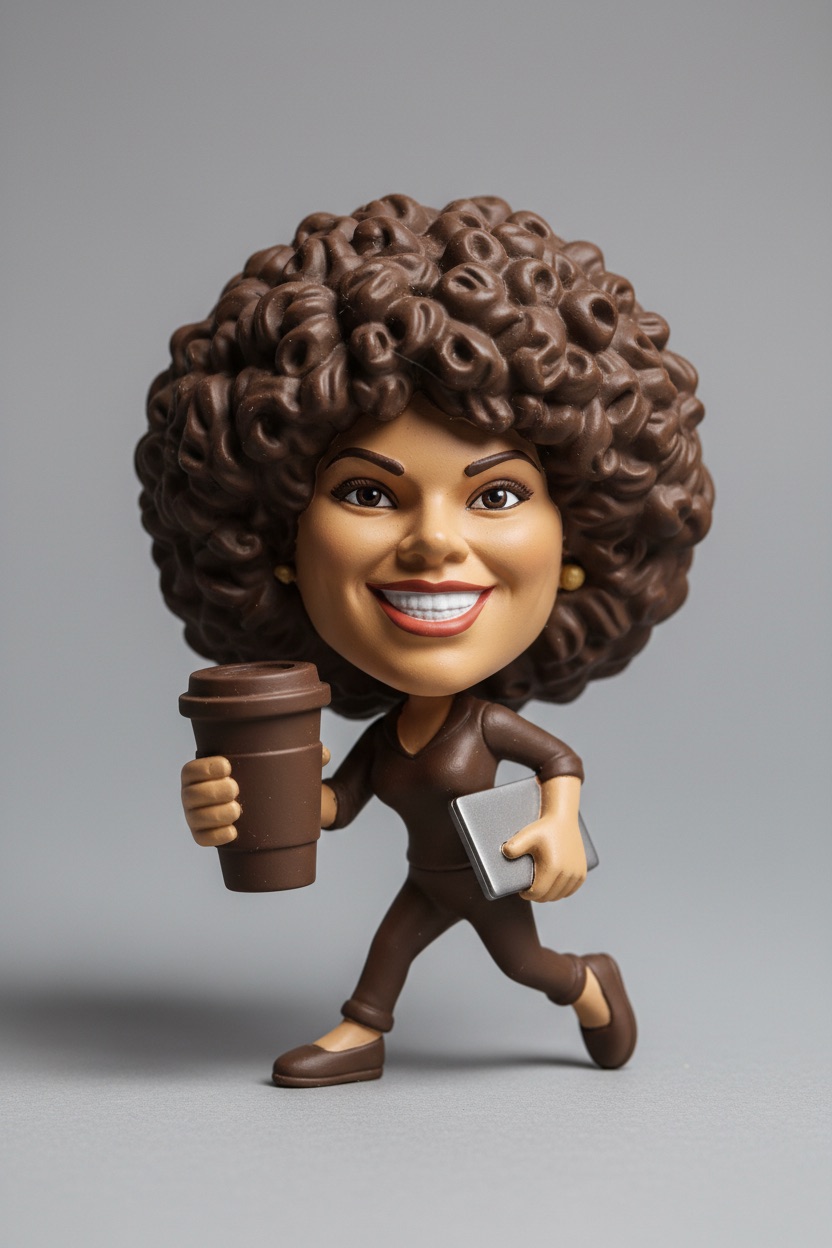
Generated output. The contact shadow under the front foot is what sells it as a real object on a real surface. Without that line in the prompt these renders float, and a floating figure reads instantly as CGI.
▶ Try this as a fill-in template →
The mould seams and micro-scratches matter more than the sculpt. A perfectly clean surface looks like a render; a surface with the small manufacturing imperfections of an actual cast object looks like a photograph of a thing you could pick up.
Cartoon caricature for a profile picture
The cartoon-trend look: bold flat colour, heavy outline, exaggeration all the way up. This is the one to use when you want it readable at 40 pixels in a group chat.
Bold cartoon caricature illustration of a man in his mid-twenties
with messy hair and round glasses, in the flat-colour
animated-series style people use for profile pictures.

Exaggeration: push proportion and expression well past realism — an
oversized head on a small body, with wildly exaggerated hair volume
and a huge grin — while keeping the face specific to this person
rather than a generic cartoon type, which is the whole difficulty
here. Exaggerate proportion, expression and posture only; never
ethnic features, and keep skin tone natural.

Line: a confident heavy outline around the silhouette with lighter
interior lines, tapering where the form turns, in the clean inked
style of a modern animated series.
Shading: flat cel shading built from hard-edged shadow shapes, one
shadow tone plus one highlight per colour area, no soft airbrushed
gradients anywhere.
Eyes: wide and delighted, eyebrows high — drawn large and highly
expressive with clean specular highlights, but with the eye spacing
and shape kept individual to this face.
Hair: rendered as distinct clumped masses with a strong readable
silhouette, not as individual strands.
Hands: drawn simply and correctly, four fingers and a thumb, in a
clear readable gesture.
Background: flat radiating speed lines in a single bold colour,
drawn with playful perspective distortion.
Colors: bright saturated primaries with a teal accent.
Composition: energetic and lively, subject dominating the frame, one
strong diagonal running through the pose.

Negative: racial or ethnic feature exaggeration, altered skin tone,
generic cartoon face, soft airbrushed gradient shading, muddy
colours, photorealism, real person likeness, trademarked characters,
existing cartoon characters, brand logos, malformed hands, extra
fingers, fused fingers, blurry, watermark, text, low quality.
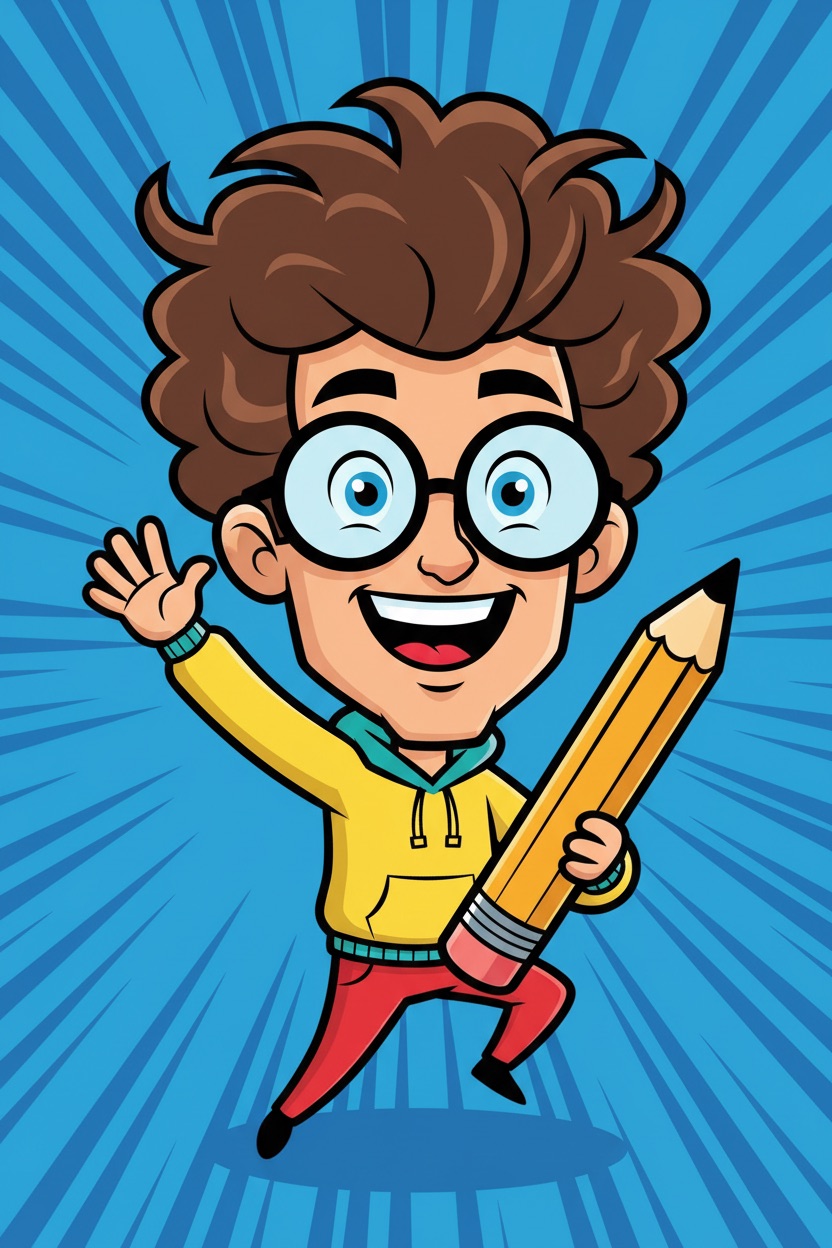
Generated output. Flat cel shading and a heavy silhouette outline are what make this survive being shrunk to a thumbnail — soft gradient shading turns to mush at avatar size.
▶ Try this as a fill-in template →
Specifying hands explicitly is not paranoia. Cartoon styles invite loose, gestural hands, and loose gestural hands are exactly where image models produce six fingers. Naming the count in the prompt is cheap insurance.
Party and event caricature
The fast marker-and-wash look of a caricaturist working a table at a wedding — loose, quick, visibly made in about four minutes.
Live-event caricature of a laughing woman at a wedding reception
table, drawn in the fast loose style of a caricaturist working a
party table in under five minutes.

Exaggeration: large head, small quickly-indicated body, one dominant
feature pushed hard and the rest resolved in as few strokes as
possible. Exaggerate proportion, expression and posture only; never
ethnic features, and keep skin tone natural and warm.

The whole point of this style is economy — leave strokes visible,
leave edges open, leave the drawing looking made rather than
rendered.

Activity or prop that identifies them: a raised champagne glass,
indicated in three strokes rather than fully drawn.
Line: thick black brush marker with visible stroke direction, laid
down fast, with occasional overshoot past the corner and no reworked
or corrected lines.
Colour: applied as loose flat marker blocks that deliberately overrun
the linework in places, with large areas left as bare paper.
Paper: cheap white cartridge paper, slightly buckled where the
marker went down wet.
Background: one sweeping stroke of colour behind the head.
Colors: black line, warm skin tones and one bright coral accent.
Composition: head and shoulders large in frame, body dropping away
fast in scale, drawing sitting slightly off-centre on the sheet with
visible paper margin.

Negative: racial or ethnic feature exaggeration, altered skin tone,
overworked rendering, smooth digital gradient, perfectly clean edges,
corrected linework, real person likeness, trademarked characters,
brand logos, distorted hands, extra fingers, watermark, text, low
quality.
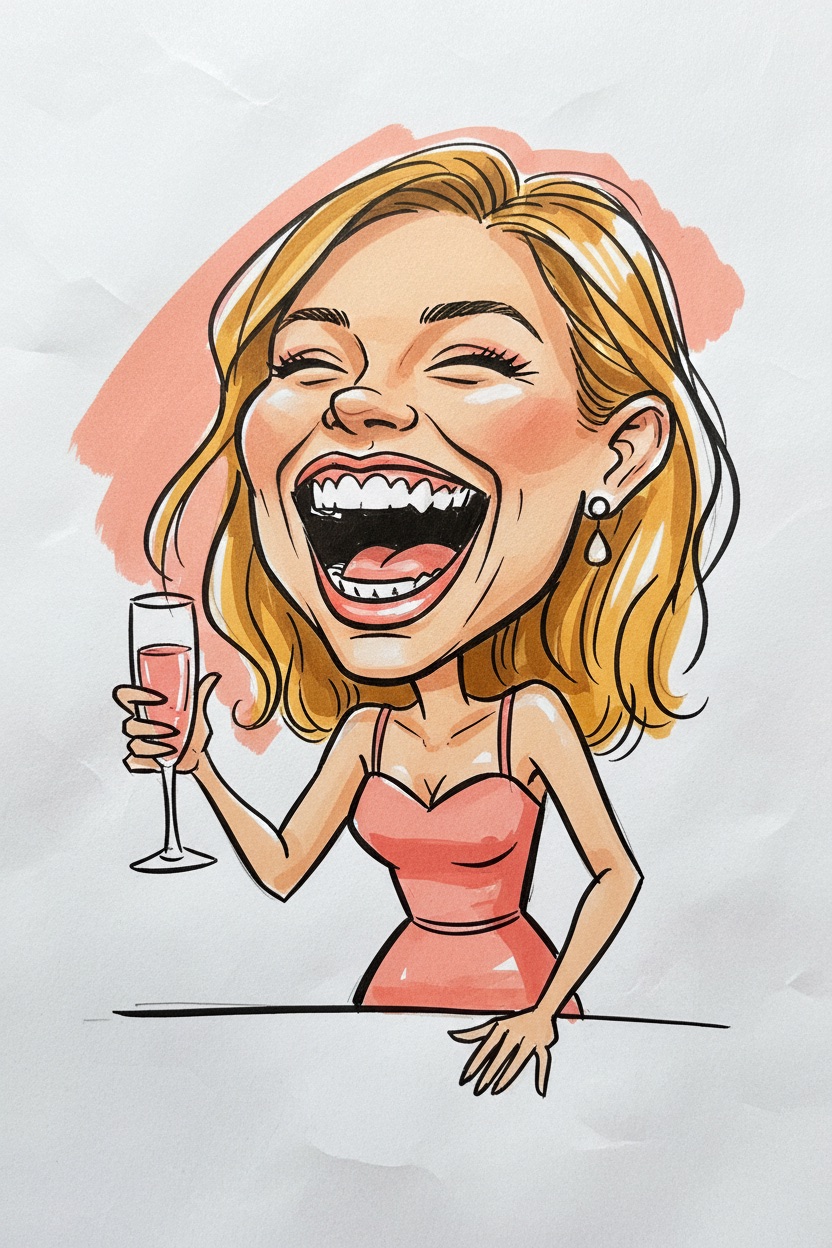
Generated output. The coral wash behind her head runs past the outline and stops mid-stroke, and the champagne glass is four lines. Asking for the drawing to look "made rather than rendered" is what produces that.
▶ Try this as a fill-in template →
Everything in this prompt is an instruction to do less. Overshooting strokes, open edges, colour outside the lines, bare paper — those read as speed and confidence, and they are the only reason this style looks hand-drawn instead of computed.
Team and office caricature
A whole team in one frame, everyone exaggerated, everyone doing the thing they are known for.
Group caricature illustration of five colleagues in one scene.

Exaggeration: every figure gets an enlarged head, an amplified
characteristic expression and an exaggerated posture — exaggerate
proportion, expression and posture only, never ethnic features, and
keep every skin tone natural and unaltered.

Each person must be individually distinguishable at a glance by
silhouette alone: vary height, build, hair mass and posture enough
that no two figures read the same from across a room.

Roles, shown through what each one is physically doing and what is
in their hands, never through written labels: one wearing a headset
with a hand raised mid-shout, one hugging an overflowing basket of
snacks, one holding a wrench and a tangle of cables, one hunched
over a desktop keyboard ignoring everyone, one clutching their head
in front of a large desktop monitor covered in overlapping windows.
All food packaging in frame is plain unprinted foil, and all screens
are plain bezels showing only abstract shapes.

Group activity: crowded around a whiteboard, all reacting differently
to the same thing — figures arranged at genuinely different depths
and heights so the group forms a shape rather than a line, with at
least one person half-out of frame or partly hidden behind another.
Setting: a small startup room with a whiteboard behind, drawn with
playful perspective distortion so the room bends inward.
Medium: hand-drawn ink and watercolour caricature, confident varied
line weight — heaviest on foreground figures, lightest on the ones
furthest back.
Colors: warm ochre, teal and paper cream, foreground figures more
saturated than background ones.
Composition: a clear focal figure at the centre of the action, the
others angled and looking toward that focus.

Negative: racial or ethnic feature exaggeration, altered skin tone,
identical repeated faces, figures posed in a straight row, written
labels, name tags, captions, real person likeness, trademarked
characters, brand logos, distorted hands, extra fingers, merged
limbs, watermark, text, low quality.
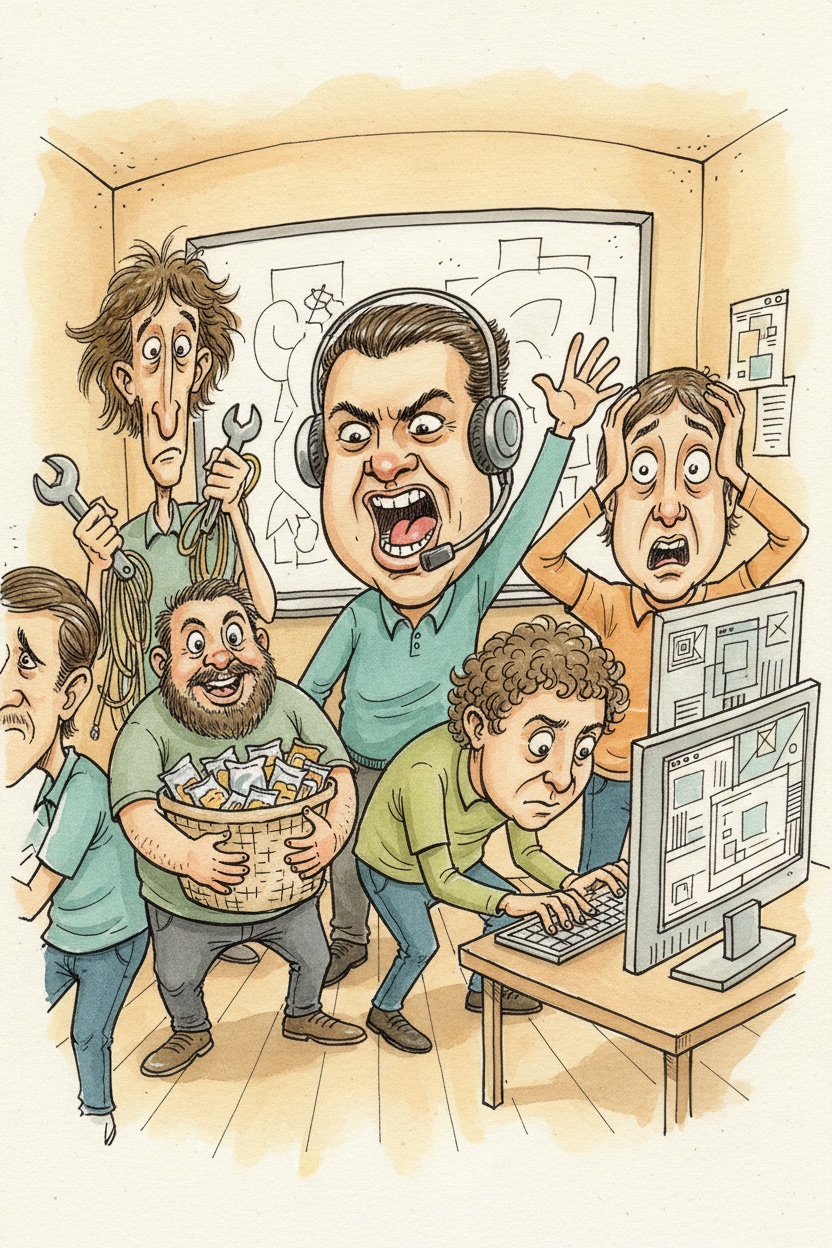
Generated output. Every role is legible without a caption because each one is an action plus an object. The line weight drops on the figures further back, which is what creates depth in a flat illustration.
▶ Try this as a fill-in template →
Describe roles as actions, not as labels. Writing "the one who brings snacks" into the prompt makes image models literally write that sentence onto the picture, usually misspelled. Writing "one hugging an overflowing basket of snacks" gets you the same idea rendered as a drawing. This is the single most useful trick in group caricature prompting.
Keeping a caricature funny, not offensive
Short section, worth reading once.
Caricature has a genuinely ugly history alongside the affectionate one. For a long stretch it was the standard visual vocabulary for racial and ethnic mockery, and those images are still the first thing many people picture when they hear the word. Image models learned from all of it.
Three practical rules cover almost everything:
Exaggerate expression, proportion and posture — never ethnicity. The legitimate targets of caricature are how big your grin is, how you hold your shoulders, how much hair you have. Nose shape, eye shape, lip fullness and skin tone are not features to push; they are the exact features the offensive tradition pushed. Every template above bars this explicitly in the negative prompt, and it is worth keeping that line in any prompt of your own.
Say "keep my skin tone exactly as it appears in the photo." Without it, models routinely lighten skin during stylisation. It is a well-documented failure mode, it happens silently, and one sentence prevents it.
Caricature people who are in on it. The form is affectionate when the subject is enjoying it and unkind when they are not. Yourself, your friends who asked, your team at a leaving do — fine. Someone who did not ask, or a real public figure you are trying to humiliate, is a different activity wearing the same clothes.
There is also a privacy question worth thirty seconds. The "based on everything you know about me" prompt works by surfacing what the model has stored about you, which is precisely why people are startled when a detail they mentioned months ago turns up in the picture. If that bothers you, look at what is in your memory settings first, or use the templates above where you state the details yourself and nothing is being read back to you.
Do you need a caricature generator?
There are a lot of dedicated caricature generators and caricature maker sites, and a fair number of them are wrappers around the same image models you already have access to, with a watermark and a paywall added.
Where a dedicated tool genuinely helps: batch work, a guaranteed consistent house style across fifty staff portraits, or print-resolution output with a commercial licence attached. Those are real reasons.
Where it does not: a single caricature of yourself. A well-written prompt gives you more control than any generator's preset dropdown, because you can name the exact exaggeration level, the exact medium and the exact features to push — which is the entire craft, and precisely what a preset takes away from you.
The one thing worth fixing first is your input photo. A soft, dark or low-resolution source photo caps the quality of everything downstream, and cleaning it up before you start is the cheapest improvement available. The ChatGPT photo enhancement prompt does that part in one step.
What to do with these
Start with the job caricature — it is the trend proper and the one people actually share. If the first result looks like a polite portrait, you have found the problem this whole article is about: go back and push the exaggeration numbers, and add the "find the one feature my face is about" line.
Then pick by output. Profile picture, use the cartoon avatar. Something to frame, use the editorial ink. Something to print on an invitation, use the couple template and leave the space for text.
All ten templates:
- Caricature of Me and My Job
- Photo to Caricature Converter
- Personality Caricature — Your Traits, Not Your Job
- Wedding and Couple Caricature
- Pet Caricature Portrait
- Editorial Ink Caricature Sketch
- 3D Caricature Figurine
- Cartoon Caricature Avatar
- Live Party Caricature
- Team and Office Caricature Scene
Related:
- Browse all caricature prompts
- Portrait photography prompts — the realistic end of the same problem
- Pencil drawing and sketch prompts — line technique that carries straight into caricature
- Anime art style prompts — if the cartoon avatar is the direction you liked
- ChatGPT photo enhancement prompt — clean up your source photo first