
The 60-second version
What you need:
- A ChatGPT Plus subscription ($20/month) — required for GPT-4o image generation
- A photo of any object you want to learn to draw
- One of the 40+ templates below, or the universal master prompt
The universal master prompt — copy it now:
I am a complete beginner learning to draw and I want to learn how to draw [SUBJECT]. Generate a single image showing a step-by-step drawing tutorial in [NUMBER] steps arranged in a grid. Step 1 must contain ONLY the most basic geometric shapes — circles, ovals, rectangles, or straight lines. No detail at all in Step 1. Each step should add a little more detail and refinement so a beginner can follow and replicate each step easily. The final step should be a complete, clean pencil sketch. Use consistent line weight and style across all steps. Do not include any text labels inside the image.
Replace [SUBJECT] with a description of your object (or attach a photo), replace [NUMBER] with 6 for most subjects. For subject-specific templates with better starting-shape instructions, use the library below.
How to Use ChatGPT to Learn to Draw Step by Step
Most ChatGPT drawing guides show you how to prompt for a finished sketch. This guide does something different: it uses ChatGPT to generate the drawing lesson itself — so you can actually learn to draw, not just produce AI art.
The idea: upload a photo of any real object — a flower you found on a walk, your pet, your coffee cup, a shoe — and prompt ChatGPT to decompose it into a progressive, step-by-step drawing tutorial, the same way instructional drawing books do. ChatGPT generates a single grid image where each panel builds on the last, starting from the simplest possible shapes and ending at a finished sketch.
This turns ChatGPT into a personal drawing tutor for any subject you want to learn to draw — not just generic subjects, but the specific thing in front of you.
The Shiuli flower: a real example
Here is the workflow in practice. On a morning walk, I found a small Shiuli flower (Night-flowering jasmine — Nyctanthes arbor-tristis). I took a photo:
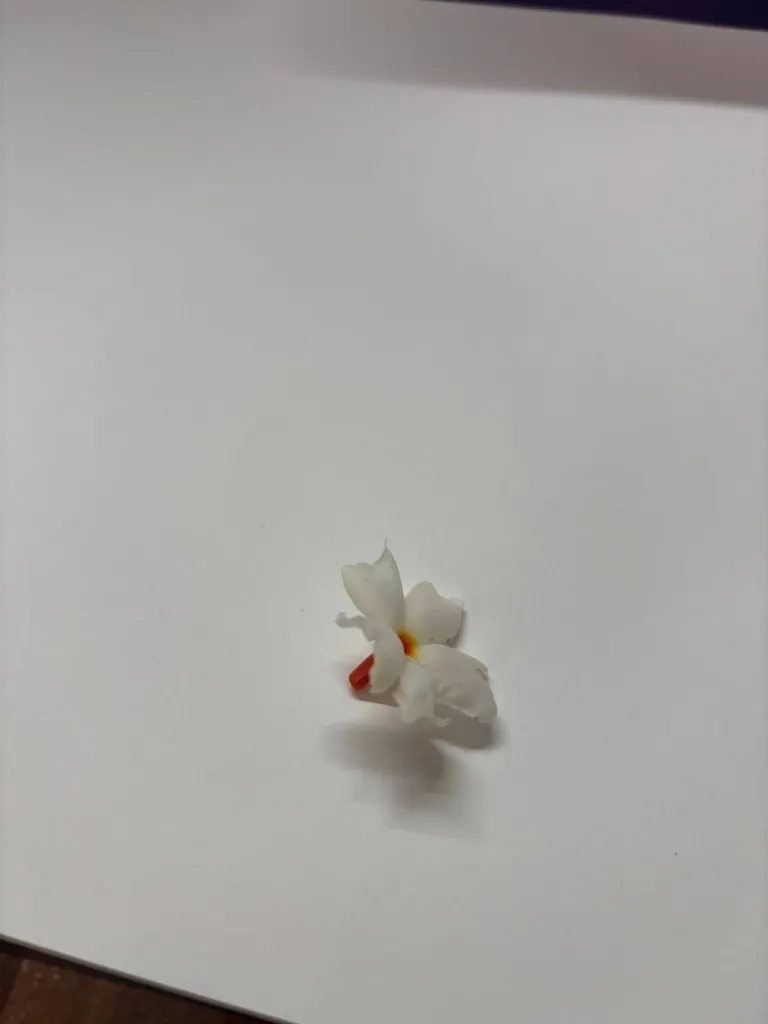
I then uploaded it to ChatGPT Plus with this prompt:
"I want to learn to draw this flower. Can you generate an image that breaks this down into line art and slowly progresses into the entire flower in sketch in 6 steps. The image should show the slow steps on how to draw this flower starting with basic shapes. This will become a tutorial image for a beginner to sketching."
The output:
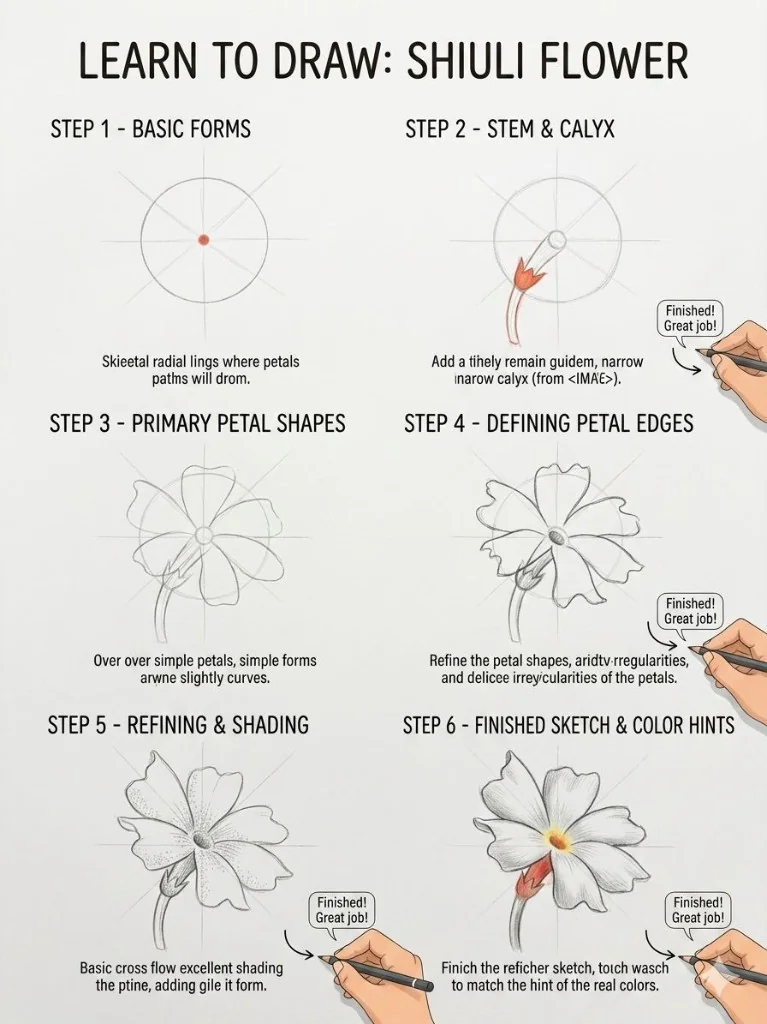
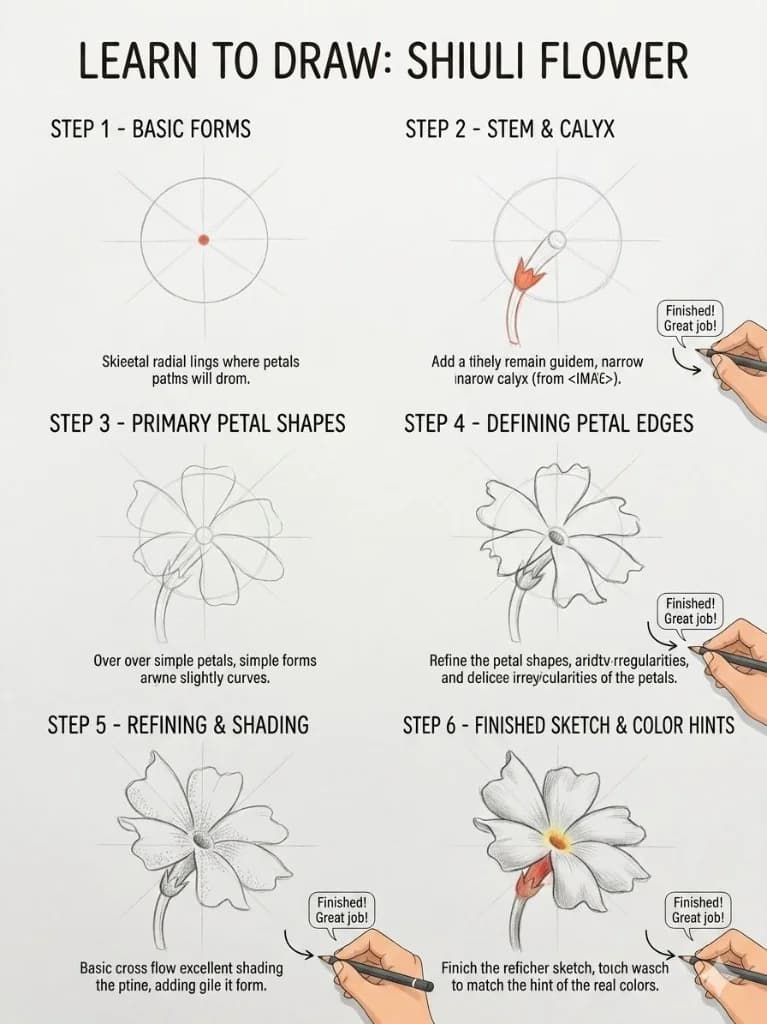
The result walks through: (1) a bare circle as the base form, (2) adding the stem and calyx, (3) rough petal shapes radiating outward, (4) refining petal edges and adding irregularity, (5) shading and texture, and (6) a finished sketch with color hints matching the real flower.
One honest note: the step label text inside the image came out garbled — "Skieetal radial lings where petals paths will drom" instead of a clean description. This is a consistent AI image-generation limitation. The visual progression is correct and followable; the text labels are not reliable. All the templates below include an instruction to omit in-image text for cleaner output. Use ChatGPT's text response alongside the image when you want step-by-step written guidance.
How to use these prompts
- Open chat.openai.com and confirm you're on a Plus account
- Start a new chat and select the GPT-4o model
- Option A — with your own photo: Click the paperclip icon to attach your photo, then paste a template below
- Option B — without a photo: Paste a template describing the subject in words — ChatGPT will generate both the reference form and the tutorial from its training knowledge
- Review the output grid and iterate — add a follow-up like "make Step 1 even simpler, just an oval and a line" if the starting point is too complex
- Ask for a text companion: "Now describe each of the 6 steps in words" to get written guidance alongside the visual
Best for: flowers, animals, household objects, faces, food, vehicles, leaves, geometric still-life subjects. Harder for: highly detailed scenes, hair in motion, complex hands.
The Master Prompt Formula
Every strong learn-to-draw prompt uses the same structure:
[Subject description] + [number of steps] + [starting constraint] + [progression instruction] + [final step target] + [style modifier] + [no-text instruction]
Broken down:
- Subject description: What you want to draw. Be specific: "a single daisy flower from the front" beats "a flower." If uploading a photo, "this flower in the photo" works.
- Number of steps: 4 for simple subjects, 6 for most, 8 for complex subjects like faces or horses.
- Starting constraint: "Start with the most basic geometric shapes only — circles, ovals, straight lines." This forces the AI to actually start simple instead of jumping ahead.
- Progression instruction: "Each step should add more detail and refinement, building on the previous step." Without this, steps can be inconsistent in their pacing.
- Final step target: "The final step should be a complete, clean [pencil sketch / ink line drawing / shaded illustration]."
- Style modifier: Pencil sketch, ink line art, bold marker, technical lines, watercolor guide, etc.
- No-text instruction: "Do not include any text labels or annotations inside the image." Prevents the garbled text problem.
Flower & Plant Drawing Prompts
1. Generic flower (photo upload)
I am a beginner learning to draw and I want to learn how to draw this flower. Generate a single tutorial image showing 6 steps arranged in a 2x3 grid. Step 1 must show ONLY a plain circle and a single stem line — no petals, no detail at all. Steps 2-5: progressively add petals, refine shapes, add texture and detail, with each step simple enough for a beginner to replicate. Step 6: a complete clean pencil sketch of the flower. Consistent style throughout. Do not include any text inside the image.
2. How to Draw a Rose Step by Step
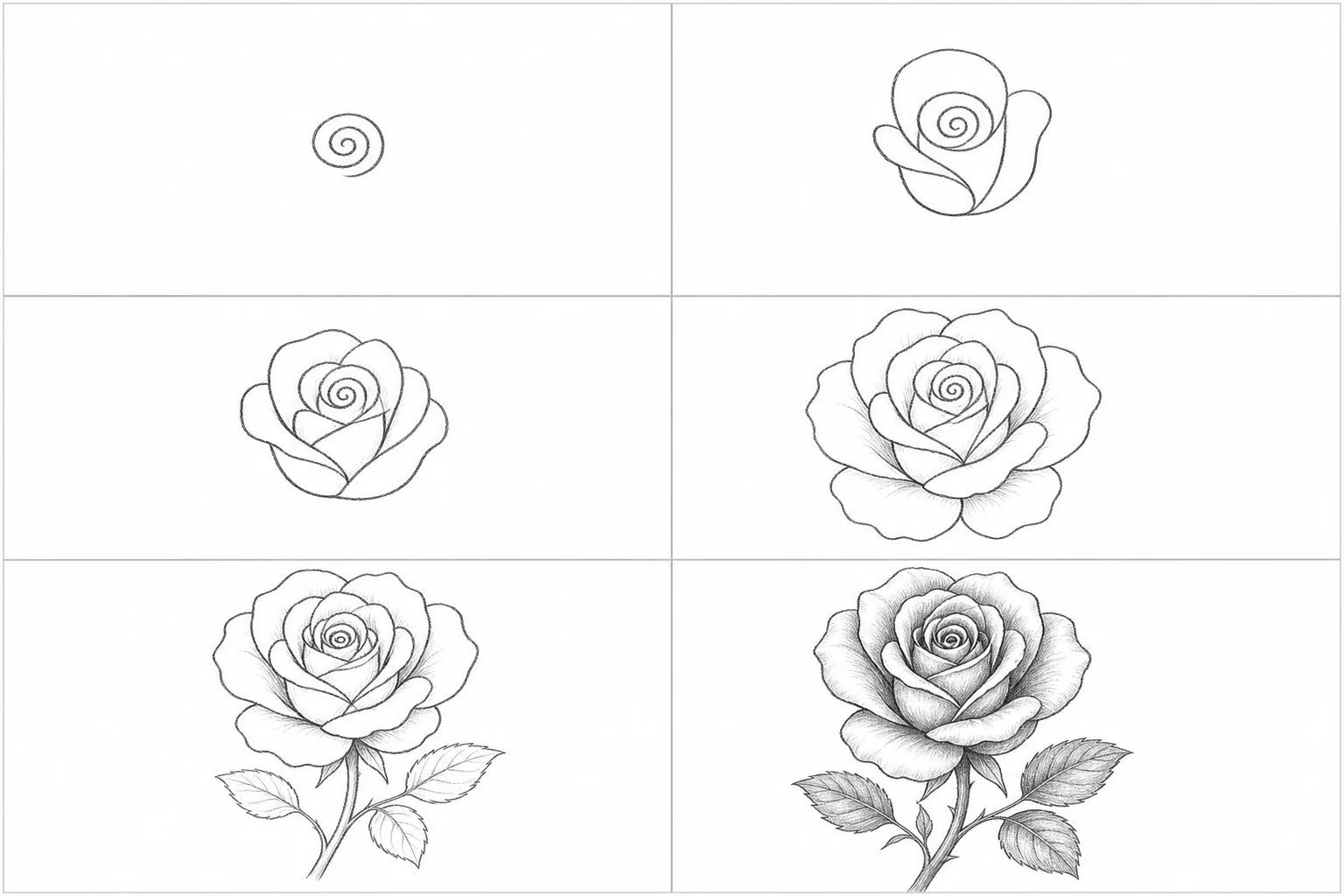
I am a beginner learning to draw and I want to learn how to draw a rose. Generate a 6-step drawing tutorial for a single rose in full bloom starting with basic shapes so a beginner can learn how to draw easily. Step 1 must show ONLY a small tight spiral shape for the center bud — nothing else. Each step should unfold more petals outward, adding curved edges and natural petal overlap, keeping each step simple enough to follow. Final step: a detailed pencil sketch rose with visible petal texture and one leaf. Arrange as a 2x3 grid. No text labels in the image.
3. How to Draw a Sunflower Step by Step
I am a beginner learning to draw and I want to learn how to draw a sunflower starting with basic shapes. Create a 6-step drawing tutorial arranged in a grid. Step 1 must show ONLY a plain circle for the seed head — no petals, no stem, no detail at all. Steps 2-3: add a rough ring of simple oval petal outlines only. Steps 4-5: refine petals and add seed-head texture detail one layer at a time. Step 6: complete sunflower pencil sketch with stem and two leaves. Each step should be simple enough for a complete beginner to replicate. Clean pencil style throughout. No text in the image.
4. Lotus
I am a beginner learning to draw and I want to learn how to draw a lotus flower. Generate a 6-step drawing tutorial for a lotus viewed from slightly above, starting with basic shapes so a beginner can follow each step easily. Step 1 must show ONLY a flat oval — no petals or detail. Each step should add one layer of petals concentrically, refining their curved pointed shape gradually. Final step: a complete pencil sketch showing all petal layers and a simple water-surface base line. Consistent line weight throughout. No text inside the image.
5. Tulip
I am a beginner learning to draw and I want to learn how to draw a tulip starting with basic shapes. Create a 6-step drawing tutorial arranged in a grid. Step 1 must show ONLY a plain egg shape for the bloom and a single vertical line for the stem — no petals, no detail. Steps 2-4: add petal separation lines, curve the outer petals, then add one leaf. Steps 5-6: refine edges and shade the final pencil sketch. Keep each step simple enough for a beginner to replicate. No text labels inside the image.
6. Leaf (simple, for beginners)
I am a complete beginner learning to draw and I want to learn how to draw a simple leaf. Generate a 4-step drawing tutorial starting with the most basic shape so a beginner can easily follow. Step 1 must show ONLY a plain oval — nothing else. Step 2: add a single midrib line down the center. Step 3: add main vein lines branching from the midrib. Step 4: the complete leaf with subtle shading along veins. Clean pencil style, arranged in a 2x2 grid. No text in image.
7. Cherry blossom branch
I am a beginner learning to draw and I want to learn how to draw a cherry blossom branch starting with basic shapes. Create a 6-step drawing tutorial arranged in a grid. Step 1 must show ONLY two simple diagonal straight lines for the main branch — no blossoms, no buds, no texture. Steps 2-3: add smaller branch offshoots as simple lines only. Step 4: add rough circle clusters where blossoms will be. Step 5: refine individual 5-petal shapes on each blossom. Step 6: complete pencil sketch with bark texture lines and full blossom detail. Keep each step simple enough for a beginner to replicate. No text inside the image.
Animal & Pet Drawing Prompts
8. How to Draw a Cat Step by Step
I am a beginner learning to draw and I want to learn how to draw a sitting cat starting with basic shapes. Generate a 6-step drawing tutorial arranged in a 2x3 grid. Step 1 must show ONLY two plain circles — a large one for the body and a smaller one for the head — nothing else. Each following step adds one or two new elements only: ears, then facial feature outlines, then paws, then the tail. Final step: clean pencil sketch cat with fur texture lines and expression. Keep each step simple enough for a complete beginner to follow and replicate. No text labels inside the image.
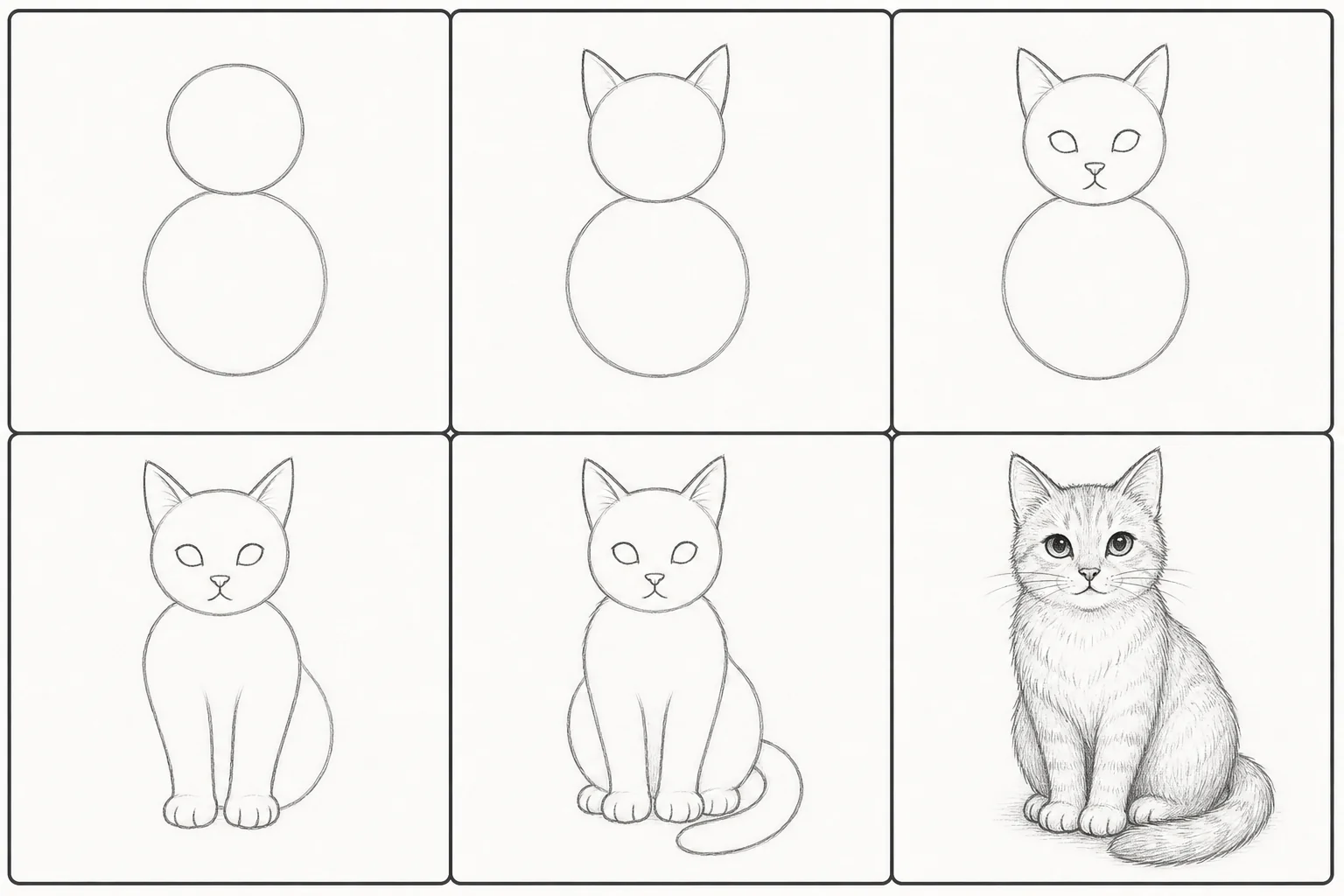
9. How to Draw a Dog Step by Step
I am a beginner learning to draw and I want to learn how to draw a Labrador dog in side profile starting with basic shapes. Create a 6-step drawing tutorial arranged in a grid. Step 1 must show ONLY a large oval for the torso and a circle for the head — no other marks at all. Steps 2-5: add neck connection, then four simple leg rectangles, then the snout and ears, then the tail — one element group per step. Step 6: complete pencil sketch with fur direction lines and facial detail. Keep every step simple enough for a beginner to replicate. Clean consistent style. No text in image.
10. Bird (generic small songbird, perched)
I am a beginner learning to draw and I want to learn how to draw a small perched bird starting with basic shapes. Generate a 6-step drawing tutorial arranged in a grid. Step 1 must show ONLY two plain ovals — a large one for the body and a small one for the head — nothing else. Each following step adds one new element only: beak, then wing outline, then tail shape, then feet and branch line, then feather texture. Final step: complete pencil sketch bird perched on a branch. Keep every step simple enough for a complete beginner to follow. No text inside the image.
11. How to Draw a Butterfly Step by Step
I am a beginner learning to draw and I want to learn how to draw a butterfly starting with basic shapes. Create a 6-step drawing tutorial for a butterfly with wings open, viewed from above, arranged in a 2x3 grid. Step 1 must show ONLY a vertical line for the body axis and two large plain oval shapes for the wings — no patterns, no detail at all. Steps 2-5: add the lower wing shapes, then simple inner wing curve lines, then antenna, then body detail. Step 6: detailed pencil sketch butterfly with wing patterns. Keep every step simple enough for a complete beginner to replicate. Consistent style throughout. No text labels.
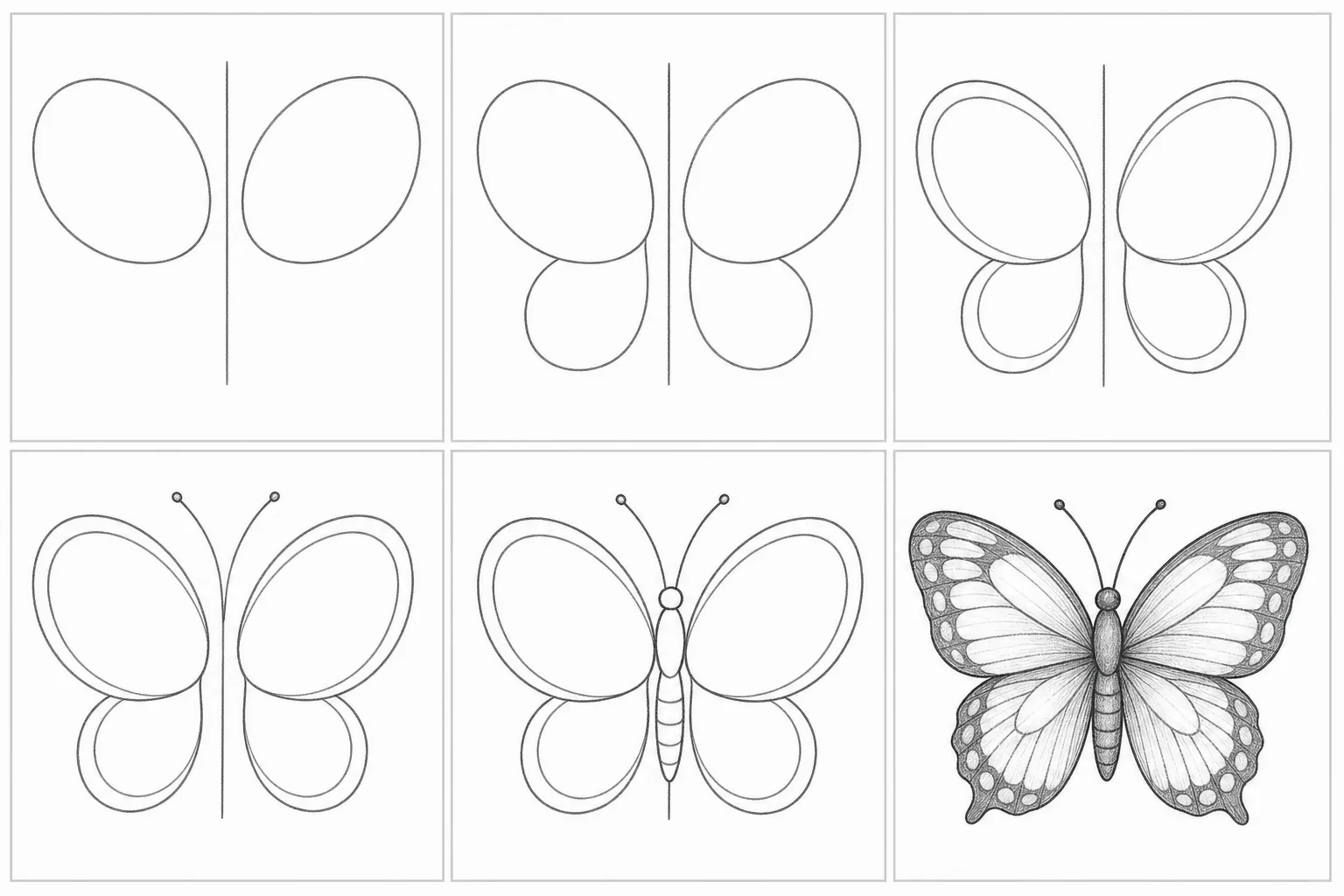
12. Fish (tropical, side view)
I am a beginner learning to draw and I want to learn how to draw a tropical fish starting with basic shapes. Generate a 6-step drawing tutorial for a tropical fish in side profile arranged in a grid. Step 1 must show ONLY a plain oval for the body — no fins, no tail, no detail at all. Steps 2-5: add the tail shape, then the dorsal and pectoral fins, then the eye and mouth, then a simple scale pattern. Step 6: complete pencil sketch with full scale texture and fin detail. Keep every step simple enough for a beginner to follow. Clean line art style. No text in image.
13. How to Draw a Horse Step by Step
I am a beginner learning to draw and I want to learn how to draw a horse starting with basic shapes. Create an 8-step drawing tutorial for a horse in side profile, standing still, arranged in a 2x4 grid. Step 1 must show ONLY three basic geometric shapes: a large rectangle for the torso, a circle for the haunches, and an oval for the head — no other marks. Each following step adds one element group only: neck, then four simple rectangular legs, then mane and tail, then ear and eye, then snout, then hooves and muscle lines. Final step: clean detailed pencil sketch horse. Keep every step simple enough for a beginner to follow. No text labels in the image.
14. Rabbit (sitting)
I am a beginner learning to draw and I want to learn how to draw a sitting rabbit starting with basic shapes. Generate a 6-step drawing tutorial for a rabbit facing slightly to the side, arranged in a grid. Step 1 must show ONLY three plain circles: a large one for the lower body, a smaller one for the upper body, and a tiny one for the head — no ears, no face, no detail. Each following step adds one element: long ears, then face outline, then paw shapes, then fluffy tail. Final step: pencil sketch rabbit with soft fur texture lines. Keep every step simple enough for a complete beginner to replicate. No text inside the image.
Face & Portrait Drawing Prompts
15. How to Draw a Face Step by Step
I am a beginner learning to draw and I want to learn how to draw a human face from the front starting with basic shapes. Generate a 6-step drawing tutorial arranged in a 2x3 grid. Step 1 must show ONLY a plain oval — nothing else. Step 2: add horizontal and vertical guideline lines crossing the oval to mark where features will go. Step 3: place rough simple markers only — two small ovals for eyes, a triangle for the nose, a curved line for the mouth, two small shapes for ears. Steps 4-5: refine each feature with proper shape and proportion, one feature group per step. Step 6: clean portrait pencil sketch with guidelines removed. Keep every step simple enough for a beginner to follow. No text inside the image.
16. Eye (close-up)
I am a beginner learning to draw and I want to learn how to draw a realistic single eye starting with basic shapes. Create a 6-step drawing tutorial arranged in a grid. Step 1 must show ONLY a plain almond outline — no iris, no lashes, no detail at all. Step 2: add a circle inside for the iris. Step 3: add the pupil circle and upper/lower eyelid curves. Step 4: add the lash line and eyebrow shape. Steps 5-6: shade the iris with radial lines, add catchlight dot, and draw individual lash strokes. Final result: a detailed realistic pencil eye. Keep every step simple enough for a beginner to follow. No text inside image.
17. Nose (front view)
I am a beginner learning to draw and I want to learn how to draw a nose from the front starting with basic shapes. Generate a 4-step drawing tutorial arranged in a 2x2 grid. Step 1 must show ONLY two small circles for the nostrils and a narrow vertical rectangle for the bridge — no shading, no curves, no detail. Step 2: add the nose tip curve and wing curves connecting the elements. Step 3: refine the shape into smooth natural curves and add light shading lines. Step 4: a complete, natural pencil nose sketch with shadow and subtle detail. Keep every step simple enough for a beginner to replicate. No text inside image.
18. Child's face (simplified, for young learners)
I am a young beginner learning to draw for the first time and I want to learn how to draw a child's face. Generate a 6-step drawing tutorial starting with the most basic shapes possible so a child aged 8-12 can easily follow each step. Step 1 must show ONLY a large plain circle for the head — nothing else. Each step adds just one simple element: ears, then two dot eyes, then a curved smile and small triangle nose, then hair outline, then detail. Final step: a complete friendly cartoon-style face with bold clean lines. Every step must be bold and simple enough for a young beginner to draw. No text labels inside the image.
19. Profile face (side view)
I am a beginner learning to draw and I want to learn how to draw a human face in side profile starting with basic shapes. Create a 6-step drawing tutorial arranged in a grid. Step 1 must show ONLY a plain circle for the cranium — no jaw, no features, no detail. Step 2: add the jaw extension as a simple angular shape below. Step 3: add rough placement markers only — a small bump for the nose, a line for the lips, a small oval for the ear. Steps 4-5: refine each feature into proper profile shapes. Step 6: clean pencil profile portrait. Keep every step simple enough for a beginner to follow. No text in image.
Hands & Feet Drawing Prompts
20. Open hand (palm facing forward)
I am a beginner learning to draw and I want to learn how to draw an open human hand starting with basic shapes. Generate a 6-step drawing tutorial for a hand with palm facing forward and fingers spread, arranged in a grid. Step 1 must show ONLY a plain rectangle for the palm and five short straight lines pointing upward for the finger directions — no finger detail at all. Steps 2-4: add simple rectangular shapes for each finger gradually, then the thumb shape, then knuckle marks. Steps 5-6: refine into natural finger curves and add final pencil sketch detail. Maintain exactly 5 fingers in every step. Keep every step simple enough for a beginner to follow. No text in image.
21. Hand holding a pencil
I am a beginner learning to draw and I want to learn how to draw a hand holding a pencil starting with basic shapes. Create a 6-step drawing tutorial arranged in a grid. Step 1 must show ONLY a plain rectangle for the palm and a long narrow cylinder for the pencil — no fingers, no detail at all. Steps 2-5: add simple curved finger shapes wrapping around the pencil one at a time, then the thumb, then knuckle marks, then the pencil tip and eraser end. Final step: a complete realistic pencil-sketch hand with full detail. Keep every step simple enough for a beginner to follow. No text labels inside the image.
22. Foot (side profile)
I am a beginner learning to draw and I want to learn how to draw a human foot in side profile starting with basic shapes. Generate a 4-step drawing tutorial arranged in a 2x2 grid. Step 1 must show ONLY a simple wedge shape for the overall foot form — no toes, no arch, no detail at all. Step 2: add the heel bump and arch curve to the bottom edge. Step 3: add a rectangular block for the toe area and ankle line at the top. Step 4: complete pencil sketch foot with individual toe shapes and subtle shadow. Keep every step simple enough for a beginner to replicate. No text inside image.
Everyday Object Drawing Prompts
23. Coffee mug (3/4 view)
I am a beginner learning to draw and I want to learn how to draw a coffee mug starting with basic shapes. Generate a 6-step drawing tutorial for a ceramic mug in a 3/4 view, arranged in a 2x3 grid. Step 1 must show ONLY a plain rectangle for the mug body — no handle, no rim, no detail at all. Step 2: add an ellipse for the rim at the top. Step 3: add the curved handle shape. Step 4: add the base ellipse and refine the body curves. Step 5: add surface details like a simple pattern or the interior shadow. Final step: clean pencil sketch with subtle cast shadow. Keep every step simple enough for a beginner to replicate. No text inside image.
24. Sneaker / shoe (side view)
I am a beginner learning to draw and I want to learn how to draw a sneaker in side profile starting with basic shapes. Create a 6-step drawing tutorial arranged in a grid. Step 1 must show ONLY a flat elongated oval for the sole and a simple rounded rectangle for the upper body of the shoe — no laces, no detail at all. Steps 2-5: add the toe box curve, then the heel shape, then the lace holes and tongue area, then the sole tread line and any panel detail. Step 6: clean pencil sneaker sketch with full line detail. Keep every step simple enough for a beginner to follow. No text labels in the image.
25. Bottle (glass, front view)
I am a beginner learning to draw and I want to learn how to draw a glass bottle from the front starting with basic shapes. Generate a 6-step drawing tutorial arranged in a grid. Step 1 must show ONLY a tall plain rectangle for the body and a narrow rectangle for the neck — no curves, no cap, no detail. Step 2: round off the shoulder and base into gentle curves. Step 3: add the cap shape at the top and the base curve. Step 4: add a rectangle for the label area. Step 5: add glass highlight lines on the body. Final step: detailed pencil sketch bottle with full highlight and shadow. Keep every step simple enough for a beginner to replicate. No text in image.
26. Chair (simple wooden, 3/4 view)
I am a beginner learning to draw and I want to learn how to draw a simple wooden chair in 3/4 view starting with basic shapes. Create a 6-step drawing tutorial arranged in a grid. Step 1 must show ONLY a plain flat square for the seat — no legs, no back, no detail. Step 2: add four simple straight lines dropping down for the legs. Step 3: add the backrest as two vertical rectangles and one horizontal top bar. Step 4: add the front leg perspective and seat edge thickness. Step 5: add wood grain lines and joint marks. Final step: complete clean pencil sketch chair. Keep every step simple enough for a beginner to replicate. No text labels in image.
27. Backpack (front view)
I am a beginner learning to draw and I want to learn how to draw a backpack from the front starting with basic shapes. Generate a 6-step drawing tutorial arranged in a grid. Step 1 must show ONLY a large plain rounded rectangle for the main body — no pockets, no straps, no zippers. Step 2: add a smaller rounded rectangle for the front pocket. Step 3: add two curved strap shapes on either side. Step 4: add zipper lines along the top and pocket. Step 5: add the top handle and any logo area. Final step: detailed pencil sketch backpack with stitching lines and full detail. Keep every step simple enough for a beginner to follow. No text inside image.
Food Drawing Prompts
28. Apple (front view)
I am a beginner learning to draw and I want to learn how to draw an apple starting with basic shapes. Generate a 4-step drawing tutorial arranged in a 2x2 grid. Step 1 must show ONLY a plain circle — no stem, no leaf, no indent, no detail at all. Step 2: add a small dip indent at the top of the circle, a short stem line, and a simple leaf shape. Step 3: add a small highlight circle on the upper surface and refine the overall apple shape. Step 4: complete pencil sketch apple with gentle shading and the leaf vein. Keep every step simple enough for a complete beginner to replicate. No text in image.
29. Ice cream cone
I am a beginner learning to draw and I want to learn how to draw an ice cream cone starting with basic shapes. Create a 6-step drawing tutorial arranged in a grid. Step 1 must show ONLY a plain triangle for the cone and a plain circle for the scoop — no texture, no detail at all. Step 2: add the waffle grid lines on the cone. Step 3: add the scoop's rounded texture bumps along the top edge and a single drip on the side. Step 4: add a second scoop outline behind the first. Step 5: add a small circle for a cherry on top. Final step: clean complete pencil sketch. Keep every step simple enough for a beginner to replicate. No text labels in image.
30. Strawberry
I am a beginner learning to draw and I want to learn how to draw a strawberry starting with basic shapes. Generate a 4-step drawing tutorial arranged in a 2x2 grid. Step 1 must show ONLY a plain teardrop shape — no seeds, no leaves, no detail at all. Step 2: add small oval seed dots scattered evenly across the surface. Step 3: add the leafy hull at the top as a simple cluster of pointed petal shapes and a short stem. Step 4: complete pencil sketch with refined seed detail, hull, and light shading. Keep every step simple enough for a complete beginner to replicate. No text in image.
31. Croissant
I am a beginner learning to draw and I want to learn how to draw a croissant starting with basic shapes. Create a 6-step drawing tutorial for a croissant viewed from the side at a slight angle, arranged in a grid. Step 1 must show ONLY a plain crescent shape — no texture, no detail, no layers. Step 2: add curved tapering ends. Step 3: add the first set of horizontal layered lines across the surface. Step 4: add more layered texture lines and the diagonal roll lines. Step 5: add the underside shadow and highlight ridge line on top. Final step: complete pencil-sketched croissant with full flaky texture. Keep every step simple enough for a beginner to replicate. No text inside image.
Vehicle Drawing Prompts
32. How to Draw a Car Step by Step
I am a beginner learning to draw and I want to learn how to draw a car in side profile starting with basic shapes. Generate a 6-step drawing tutorial arranged in a 2x3 grid. Step 1 must show ONLY a plain rectangle for the car body and two plain circles for the wheels — no windows, no doors, no detail at all. Step 2: add the curved roofline on top of the rectangle. Step 3: add wheel arch curves and door division lines. Step 4: add simple rectangle windows and headlight shapes. Step 5: add the body crease line and door handle marks. Final step: clean complete pencil-sketch car with full line detail. Keep every step simple enough for a beginner to follow. No text labels in image.
33. Bicycle
I am a beginner learning to draw and I want to learn how to draw a bicycle starting with basic shapes. Create an 8-step drawing tutorial arranged in a 2x4 grid. Step 1 must show ONLY two same-size plain circles for the wheels — no frame, no spokes, nothing else. Step 2: add the simple diamond frame shape connecting front and rear wheel centers. Steps 3-6: add handlebars, then seat, then pedal and chain ring, then spoke lines on both wheels. Steps 7-8: add fork, brakes, and refine into the final complete pencil sketch bicycle. Keep every step simple enough for a beginner to replicate. No text in image.
34. Airplane (side view)
I am a beginner learning to draw and I want to learn how to draw a commercial airplane in side profile starting with basic shapes. Generate a 6-step drawing tutorial arranged in a grid. Step 1 must show ONLY a long horizontal oval for the fuselage — no wings, no tail, no detail at all. Step 2: add the main wings as simple triangular shapes. Step 3: add the vertical tail fin and horizontal stabilizer as simple rectangles. Step 4: add the cockpit window shapes and nose cone curve. Step 5: add the engine nacelle below the wing as a simple oval. Final step: complete pencil sketch airplane with window row and full line detail. Keep every step simple enough for a beginner to follow. No text labels in image.
35. Boat / sailboat
I am a beginner learning to draw and I want to learn how to draw a sailboat starting with basic shapes. Create a 6-step drawing tutorial arranged in a grid. Step 1 must show ONLY a plain triangle for the main sail and a simple curved arc for the hull — no mast, no water, no detail. Step 2: add a vertical straight line for the mast connecting the hull to the sail. Step 3: add a second smaller triangular sail in front (jib). Step 4: add the boom as a horizontal line from the mast and the waterline. Step 5: add hull detail lines and gentle wave shapes on the water. Final step: complete pencil sketch sailboat with reflection lines in the water. Keep every step simple enough for a beginner to follow. No text inside image.
Building & Architecture Drawing Prompts
36. Simple house (front view)
I am a beginner learning to draw and I want to learn how to draw a simple house from the front starting with basic shapes. Generate a 6-step drawing tutorial arranged in a grid. Step 1 must show ONLY a plain rectangle for the house body and a triangle for the roof — no windows, no door, no detail at all. Step 2: add a rectangle for the front door and two square windows. Step 3: add a chimney rectangle on the roof. Step 4: add a triangular porch overhang and path leading to the door. Step 5: add brick or siding texture lines across the walls. Final step: complete clean pencil sketch house. Keep every step simple enough for a complete beginner to replicate. No text labels in image.
37. Lighthouse
I am a beginner learning to draw and I want to learn how to draw a lighthouse starting with basic shapes. Create a 6-step drawing tutorial arranged in a grid. Step 1 must show ONLY a tall plain trapezoid for the tower body — no windows, no stripes, no detail. Step 2: add a small rectangle for the light room at the top and a circle for the light itself. Step 3: add the balcony railing as a horizontal band below the light room. Step 4: add horizontal stripe bands across the tower. Step 5: add a small arched door at the base and rocky cliff shapes below. Final step: clean pencil sketch lighthouse with full detail. Keep every step simple enough for a beginner to follow. No text in image.
38. Archway / doorway
I am a beginner learning to draw and I want to learn how to draw an arched stone doorway starting with basic shapes. Generate a 6-step drawing tutorial arranged in a grid. Step 1 must show ONLY a simple arch shape — a rectangle with a semicircle on top — no stones, no door, no detail. Step 2: add rectangular stone block outlines along both sides of the arch. Step 3: add the keystone shape at the top of the arch and the arch stones. Step 4: add the wooden door divided into two panels with a simple vertical line. Step 5: add a flat step at the base and the door handle. Final step: detailed pencil sketch with stone texture and wood grain lines. Keep every step simple enough for a beginner to replicate. No text inside image.
Cartoon & Character Drawing Prompts
39. Simple cartoon bear
I am a beginner learning to draw and I want to learn how to draw a cartoon bear face starting with basic shapes. Generate a 6-step drawing tutorial for a cartoon bear face from the front, arranged in a grid. Step 1 must show ONLY a large plain circle for the head and a smaller plain circle overlapping at the bottom for the muzzle area — no ears, no eyes, no detail. Step 2: add two small circles at the top for ears. Step 3: add two oval eyes and a nose dot. Step 4: add a curved smile line and inner ear circles. Steps 5-6: add eyebrow lines and any final detail, then clean up into a complete bold cartoon-style line art finish. Keep every step simple and friendly enough for a beginner to follow. No text in image.
40. Simple cartoon robot
I am a beginner learning to draw and I want to learn how to draw a cartoon robot starting with basic shapes. Create a 6-step drawing tutorial for a simple robot from the front, arranged in a grid. Step 1 must show ONLY a large rectangle for the body and a square for the head sitting on top — no arms, no legs, no detail at all. Step 2: add two rectangular arm shapes on either side. Step 3: add two rectangular leg shapes at the bottom. Step 4: add a square screen on the face with two dot eyes and a line mouth. Step 5: add antenna on top of the head and bolt circles at the joints. Final step: clean fun cartoon robot pencil sketch with all details. Keep every step simple enough for a complete beginner to follow. No text labels in image.
41. Cartoon cat face (emoji-style)
I am a beginner learning to draw and I want to learn how to draw a cartoon cat face starting with basic shapes. Generate a 4-step drawing tutorial arranged in a 2x2 grid. Step 1 must show ONLY a plain circle — nothing else. Step 2: add two pointed triangles at the top for ears and two almond shapes for eyes. Step 3: add a small triangle nose, a curved mouth, and six whisker lines on each side. Step 4: complete cartoon cat face with clean bold line art and inner ear triangles. Keep every step simple and cute enough for a complete beginner. No text inside image.
Landscape & Scene Drawing Prompts
42. Mountain scene (simple)
I am a beginner learning to draw and I want to learn how to draw a simple mountain landscape starting with basic shapes. Generate a 6-step drawing tutorial arranged in a grid. Step 1 must show ONLY two large plain triangles for the mountain peaks and a single horizontal baseline — no trees, no clouds, no detail. Step 2: add a row of small triangles along the base for pine trees. Step 3: add a horizontal path or river in the foreground as simple lines. Step 4: add cloud shapes as overlapping oval clusters in the sky. Step 5: add snow cap triangles near the mountain peaks. Final step: complete pencil sketch mountain scene with shading and texture. Keep every step simple enough for a beginner to replicate. No text labels in image.
43. Single tree (oak, summer)
I am a beginner learning to draw and I want to learn how to draw a single oak tree starting with basic shapes. Create a 6-step drawing tutorial arranged in a grid. Step 1 must show ONLY a vertical straight line for the trunk and a large plain oval for the canopy — no branches, no leaves, no detail. Step 2: add the major branch lines visible at the edges of the canopy oval. Step 3: add root lines spreading from the base of the trunk. Step 4: add leaf cluster bumps around the canopy edge to replace the smooth oval outline. Step 5: add internal leaf texture marks across the canopy. Final step: complete pencil sketch oak tree with full detail and bark texture on the trunk. Keep every step simple enough for a beginner to replicate. No text in image.
44. Beach scene
I am a beginner learning to draw and I want to learn how to draw a simple beach scene starting with basic shapes. Generate a 6-step drawing tutorial arranged in a grid. Step 1 must show ONLY a single horizontal straight line for the horizon and a curved line below for the beach edge — nothing else at all. Step 2: add two or three simple curved wave lines on the water. Step 3: add a vertical trunk line and a cluster of oval leaf shapes at the top for one palm tree. Step 4: add oval cloud clusters in the sky. Step 5: add a simple sun circle near the horizon and light hatching on the water. Final step: complete pencil sketch beach scene with full shading and texture. Keep every step simple enough for a beginner to follow. No text labels inside image.
Customizing your output
The templates above are starting points. Every element is adjustable.
Change the number of steps:
- Add "4 steps" for a simple subject:
break this into 4 steps, arranged in a 2x2 grid - Use "8 steps" for complex subjects:
create an 8-step progression in a 2x4 grid
Change the art style: Replace "pencil sketch" with any of these and the entire progression shifts:
clean ink line art— fineliner or felt-pen lookbold marker illustration— kids' coloring-book styletechnical drafting lines— architectural, precisesoft watercolor sketch— loose, expressive, with visible washcharcoal drawing— textured, tonal
Simplify for children:
Add to any prompt: simplified for a child aged 6-10, using only the most basic shapes, large and bold lines
Add a shading step:
Append: Include one dedicated shading step before the final result, showing where shadows fall
Add color hints to the final step:
Append: In the final step only, add light color hints using the natural colors of the subject
Clean unlabeled grid (cleanest output):
Always include: Do not include any text labels, step numbers, or annotations of any kind inside the image
Get written step-by-step instructions too:
After receiving the image, ask in a follow-up message: Now describe what to draw in each of the 6 steps, in one sentence each
Common mistakes and how to fix them
1. The AI starts too detailed in Step 1
ChatGPT sometimes skips the "basic shapes only" instruction and opens with a half-finished drawing. Fix: be more explicit — "Step 1 must contain ONLY a circle and a single straight line. No other marks."
2. The subject changes shape between steps
The flower in Step 2 might look slightly different from Step 3 — petal count shifts, proportions drift. This is common in multi-panel generated images. Fix: "Maintain consistent scale, proportions, and orientation of the subject across all 6 panels" added to your prompt reduces drift significantly. Alternatively, iterate one step at a time using ChatGPT's conversation context.
3. Too much happens between steps
If Steps 2-3 look nearly identical and then Step 4 jumps ahead, the pacing is off. Fix: explicitly anchor each step — "Step 2 adds petals only, Step 3 adds the stem and calyx only, Step 4 refines petal edges only."
4. Text labels are garbled
As noted with the Shiuli example, AI image generation produces unreliable text inside images. Fix: add "Do not include any text labels, numbers, or writing inside the image" to your prompt. If you want step descriptions, ask for them as a separate text response.
5. Asking for too much in one prompt
Requesting a 12-step tutorial with shading, a color guide, and a reference image all in one prompt often produces an overloaded, cluttered result. Fix: start with a clean 6-step progression, then add a shading overlay or color step as a follow-up in the same chat.
6. No follow-up iteration
The first result is the starting point, not the final product. ChatGPT maintains image context within a conversation — reply with "Make Step 1 simpler" or "The petals in Step 3 are too refined, pull back the detail" and the model will regenerate with your adjustment.
Related guides
For generating finished sketch art (rather than drawing tutorials):
- Best ChatGPT Prompts for Pencil Drawing and Sketch Art
- ChatGPT Pencil Drawing Techniques — Advanced Prompts
- ChatGPT Sketch Prompts for Architectural and Fashion Drawing
- ChatGPT Architectural Drawing Prompts
For editing and transforming photos with ChatGPT:
Explore other ChatGPT art styles:
Browse the full prompt library:
All prompts in this guide are tested with GPT-4o (ChatGPT Plus) as of May 2026. Results may vary with model updates — use the conversation loop to iterate for best output.